500 MIles
Sometimes the longest journey isn't measured in miles, but in the distance between people who once loved one another


 4 Oct 2026
  Russ Matthews
 There is something beautifully understated about 500 Miles. This quiet Irish road movie begins with two brothers attempting to travel across Britain and Ireland, but gradually reveals that the real journey is considerably more difficult: finding a way back to a family fractured by grief.
Director Morgan Matthews allows the story to unfold slowly, moving between present-day hardship and memories of happier times. The result is an endearing and ultimately heartbreaking tale about grief, trauma, forgiveness and our yearning to recover something we once had but somehow lost along the way.
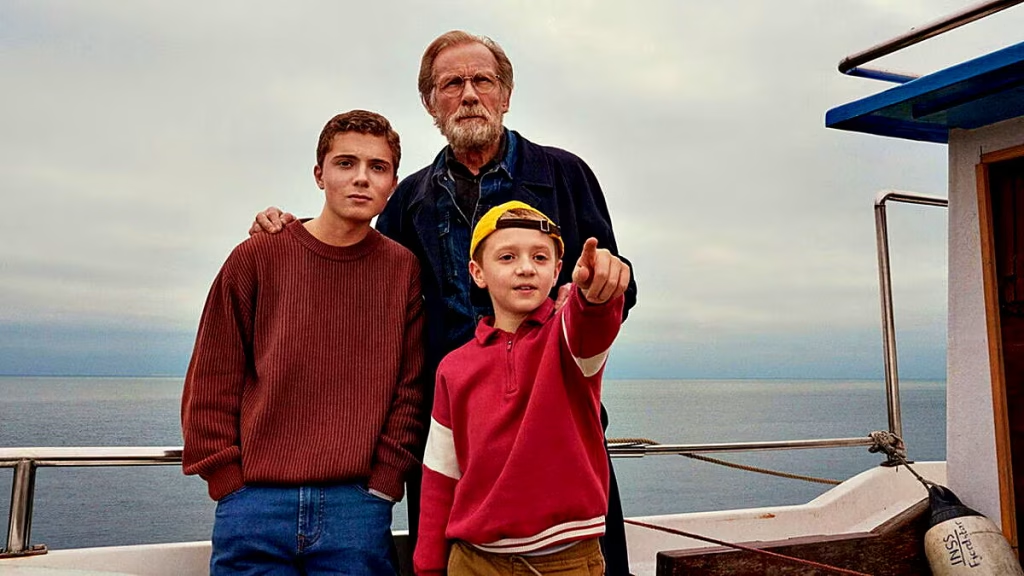
Finn (Roman Griffin Davis) and his younger brother Charlie (Dexter Sol Ansell) are living in England while their parents’ marriage is falling apart. Fearing they may be separated, the brothers decide to run away and make the long journey to the west coast of Ireland to find their estranged grandfather, John (Bill Nighy). It is the last place Finn remembers his family being truly happy. That becomes important.
Something happened during those happier days that tore this family apart, leaving John separated from his grandchildren and everyone carrying emotional wounds they have never properly addressed. Finn isn’t merely running away from home. He is trying to run back to a time before everything went wrong. As the boys travel by bus, ferry and whatever other means they can find, they rely on their own ingenuity and the kindness of strangers, including free-spirited musician Kait (Maisie Williams), who has troubles of her own. Yet the closer they get to their grandfather, the more their family’s story begins to unfold.
When memories were happier
One of the film’s greatest strengths is how Matthews uses flashbacks. We see moments when this family laughed together, enjoyed one another and experienced the beauty of the Irish coast without the cloud that now hangs over them.These scenes aren’t merely sentimental memories inserted to make the audience feel something. They show us what everyone has lost.That’s what makes the estrangement so painful. There was love here. There still is.
It has simply become buried beneath grief, blame and the inability to face what happened. Bill Nighy is perfectly suited to this sort of role. John is eccentric and endearing, but there is a sadness behind his eyes that suggests considerably more is happening beneath the surface. Nighy doesn’t need grand speeches to communicate regret. Sometimes simply watching him interact with the boys tells us everything we need to know. Yet the younger actors carry much of the film.
Roman Griffin Davis gives Finn the determination of an older brother convinced he can somehow hold everything together, while Dexter Sol Ansell brings warmth and vulnerability to Charlie. Their relationship provides the heart of the story.
A family divided by tragedy
500 Miles works best when it remains quiet. There are moments of humour along the road, and the Irish landscape provides a beautiful backdrop, but the film never loses sight of the sadness driving Finn’s journey.Then comes the unexpected turn.
Without spoiling what happens, the revelation changes how we understand much of what has come before. Moments that seemed merely endearing suddenly carry another emotional weight. This is where 500 Miles reaches into the heart.
The twist isn’t there simply to shock the audience. Instead, it helps us understand why this family has become so fractured and why Finn is so desperate to return to the place where he remembers them being happy. Grief can do strange things to families. Sometimes it draws people closer. Sometimes it causes people who desperately need one another to move further apart. Blame can become easier than grief because grief requires us to admit that some things cannot be fixed.
Yet 500 Miles suggests that broken relationships might still be repaired. Not because the tragedy disappears. Not because anyone forgets, but because forgiveness can begin building a bridge across the distance grief has created.
The bottom line
500 Miles is a beautifully tragic tale about a family trying to bridge the gap created by loss. Morgan Matthews doesn’t need enormous dramatic set pieces or emotional manipulation to make the story work. He simply allows these characters, their memories and the magnificent Irish coastline to gradually reveal what has been lost.
Bill Nighy brings his usual understated brilliance, but Roman Griffin Davis and Dexter Sol Ansell give the film its heart as two brothers travelling hundreds of miles in search of something considerably more important than a destination. They want their family back. The revelation waiting along the journey may pull the heart out of many viewers, but it also makes the desire for reconciliation entirely understandable.
Sometimes 500 miles is the easy part. The greater distance is between two people who love one another but no longer know how to cross the space between them.
REEL DIALOGUE: How deep can forgiveness go within a family?
Families know how to hurt one another. That may sound harsh, but the people closest to us are also the people who know our weaknesses, understand our history and carry expectations that strangers never could. When tragedy enters that mixture, forgiveness can become extraordinarily difficult.
500 Miles asks whether a family fractured by grief can ever find its way back to one another. The Bible never treats forgiveness as pretending something painful didn’t happen. Nor does forgiveness mean that consequences disappear or that reconciliation is always simple. Instead, forgiveness begins by recognising how much we ourselves have been forgiven.
Paul writes:
“Bear with each other and forgive one another if any of you has a grievance against someone. Forgive as the Lord forgave you.” — Colossians 3:13
Those final words make this considerably more challenging.
As the Lord forgave you.
Christian forgiveness isn’t based upon whether another person deserves it. It begins with recognising the extraordinary forgiveness God has already extended towards us. Jesus makes this central to Christian relationships:
“I do not say to you seven times, but seventy-seven times.” — Matthew 18:22
Jesus isn’t suggesting we keep a spreadsheet until someone reaches their seventy-eighth offence. His point is that forgiveness should characterise those who understand God’s grace. That doesn’t make forgiveness painless. Some wounds run deep. Some relationships take years to rebuild. Forgiveness may happen long before trust can be restored.
Yet 500 Miles beautifully reminds us that sometimes the greatest journey a family can make is towards one another.
Finn and Charlie travel hundreds of miles hoping to recover something their family has lost. Perhaps the harder question is much closer to home.
How far would you be willing to go to forgive someone you love?

Reel Dialogue has entered the world of YouVersion: Download the app, dive into the plans, and engage with the Bible in a fresh and exciting way.
Reel Dialogue has entered the world of YouVersion: Download the app, dive into the plans, and engage.

About Russ Matthews


More Films like this
View All
The Chronology of Water
Some people run from their past. Lidia Yuknavitch tried to swim away from hers.
The Last Whale Singer
Something familiar is in the waves, we’ve swum through most of these waters before.