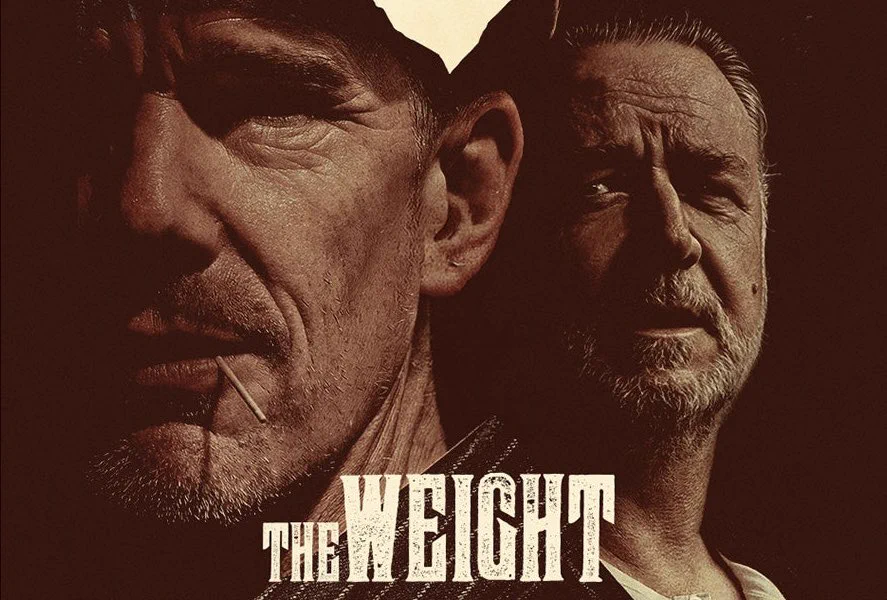
The Weight
Sometimes the heaviest thing a man carries isn’t the gold on his back.


 21 Sep 2026
  Russ Matthews
 There could hardly be a more appropriate title for The Weight. Set against the desperation of the Great Depression, this is a film filled with people carrying burdens—poverty, prison sentences, broken families, guilt, greed and eventually bags of gold that may represent their only opportunity for freedom.
Russell Crowe and Ethan Hawke may share top billing, but make no mistake: this film belongs to Hawke.
Set in Oregon in 1933, the story follows Samuel Murphy (Hawke), a widowed father separated from his young daughter, Penny (Avy Berry), and sent to a brutal prison work camp. His greatest concern isn’t merely surviving his sentence. If he cannot get back to his daughter soon enough, he risks losing her altogether. Then Warden Clancy (Crowe) offers him a proposition. Murphy can earn his freedom, but there is a considerable catch. He and a small group of prisoners must transport a fortune in gold through the wilderness. Suddenly, an impossible proposition begins to look remarkably attractive.
The weight of the world
Director Padraic McKinley gives The Weight an almost fable-like quality. The premise is straightforward enough: put a group of desperate men together, strap an enormous amount of gold to their backs and send them into unforgiving territory. Then watch what happens. Yet the gold quickly becomes more than something valuable to carry.
Each man enters the wilderness already burdened by his own story. The gold simply makes those burdens physical. With every mile, the promise of freedom becomes heavier, greed becomes more tempting and trust becomes increasingly difficult. There is something almost biblical about the imagery of men struggling beneath the weight of the very treasure they believe might save them.
The Depression-era setting makes the proposition particularly believable. The film doesn’t romanticise the prison work camp or the harshness of the chain gang. This is a brutal world where men have very few choices, which makes Clancy’s offer understandable. When life has already stripped away almost everything a person values, carrying gold across the mountains doesn’t sound quite as ridiculous as it should. The wilderness itself becomes another character. It can be beautiful, but there is little comfort to be found within it. The landscape is simply another obstacle standing between Samuel and the daughter he desperately wants to see again.
Ethan Hawke carries the load
Russell Crowe brings the expected presence to Clancy, but his role is smaller than the billing might suggest. This is Ethan Hawke’s film from beginning to end. Hawke gives Samuel a quiet desperation that prevents him from becoming another conventional rugged hero. He is not pursuing wealth simply for the sake of being rich or freedom merely because prison is unpleasant. Everything circles back to his daughter.
That gives the journey an emotional urgency beyond whether these men will actually get the gold across the mountains. The supporting cast are allowed enough space for their own stories and motivations to unfold without distracting from Samuel’s journey. They fall in alongside Hawke rather than competing with him, giving the travelling party the sense of damaged people temporarily forced into the same story.
Julia Jones as Anna is particularly important. She brings a welcome balance to what could otherwise become an overwhelmingly masculine tale of hardened men, violence and survival. Anna is no mere addition to the travelling party; her presence changes the dynamic and gives the story another perspective on survival, belonging and what freedom might actually mean.
At times, the film is gut-wrenching, particularly in its depiction of Depression-era hardship and the relationship between Samuel and Penny. The father-daughter connection gives the story its heart and prevents the film from becoming merely another tale of men turning against one another over treasure.
If there is a weakness, it comes in the conclusion. After everything these characters endure, the final stages wrap themselves up a little too neatly. There is an almost ‘happily ever after’ quality that doesn’t entirely match the harshness and moral complexity of the journey that preceded it. A story this heavy perhaps deserved an ending that allowed us to feel the burden for a little longer. Still, that doesn’t undo what came before.
The Weight remains a satisfying and surprisingly moving story about humanity’s determination to overcome adversity when there is something—or someone—worth fighting for.
What should parents know?
The Weight is definitely intended for mature audiences. The film contains brutal prison conditions, physical violence, bloody imagery and the constant threat of death as the prisoners travel through the wilderness. The Depression-era setting also carries considerable emotional weight. Poverty, imprisonment, desperation and the separation of a father and child are central to the story.
This isn’t family entertainment, despite the father-daughter relationship at its centre. Older viewers, however, may find that relationship provides some worthwhile opportunities to discuss sacrifice, parental love and what people are prepared to endure for those they love.
The bottom line
The Weight is aptly named. There is the physical weight of the gold, the crushing economic weight of the Great Depression, the emotional weight of separation and the moral weight of every decision these desperate characters must make.
And then there is Ethan Hawke, who carries the weight of the film itself. Crowe provides the menace, Jones gives the journey some much-needed balance and the supporting cast each add something to this unusual travelling party. Yet Hawke gives the story its heart, turning what could have been a straightforward gold-smuggling adventure into something far more human.
The destination may be a little too convenient, but the journey is well worth taking.
REEL DIALOGUE: What would you do for the sake of your child?
Strip away the gold, the prison camp and the wilderness, and Samuel Murphy’s motivation is remarkably simple. He wants his daughter back.
That changes the meaning of almost every risk he takes. He isn’t merely fighting for freedom; he is fighting for the opportunity to be a father again.
Parents will understand something of that instinct. We sacrifice sleep, money, time, opportunities and sometimes our own ambitions for our children. Most of us will never be asked to carry gold across mountains to get back to them, but the question underneath Samuel’s journey remains surprisingly relevant.
What are we prepared to sacrifice for the sake of our children?
Jesus uses the natural love of a parent to help us understand something about the character of God:
“If you then, who are evil, know how to give good gifts to your children, how much more will your Father who is in heaven give good things to those who ask him!” — Matthew 7:11
Scripture doesn’t present parental love as perfect. Human fathers and mothers fail. Yet our desire to protect, provide for and remain close to our children offers a glimpse of something greater.
Psalm 103:13 says: “As a father shows compassion to his children, so the LORD shows compassion to those who fear him.”
Perhaps that is ultimately what gives Samuel the strength to keep carrying the weight. The gold may promise freedom, but the gold isn’t what matters most. His daughter is.
The treasure on his back has value only because it might return him to the person he loves.
What burdens would you be willing to carry for the sake of your child—and what does that tell us about the value of sacrificial love?

Reel Dialogue has entered the world of YouVersion: Download the app, dive into the plans, and engage with the Bible in a fresh and exciting way.
Reel Dialogue has entered the world of YouVersion: Download the app, dive into the plans, and engage.

About Russ Matthews


More Films like this
View All 500 MIles
Sometimes the longest journey isn't measured in miles, but in the distance between people who once loved one another
Digger
One of the most brilliantly constructed films I have absolutely no desire to watch again