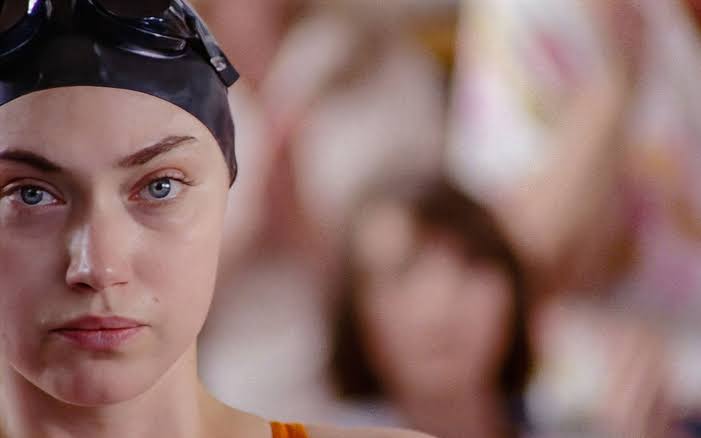
The Chronology of Water
Some people run from their past. Lidia Yuknavitch tried to swim away from hers.


 21 Sep 2026
  Cliff Phlipiah
 At a young age, Lidia Yuknavitch retreats into the worlds of writing and competitive swimming to escape her abusive home. Her father, Mike (Michael Epp), physically and sexually abuses both Lidia and her older sister, Claudia, while their alcoholic mother remains silent, eventually leading Claudia to flee.
Despite Mike’s attempts to sabotage her college prospects, Lidia (Imogen Poots) eventually escapes to attend college in Texas on a swimming scholarship. However, substance abuse, sexual exploration and partying threaten her college career as she struggles with the trauma of her past. Can this multi-talented yet deeply damaged young woman overcome her self-destructive tendencies and learn how to thrive?
The title The Chronology of Water refers to swimming as one of Lidia’s earliest survival mechanisms. At the same time, the unpredictable way water flows represents how memories can be internalised and recalled in a non-linear fashion. Although director Kristen Stewart’s The Chronology of Water and Sean Durkin’s The Iron Claw have very different contexts—competitive swimming and writing versus professional wrestling—the two films share striking parallels. Both are intense biographical dramas that explore elite athleticism colliding with personal tragedy, with a dominant and abusive patriarch at the centre of the family.
Here, Lidia’s abuse results in extreme trauma that she spends much of her life trying to outrun. Despite being a competitive swimmer, the intense pressure contributes to her self-destruction. Furthermore, she sabotages meaningful relationships because she is so damaged that she feels unworthy of happiness.
This makes Lidia difficult to embrace for much of the film. After becoming pregnant and marrying at a young age, she treats her husband terribly, even becoming physically abusive towards him in ways that echo the treatment she received from her own father. When their child is stillborn, the marriage eventually falls apart. The film does not necessarily use Lidia’s traumatic history to excuse everything she subsequently does. Instead, it demonstrates the devastating cycle that can emerge when abuse continues to shape the victim long after they have escaped the abuser.
Finding another way through
Ultimately, Lidia’s talents become some of her greatest assets as she begins finding ways to confront her past. Swimming initially gives her somewhere to escape, but writing eventually provides a means of expression.
Her encounter with writer Ken Kesey helps unleash her abilities as an author. Lidia’s writing about the physical and sexual trauma inflicted by her father is so graphic and confronting that some students leave the room during one of her readings. Yet it is through writing that she eventually begins moving towards recovery.
Later, after becoming an established writer and building a life with her new partner and their young son, Lidia receives a visit from her abusive father. He comments that her published account of his abuse does not paint him favourably, although he does not deny what happened. When he tells Lidia that he is proud of her and what she has achieved, she finally receives something she has seemingly spent much of her life seeking.
Kristen Stewart’s direction is artistically effective, while cinematographer Corey C. Waters’ imagery is as confronting and gritty as the subject matter itself. This is not an easy film to watch, either visually or emotionally, but its uncompromising approach reflects the fractured life at the centre of the story.
What should parents know?
The Chronology of Water is rated R18+ in Australia and deals extensively with confronting adult subject matter.
The film contains depictions and discussions of childhood physical and sexual abuse, alcoholism, substance abuse, sexual content, domestic violence, trauma and the loss of a child. Some of the imagery is deliberately confronting, particularly as Lidia recalls the abuse she and her sister suffered at the hands of their father.
This is a very difficult film, both in its imagery and subject matter, and viewers with personal experiences of abuse or trauma should be particularly aware of its content before watching.
The bottom line
The Chronology of Water is an intense biographical drama about the long-lasting consequences of abuse and the different ways one woman attempts to survive what happened to her.
Imogen Poots delivers a challenging central performance as a woman who can be frustrating, destructive and, at times, deeply unlikeable. Yet this complexity is important to the story. Lidia may escape the home in which she was abused, but escaping the effects of that abuse proves considerably more difficult.
Swimming helps her survive. Writing eventually helps her confront what she survived. Kristen Stewart and cinematographer Corey C. Waters capture that journey with imagery that is raw, artistic and appropriately uncomfortable.
REEL DIALOGUE: Can confronting the truth about our past help prevent it from controlling our future?
One of the most confronting aspects of The Chronology of Water is that escaping an abusive situation does not necessarily mean escaping its influence. Lidia physically leaves her father behind, but the damage he inflicted follows her into adulthood, affecting her relationships, her choices and even the way she treats those closest to her.
There is something profoundly difficult about confronting the truth of our past. Sometimes it seems easier to bury painful memories, numb them or simply keep moving. Yet Lidia gradually discovers that refusing to acknowledge what happened does not remove its power. Her writing becomes a means of finally giving words to experiences that had shaped her life for years.
The Bible never asks us to pretend that suffering did not happen. Scripture repeatedly gives people permission to lament, grieve and speak truthfully about pain. The Psalms are filled with people bringing their wounds before God rather than hiding them.
David writes: “When I kept silent, my bones wasted away through my groaning all day long.” — Psalm 32:3
There is wisdom in recognising that silence does not necessarily bring healing.
Christianity also offers the hope that our past does not have to become the final definition of who we are. Paul writes, “Therefore, if anyone is in Christ, he is a new creation” (2 Corinthians 5:17).
This does not erase what has happened, excuse those responsible or suggest that recovery from trauma is simple. Rather, it points towards the possibility that our wounds do not have to have the final word over our identity or our future.
Lidia cannot rewrite her childhood, but she can begin to change what influence it has over the rest of her story.
What parts of our past might we need to confront honestly before we can begin moving forward?

Reel Dialogue has entered the world of YouVersion: Download the app, dive into the plans, and engage with the Bible in a fresh and exciting way.
Reel Dialogue has entered the world of YouVersion: Download the app, dive into the plans, and engage.

About Cliff Phlipiah


More Films like this
View All 500 MIles
Sometimes the longest journey isn't measured in miles, but in the distance between people who once loved one another
