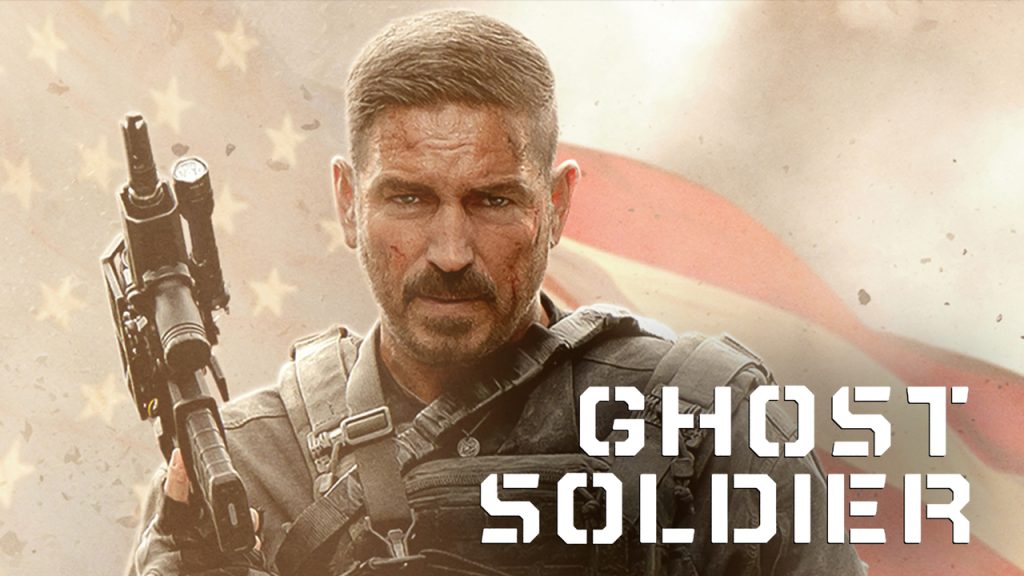
Ghost Soldier
An old-school action hero with a modern arsenal, a moral compass and the potential for greatness, if only the story could keep up.


 16 Nov 2026
 Russ Matthews
There was a time when action heroes ruled the cinema. The 1980s and 1990s gave us larger-than-life characters who could walk through explosions, survive impossible odds and deliver justice with a well-timed punch or an extraordinary collection of weapons.
These were men of few words, questionable invincibility and a moral certainty that rarely required much explanation. Audiences didn’t necessarily need to understand their childhood trauma or psychological motivations. They merely needed to know who the bad guys were and watch the hero take them down. Ghost Soldier, starring Jim Caviezel, feels like a deliberate return to that era, complete with spectacular action sequences, inventive weaponry and a central character who seems capable of surviving almost anything.
Unfortunately, what worked for Schwarzenegger, Stallone and their contemporaries doesn’t necessarily translate into compelling modern cinema. While Ghost Soldier delivers the spectacle expected of an action thriller, it also demonstrates why audiences have come to expect more from their cinematic heroes. There is a fascinating character buried within this production, but the filmmakers seem considerably more interested in what he can do than in helping us understand who he is.
Caviezel brings his familiar intensity and commanding screen presence to Fitz, a man whose sense of justice and personal Catholic faith shape his determination to confront evil. He has the makings of an intriguing action hero, combining the moral conviction of a traditional protagonist with the physical capabilities of someone who appears almost superhuman. Interestingly, Fitz also offers encouragement to fathers everywhere who may have thought their action-hero days were behind them. Apparently, you don’t need to spend countless hours in the gym to become an unstoppable force against injustice. You simply need the right motivation, an impressive arsenal and the ability to endure more punishment than any ordinary person should reasonably survive.
There is something appealing about this old-fashioned approach, particularly when so many contemporary action films seem determined to undermine their heroes through cynicism or endless self-analysis. Caviezel has the presence to carry a franchise, and Fitz has enough potential to become a memorable addition to the genre. Yet the screenplay never gives the character the emotional depth or personal connections needed to elevate him beyond the familiar action-hero mould.
Director and production team clearly invested considerable energy into the film’s visual presentation. There are imaginative action sequences, an impressive variety of weapons and some genuinely innovative moments that demonstrate a willingness to push the boundaries of conventional combat choreography. The special effects and imagery provide much of the entertainment, and there are sequences that will undoubtedly satisfy those looking for an adrenaline-fuelled cinematic experience. However, the production’s emphasis on spectacle comes at a considerable cost.
The story simply doesn’t receive the same attention.
Throughout the film, there are numerous opportunities to develop the supporting characters and establish relationships that would give the action greater emotional significance. Several moments suggest the possibility of genuinely moving storylines, yet these are introduced without sufficient development or abandoned before audiences have the opportunity to become invested. Characters appear to carry substantial emotional baggage, but the screenplay rarely allows us to unpack it alongside them.
This becomes particularly frustrating when the film attempts to deliver its more dramatic moments. The ingredients are present, but the connections between them are missing. Without adequate time to understand the relationships, motivations and consequences, scenes that should carry considerable emotional weight struggle to make the intended impact.
Even the villain offers intriguing possibilities. There is enough material to suggest a formidable adversary who could challenge Fitz on more than a physical level. Yet, once again, the screenplay seems content to establish the conflict without fully exploring the personalities behind it. A great action hero deserves an equally compelling villain, and this production never quite develops that essential relationship.
Ironically, Ghost Soldier is one of those rare films that might have benefited from being longer. Rather than adding another explosion or elaborate confrontation, an additional twenty minutes devoted to character development could have transformed the experience. Allowing the supporting cast room to breathe and providing greater insight into Fitz’s motivations would have made the inevitable action sequences considerably more satisfying.
One aspect that distinguishes Ghost Soldier from many contemporary action thrillers is its willingness to incorporate faith into the central character’s identity. This is not a Christian film, nor should audiences approach it expecting a traditional faith-based production. However, Fitz’s Catholic beliefs are presented as a genuine influence on his worldview and his determination to confront injustice.
There is something refreshing about seeing an action protagonist express his faith without embarrassment or apology. His beliefs are not merely a decorative addition to the character, but contribute to his understanding of responsibility, morality and the protection of others. This also helps distinguish the production from some of its genre contemporaries, with relatively restrained language and less overtly graphic violence than audiences might expect from a modern action thriller.
Yet, the film’s treatment of faith also raises some fascinating questions. Fitz’s moral convictions are admirable, but his actions are not necessarily justified simply because he believes he is acting on behalf of what is right. At times, his understanding of justice appears more humanistic than distinctly Christian, relying heavily upon personal determination and the conviction that he has the authority to confront evil on his own terms. This tension could have provided the screenplay with one of its strongest dramatic elements. Unfortunately, like many of the film’s more promising ideas, it remains largely unexplored.
Ultimately, Ghost Soldier has the ingredients for a successful new action franchise. Caviezel is a convincing leading man, the action is inventive, and Fitz possesses a moral foundation that could distinguish him from the increasingly crowded field of cinematic heroes. There is genuine potential here, and enough entertainment to satisfy audiences who enjoy the straightforward action adventures of previous decades.
However, impressive weaponry and spectacular effects cannot compensate for underdeveloped characters and a story that fails to connect its emotional possibilities. If the filmmakers hope to establish Fitz as a continuing action hero, they need to invest as much energy into the man behind the weapons as they do into the action surrounding him.
Ghost Soldier may have the firepower to launch a franchise, but it needs considerably more heart to make audiences want to return.
REEL DIALOGUE: Should We Take Justice Into Our Own Hands?
One of the more intriguing elements of Ghost Soldier is the relationship between Fitz’s faith and his determination to confront injustice. He believes in protecting others and standing against evil, convictions that are certainly consistent with many biblical principles. Yet his methods raise an important question: When should we act against injustice, and when should we leave justice in God’s hands?
Throughout history, humanity has struggled with this tension. We recognise that wrongdoing should have consequences, particularly when innocent people suffer. When governments, legal systems or other authorities appear unwilling or unable to respond, the temptation to take matters into our own hands can become overwhelming.
The Bible certainly does not encourage Christians to ignore injustice. Micah 6:8 calls God’s people to act justly, love mercy and walk humbly with Him. Similarly, Proverbs 31:8–9 challenges us to speak up for those who cannot speak for themselves and defend the rights of the poor and needy. These passages remind us that faith should influence how we respond to suffering and wrongdoing in the world.
However, scripture also draws an important distinction between pursuing justice and seeking personal revenge.
Romans 12:19 offers a confronting reminder: “Do not take revenge, my dear friends, but leave room for God’s wrath, for it is written: ‘It is mine to avenge; I will repay,’ says the Lord.”
This doesn’t mean Christians should remain passive in the face of evil. Rather, it challenges us to examine our motivations and recognise that personal anger, even when directed towards genuine wrongdoing, can lead us away from the very justice we claim to defend.
Romans 13:1–4 also reminds us that governing authorities have a responsibility to maintain order and respond to wrongdoing. Although these institutions are imperfect and can themselves become sources of injustice, the biblical framework distinguishes between legitimate authority and individuals appointing themselves as judge, jury and executioner.
Perhaps the most challenging example comes from Jesus Himself. Despite experiencing extraordinary injustice, betrayal and violence, He refused to make personal retaliation the foundation of His mission. His response demonstrated that strength is not merely the ability to overpower an enemy, but also the willingness to exercise restraint, extend mercy and trust God.
This provides an interesting challenge to the traditional action hero, whose moral authority is often measured by his ability to defeat those who oppose him.
Questions worth discussing:
- When we witness injustice, how do we determine whether to intervene or entrust the situation to the proper authorities? (Proverbs 31:8–9; Romans 13:1–4)
- What is the difference between pursuing justice and seeking revenge? (Romans 12:17–21)
- Can our desire to do something good lead us to justify actions that contradict our faith? (Micah 6:8; James 1:19–20)
Ghost Soldier may not explore these questions as deeply as it could, but its central character provides an opportunity for a worthwhile conversation.
Faith should influence every area of our lives, including how we respond to injustice. Yet genuine Christian conviction must be shaped by more than our personal understanding of what is right. It requires humility, wisdom and a willingness to recognise that God’s justice is not always accomplished through the methods we might choose.
After all, there is a significant difference between being willing to stand against evil and believing that we have the right to determine justice on our own terms.

Reel Dialogue has entered the world of YouVersion: Download the app, dive into the plans, and engage with the Bible in a fresh and exciting way.
Reel Dialogue has entered the world of YouVersion: Download the app, dive into the plans, and engage.

About Russ Matthews


More Films like this
View All
Fatherland
A haunting journey through a divided homeland, where the past refuses to fade and the meaning of belonging is brought into question.