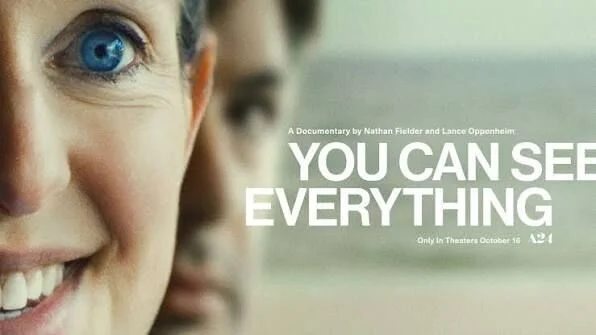
You Can See Everything
Truth Is in the Eye of the Beholder… Or Is It?


 12 Nov 2026
 Michael Walsh
With her big blue eyes and kabuki red lipstick, Elizabeth Holmes became one of the most recognisable figures in Silicon Valley, promising to revolutionise healthcare through Theranos, a blood-testing company she founded with the ambition of making medical diagnostics faster, cheaper and more accessible. But behind the black turtlenecks, carefully cultivated public persona and extraordinary promises was one of the most notorious corporate frauds in recent history.
Convicted in January 2022 of defrauding investors, Holmes became a particularly fascinating study in ambition, deception and the construction of identity. Few contemporary filmmakers are better equipped to explore the peculiarities of such a personality than Nathan Fielder. Known for his unconventional comedy in Nathan for You, his increasingly elaborate social experiments in The Rehearsal and his distinctive ability to blur the boundaries between reality and performance, Fielder has developed a filmmaking sensibility that is as uncomfortable as it is compelling. In You Can See Everything, alongside documentarian Lance Oppenheim, he turns his attention to Holmes and her partner, Billy Evans, with extraordinary and frequently bewildering results.
With just 34 days remaining before Holmes was due to report to prison, Fielder and Oppenheim embarked on an unusual documentary experiment to intimately observe the couple through the final weeks of their life before incarceration. But what followed extended well beyond that initial period, with the filmmakers spending the subsequent two years attempting to debrief, revisit and make sense of that 34-day experience and its aftermath. Through a combination of intimate observation, unconventional interventions and increasingly elaborate re-enactments, the documentary examines the couple’s relationship, Holmes’ understanding of her own circumstances and the psychological complexities of navigating life after one of the most publicised corporate scandals in modern history, where the guilty still believe they are innocent.
Singular, stunning and soul-staring, You Can See Everything is an uncanny exploration of deceit and desire, offering unprecedented voyeuristic access to the lives, minds and potential manipulative machinations of its subjects. What begins as an extraordinary exercise in documentary filmmaking quickly becomes something altogether stranger, more psychologically perplexing and increasingly difficult to categorise. It is a film concerned with the construction of identity, the performance of authenticity and the complicated relationship between what people say and what they actually mean.
The title is particularly pertinent because You Can See Everything does not necessarily mean you will see everything. This tension between access and understanding undergirds a truly singular piece of documentary filmmaking. Fielder and Oppenheim invite audiences into an intimate observational experience, seemingly granting access to conversations, interactions and private moments that would ordinarily remain beyond the reach of a camera. But the extraordinary nature of this access also raises questions about the authenticity of what is being presented. Are these genuine moments of vulnerability, carefully constructed performances or something far more complicated? The documentary’s refusal to provide straightforward answers is central to its fascination and frustration.
There is an abundance of extraordinary material here, and the less audiences know going in, the better. Watching Nathan Fielder introduce Elizabeth Holmes to the Abbott and Costello routine Who’s on First? is perhaps one of the most entertaining and bafflingly bizarre sequences of the year. It is the sort of scene that leaves audiences questioning whether to laugh, cringe or simply stare at the screen in disbelief. And it is hardly an isolated incident. There are so many gasp-worthy, jaw-dropping and utterly astonishing moments that a top ten list of the best cinematic moments of 2026 could comfortably be populated almost exclusively by scenes from this film.
What makes the experience particularly compelling is the way Fielder’s presence complicates the traditional relationship between documentarian and subject. His wavelength just connects with the terminally online generations, with an almost inexplicable understanding of the absurdity, awkwardness and peculiar social dynamics of contemporary internet culture. Rather than simply observing from a comfortable distance, he becomes an increasingly active participant in the unfolding psychological experiment. When SPOILER appears and subsequently becomes something of Fielder’s accomplice and sidekick, even re-enacting some of the documentary’s most extraordinary moments, the film takes another fascinating turn. The boundaries between observer and participant, truth and fabrication, and authenticity and imitation become increasingly blurred. It is an audacious filmmaking decision that further enhances the documentary’s pursuit of truth amidst an environment seemingly saturated with deception.
Beyond its fascinating subject matter, You Can See Everything is an exceptionally accomplished piece of cinema. The editing is immaculate, finding precisely the right rhythm across the 174-minute runtime, between uncomfortable silences, absurdist comedy and moments of extraordinary revelation. The pacing is remarkably assured, allowing seemingly inconsequential interactions to develop into something far more significant. Oppenheim and Fielder’s direction also demonstrates an impressive understanding of how to build tension without revealing where that tension is leading. Complementing everything is a spectral score from Ari Balouzian that adds an unsettling atmosphere to proceedings, further reinforcing the film’s distinctly uncanny sensibility.
Ultimately, You Can See Everything is an extraordinary exercise in not just documentary filmmaking but cinematic expression. It’s intellectually stimulating, emotionally disconcerting and frequently incomprehensible in the very best way possible. It is a fascinating examination of deception, performance and the limits of voyeuristic observation, elevated by two filmmakers willing to venture into increasingly unconventional territory. More than anything, it demonstrates that unprecedented access does not necessarily equate to understanding, and that sometimes the most revealing thing a camera can capture is what remains just beyond its reach.
If you can, you must see You Can See Everything.
REEL DIALOGUE: Can We Believe Our Own Lies?
One of the most unsettling aspects of You Can See Everything is its exploration of the relationship between truth and deception. Elizabeth Holmes’ story is a remarkable example of what happens when ambition, pride and dishonesty become so deeply intertwined that a person can seemingly lose sight of the difference between what is true and what they want to believe. But Holmes is hardly alone in this. We all have a remarkable capacity to convince ourselves that our actions are justified, that our mistakes are someone else’s fault or that the version of ourselves we present to the world is closer to the truth than the reality.
The Bible has plenty to say about the dangers of self-deception. In Jeremiah 17:9, we are reminded that “the heart is deceitful above all things”. It is a confronting reminder that our greatest capacity for deception is not necessarily directed towards others, but can be directed towards ourselves. We can become so invested in protecting our reputation, pursuing our ambitions or maintaining a particular image that we lose sight of what is actually true.
Yet Christianity offers something far greater than simply exposing our dishonesty. Jesus declares in John 8:32, “Then you will know the truth, and the truth will set you free.” This freedom comes through recognising our need for forgiveness and turning to Jesus, who is Himself the truth (John 14:6). Unlike the carefully constructed identities we create for ourselves, our identity in Christ is not dependent on our achievements, reputation or ability to convince others of our goodness. We can come before God honestly, acknowledging our failures and trusting in His grace. Perhaps the greatest freedom is not found in convincing everyone else that we are telling the truth, but in no longer needing to hide from it ourselves.

Reel Dialogue has entered the world of YouVersion: Download the app, dive into the plans, and engage with the Bible in a fresh and exciting way.
Reel Dialogue has entered the world of YouVersion: Download the app, dive into the plans, and engage.
About Michael Walsh


More Films like this
View All The Cat in the Hat (2026)
A wonderfully chaotic return to the imagination of Dr Seuss