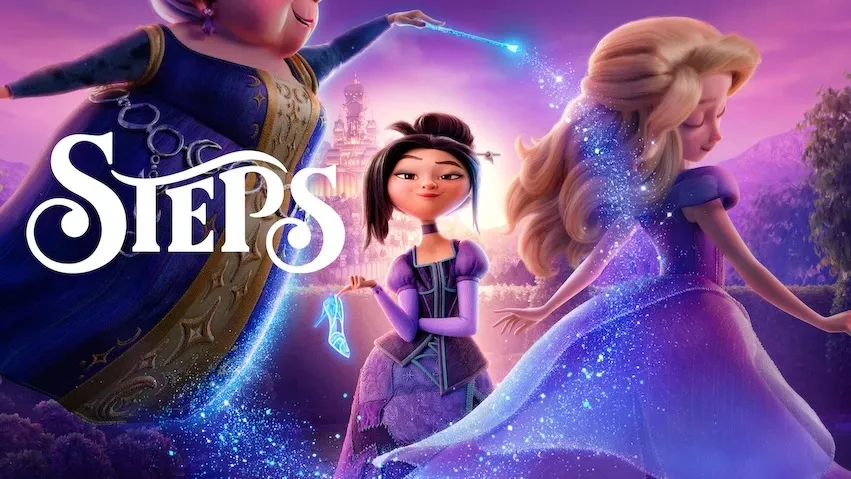
Steps
Cinderella's stepsisters finally get their moment in the spotlight, proving there's more to every fairy tale than meets the eye


 21 Nov 2026
 Russ Matthews
There is something remarkable about the staying power of Cinderella. Generations have grown up with the familiar tale of a mistreated young woman, a handsome prince, an enchanted evening and a glass slipper that somehow fits only one person in the kingdom. Yet, despite countless adaptations, one question rarely gets asked: what if the supposedly wicked stepsisters weren't quite as wicked as we've always been led to believe?
Enter Steps, an animated adventure that gives Cinderella’s overlooked family members their opportunity to tell their side of the story. With an imaginative Asian-inspired reworking of the stepmother and stepsisters, the filmmakers invite audiences into a colourful world where familiar characters aren’t necessarily who we expect them to be, and traditional distinctions between heroes and villains become considerably less straightforward.
Rather than simply revisiting Cinderella’s familiar journey, Steps challenges assumptions that have shaped our understanding of these characters for generations. After all, history tends to favour whoever tells the story, and perhaps the stepsisters have been waiting centuries for someone to give them a fair hearing.
What makes this production refreshing is its willingness to explore the humanity beneath characters traditionally dismissed as superficial, jealous and cruel. Instead of presenting the stepsisters as convenient villains, the story allows them to be flawed, misunderstood and surprisingly relatable. Their world remains obsessed with beauty, social standing and romantic expectations, but beneath these conventions are individuals attempting to discover where they belong.
The Asian cultural reimagining of the stepfamily adds another dimension to the narrative, highlighting how identity, family expectations and social pressures can influence our understanding of ourselves and others. It reinforces the film’s broader message that our assumptions are frequently shaped by appearances rather than the people beneath them.
Of course, it wouldn’t be Cinderella without a little magic, and Steps has considerable fun with fairy-tale traditions. Fairy godmothers aren’t necessarily the infallible problem-solvers we remember, and their magical interventions can create as many complications as they resolve. The notion of love at first sight also receives a playful examination, challenging the romantic certainty that has defined countless classic fairy tales.
Perhaps falling in love after a single dance isn’t quite the foundation for a lifelong relationship that generations of storytellers have led us to believe.
There is something appealing about a family film willing to question these conventions without becoming cynical. Steps doesn’t dismiss love, kindness or finding your place in the world. Instead, it suggests that genuine relationships require something more substantial than physical attraction, social status or a perfectly timed magical transformation.
One of the film’s entertaining diversions comes through its playful treatment of The Three Billy Goats Gruff. Even trolls are given an opportunity to challenge their traditional reputation. These creatures have spent generations portrayed as frightening obstacles beneath bridges, but perhaps there’s more to their story than we’ve been told.
It’s an amusing addition that reinforces the central message without becoming preachy. Just because someone looks different or has been labelled the villain doesn’t necessarily mean they deserve that reputation. Even a troll might have a perfectly reasonable explanation for being grumpy beneath a bridge.
Visually, the film embraces the colourful possibilities of its fantasy setting, creating a world that feels both familiar and delightfully unpredictable. Its animation, imaginative characters and magical complications provide opportunities for physical comedy and unexpected adventures. The filmmakers clearly enjoy taking an established narrative and asking what might happen if the rules were changed.
Yet this isn’t entirely a lighthearted journey. There are moments when Steps ventures into surprisingly dark territory, introducing imagery and situations that may unsettle younger viewers. Parents should be aware that the film occasionally moves beyond the gentle humour suggested by its fairy-tale origins.
For that reason, I’d exercise caution with children under eight, particularly those sensitive to frightening imagery. The film’s PG classification is worth taking seriously, although the overall experience remains firmly directed towards families. Thankfully, these darker elements don’t overwhelm the production’s warmth or sense of fun. Younger audiences can enjoy the magical adventures, while parents will appreciate the humour and underlying themes.
The film’s greatest strength is its willingness to find compassion within characters who might otherwise be dismissed. The stepsisters aren’t perfect, and neither are the other inhabitants of this fantasy world. They make mistakes, misunderstand one another and allow their insecurities to influence their behaviour. Yet these imperfections make them considerably more interesting than the one-dimensional villains we’ve come to expect.
Ultimately, Steps is an enjoyable family adventure that breathes fresh life into one of the world’s most familiar stories. Its imaginative approach to Cinderella’s stepsisters, playful treatment of fairy-tale conventions and willingness to look beyond appearances make it a worthwhile addition to the genre. While its darker moments may challenge the youngest viewers, families with older children should find plenty to enjoy and discuss. This is a film that understands the value of allowing everyone to tell their story, even those who have spent centuries being cast as the villains.
And who knows? After watching Steps, you may never look at a stepsister, fairy godmother or bridge-dwelling troll quite the same way again.
REEL DIALOGUE: You Can’t Judge a Book, a Stepsister or a Troll by Its Cover
One of the most appealing messages in Steps is its reminder that appearances can be remarkably deceptive. We live in a world that frequently judges people according to their looks, backgrounds, reputations and social standing. Yet how often do we discover that someone is considerably different from our initial impressions?
The Bible addresses this tendency directly in 1 Samuel 16:7, when God reminds Samuel that people look at outward appearances, but the Lord looks at the heart. This challenges our inclination to categorise others according to what we see. Whether someone’s appearance, cultural background, behaviour or reputation, we can easily form opinions without taking time to understand the person beneath the surface.
Jesus consistently demonstrated a different approach. Throughout the Gospels, he engaged with people dismissed, misunderstood or rejected by society. Tax collectors, outsiders and those considered morally unworthy were often the very people he invited into conversation and relationship. This doesn’t mean ignoring wrongdoing or pretending every decision is acceptable. Rather, it means recognising that every individual possesses dignity and value, regardless of how others perceive them.
James 2:1–4 also warns against showing favouritism based on appearances or social standing. Our treatment of others shouldn’t depend upon whether they fit our expectations of who deserves kindness or respect.
There is also an important lesson about love. While fairy tales celebrate love at first sight, 1 Corinthians 13 reminds us that love is patient, kind and not self-seeking. Genuine love requires knowing someone beyond their appearance and choosing to care for them through their imperfections.
Perhaps that’s the most valuable message families can take from Steps. Before judging someone, we should take time to hear their story. The person we dismiss may simply be waiting for someone willing to look beyond the surface.
Questions worth discussing:
- Have you ever judged someone by their appearance or reputation, only to discover you were wrong? (1 Samuel 16:7)
- Why is it easier to label someone as difficult than to understand their circumstances? (James 2:1–4)
- What makes genuine love different from the romantic idea of love at first sight? (1 Corinthians 13:4–7)
Steps reminds us that everyone has a story worth hearing, and sometimes the greatest transformation doesn’t require a fairy godmother or a magical spell. It simply begins when we choose to see others as God sees them.

Reel Dialogue has entered the world of YouVersion: Download the app, dive into the plans, and engage with the Bible in a fresh and exciting way.
Reel Dialogue has entered the world of YouVersion: Download the app, dive into the plans, and engage.

About Russ Matthews


More Films like this
View All The Hunger Games: Sunrise on the Reaping
A sequel to a prequel that's a midquel about the Second Quarter Quell