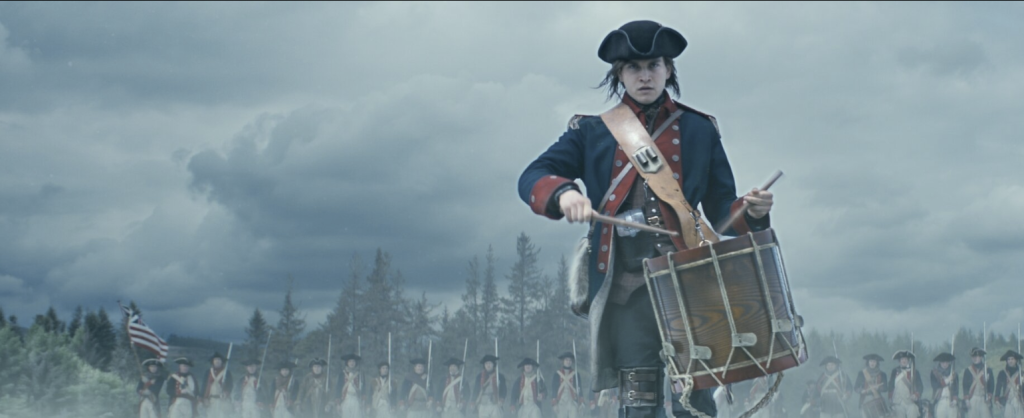
Drummer Boy


 2 Nov 2026
 Russ Matthews
There is something ambitious about bringing a musical to the screen against the backdrop of the American Revolutionary War. Add a family divided by political allegiances, racial tensions and the struggle to determine the future of a nation, and you have the makings of a dramatic historical epic.
The Drummer Boy takes this challenge head-on, combining the emotional musical storytelling of The Greatest Showman with a sprinkling of the revolutionary spirit and personal tragedy of Les Misérables.
It is an intriguing combination.
Rather than presenting a conventional historical drama, the filmmakers use contemporary musical arrangements and performances to carry the narrative forward. The result is a production that occasionally stretches credibility but frequently compensates through its undeniable musical talent, impressive production values and heartfelt performances. This is one of those films where the quality of the presentation helps overcome some of the weaknesses in the writing. And while it may not reach the heights of the musicals that have clearly influenced it, The Drummer Boy deserves recognition for attempting something different within the growing catalogue of faith-inspired cinema.
A nation divided, a family torn apart
At the heart of the film is a story of brother against brother during the American Revolutionary War. As the colonies struggle over their relationship with Britain and the possibility of independence, families find themselves caught between competing loyalties. Political convictions become personal conflicts, and decisions made in the heat of war threaten relationships that once seemed unbreakable.
This is where The Drummer Boy finds its most compelling dramatic material. The American Revolution is often remembered through its heroic figures, stirring speeches and the birth of a nation. Yet the struggle for independence also created painful divisions within communities and families. The film attempts to capture something of that emotional complexity, reminding audiences that the consequences of war are rarely confined to the battlefield.
Brothers can become enemies, friendships can fracture, and even the prospect of a better future may come at a devastating personal cost. Against this backdrop, the film explores loyalty, love, sacrifice and the difficult journey towards reconciliation. Not every dramatic development is entirely convincing, but the central premise provides a meaningful foundation for the story.
A musical with a modern heartbeat
One of the most distinctive elements of The Drummer Boy is its musical identity. There is an unmistakable influence from The Greatest Showman in the way contemporary music is woven into a historical setting. The songs are designed to communicate emotional struggles, move the narrative forward and give audiences an opportunity to connect with the characters beyond their spoken dialogue.
There are also echoes of Les Misérables, particularly in the combination of political upheaval, family conflict and characters wrestling with questions of duty and personal conviction. These comparisons inevitably create significant expectations. The strongest musical moments demonstrate why the filmmakers embraced this approach. The performances provide energy and emotional weight, often communicating more effectively than the surrounding dialogue. Other numbers are less successful, occasionally interrupting the dramatic momentum rather than enhancing it.
This unevenness is one of the film’s challenges. A musical needs its songs to feel essential to the story rather than merely impressive performances placed between dramatic scenes. The Drummer Boy does not always achieve that balance, but when the music and storytelling come together, the results are genuinely engaging.
The modern musical style may also divide audiences. Those expecting a traditional historical drama could find the contemporary arrangements distracting, while viewers who appreciate the musical approach of The Greatest Showman may find much to enjoy. Personally, I appreciated the willingness to take the risk.
Performances that rise above the script
Joel David Smallbone and Jacob Leach carry much of the film’s emotional and musical weight. Their performances help establish the central relationships and sustain the drama even when the screenplay struggles to provide the depth these characters deserve. Both bring a conviction to their roles that makes the story worth following.
India Brown is another welcome addition, providing some of the film’s strongest vocal moments. There is something of a Zendaya quality to her screen presence, particularly in the way she combines musical confidence with a character whose place in society is shaped by the racial barriers of the period. Her contribution also broadens the film’s examination of a divided nation.
The American Revolution was not simply a conflict between those loyal to Britain and those seeking independence. It unfolded within a society already marked by profound racial inequalities and contradictions surrounding the meaning of freedom. The film touches upon these tensions, adding another dimension to its portrayal of a nation wrestling with its identity.
Charles Esten provides one of the more surprising performances. Many audiences will remember him from Whose Line Is It Anyway?, making his appearance in a more villainous role an interesting change of pace. He brings a welcome edge to the proceedings and helps establish some of the conflict driving the story. Then there is Iain Glen. His presence adds a level of Hollywood gravitas to the production. Glen has the ability to give even relatively straightforward dialogue a sense of weight and authority, and he proves to be a valuable addition to this historical wartime drama.
Collectively, the cast represents one of the film’s greatest strengths. There is genuine talent on display, and the performances frequently elevate material that might otherwise struggle to hold the audience’s attention.
Where the story loses its footing
Despite these strengths, The Drummer Boy is not without its problems. The most noticeable weakness is the occasional lack of believability in the screenplay. The developing romance between Jeremiah Clem and Emaline is one example. While the relationship is clearly intended to provide an emotional centre for the story, some of its developments feel more convenient than convincing.
Romantic relationships in musicals often require audiences to accept heightened emotions and accelerated connections. That is part of the genre. However, even within this framework, the audience needs to believe in the relationship and understand why these characters are drawn together. There are moments when the film asks us to accept emotional developments without giving them sufficient time to unfold naturally.
Some of the musical numbers encounter similar difficulties. While the strongest songs add genuine momentum and emotion, others are less memorable or feel somewhat disconnected from the dramatic circumstances. These weaknesses occasionally prevent the film from reaching the emotional heights it is clearly striving towards. Nevertheless, the production’s overall quality, committed performances and musical ambition help carry it through these less successful moments.
A welcome addition to faith-inspired cinema
One of the encouraging aspects of The Drummer Boy is the standard of filmmaking on display. Faith-inspired cinema has often struggled with the balance between communicating its message and delivering a compelling cinematic experience. There can be a temptation to allow the message to dominate the storytelling, leaving characters and dramatic development feeling secondary.
While The Drummer Boy is not immune to some of these challenges, it demonstrates a welcome commitment to cinematic quality. The production values, musical arrangements and strength of the ensemble make this one of the stronger entries associated with Angel Studios. Importantly, the film’s Christian themes are woven into a larger historical narrative about family, political division, personal sacrifice and forgiveness. This gives the story an opportunity to connect with audiences who appreciate historical dramas and musicals, even if they do not normally seek out faith-based films.
It is not a perfect production, and the comparisons with The Greatest Showman and Les Misérables will inevitably expose some of its limitations. Yet there is something admirable about a film willing to combine historical drama, modern musical storytelling and Christian faith in an accessible cinematic experience. For audiences who enjoy a dash of faith alongside their historical musicals, The Drummer Boy offers a worthwhile experience.
It may not always hit the right note, but there is enough heart, talent and ambition here to make the journey rewarding.
REEL DIALOGUE: Can forgiveness restore a divided family?
There is an old saying that those closest to us are often the ones who can hurt us the most. We see this reality unfold throughout The Drummer Boy. The American Revolutionary War provides the historical setting, but the emotional struggle is much closer to home.
Families find themselves divided by convictions, loyalties and decisions that carry lasting consequences. When the people we love choose a different path, particularly one we believe to be wrong, the resulting pain can be profound. It is one thing to disagree with a stranger.
It is something entirely different to feel betrayed by a brother, sister, parent or someone with whom we have shared our lives. The closer the relationship, the deeper the wound can become. Yet the film also invites us to consider whether those divisions must define our future.
Can forgiveness overcome the hurt caused by those we love most?
The Bible provides a challenging perspective on this question.
In Colossians 3:13, the Apostle Paul writes:
“Bearing with one another and, if one has a complaint against another, forgiving each other; as the Lord has forgiven you, so you also must forgive.” (ESV)
These words are easy to appreciate when our relationships are going well. They become considerably more difficult when someone has genuinely hurt us. Forgiveness is not the same as pretending that nothing happened. It does not mean ignoring injustice, excusing destructive behaviour or automatically restoring trust where it has been broken.
Rather, forgiveness begins with a willingness to surrender our desire for revenge and recognise that bitterness does not have to determine the direction of our lives.
For Christians, the motivation for forgiveness is rooted in something far greater than our own ability to move beyond the past. It is grounded in the forgiveness we have received through Jesus Christ.
Ephesians 4:32 reminds us:
“Be kind to one another, tenderhearted, forgiving one another, as God in Christ forgave you.” (ESV)
The Christian message is that God has taken the initiative to reconcile us to Himself, even though our own choices have contributed to the brokenness of that relationship. That example challenges us to consider how we respond when relationships with those closest to us become fractured. Of course, reconciliation is not always simple.
It may require honest conversations, repentance, accountability and the gradual rebuilding of trust. In some circumstances, healthy boundaries remain necessary. But forgiveness creates the possibility that the pain of yesterday need not control every relationship tomorrow. And within a family, that possibility can be transformative.
The Drummer Boy reminds us that political differences, personal failures and painful choices can divide even those who share the deepest bonds. Yet the film also points towards the hope that love can be strengthened when people choose forgiveness over resentment. Perhaps the greatest victory is not always found on the battlefield.
Sometimes it is found when two people who have wounded one another are willing to take the first steps towards peace.
The conversation starter: When someone in your family has hurt you deeply, what would it take to begin the journey towards forgiveness and reconciliation?
Support the film — Pay It Forward
If The Drummer Boy is a film you would like to support, Angel Studios provides an opportunity to help others experience the story through its Pay It Forward programme.
You can find out more and support the film here:
Support The Drummer Boy through Angel Studios — Pay It Forward

Reel Dialogue has entered the world of YouVersion: Download the app, dive into the plans, and engage with the Bible in a fresh and exciting way.
Reel Dialogue has entered the world of YouVersion: Download the app, dive into the plans, and engage.


