Dead Man’s Wire
Can ordinary men get justice in this life?


 18 May 2026
  Russ Matthews
 In an era where every global event is splashed across social media within seconds of occurring, gripping historical stories can easily fade into the background. One such account is that of Tony Kiritsis (Bill Skarsgård), who took mortgage broker Richard Hall (Dacre Montgomery) hostage in 1977. Yet, through the modern retelling of these newsreels of yesteryear, these forgotten moments are brought back to life—not through a viral TikTok feed, but through the magic of cinema.
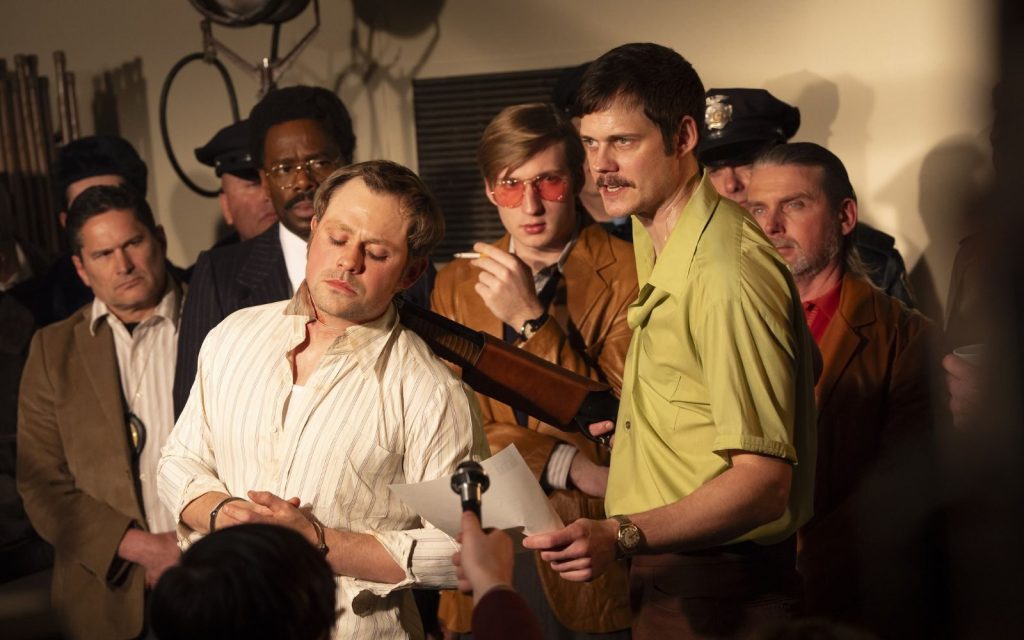
Things began to unfold at Meridian Mortgage in Indianapolis, Indiana, on Tuesday, 8 February 1977. Tony Kiritsis walked into the building for an appointment with senior mortgage broker M.L. Hall (Al Pacino) but was instead escorted to the main office by his son, Richard. Within moments, the meeting turned into a nightmare. Tony held Richard at gunpoint, wiring a sawed-off shotgun to the young man’s neck as a dead man’s switch. His erratic demand? To be compensated for allegedly being swindled out of a prosperous land deal. The events that followed sparked a media frenzy, leading to national news coverage and an unexpected series of twists that kept the world captivated.
Director Gus Van Sant (Good Will Hunting) crafts a unique and gritty tale about an unlikely folk hero who claims to seek justice for the common man. Perfectly casting Bill Skarsgård as the volatile captor who balances precariously on the edge of sanity, this becomes a surprising study of a hostage situation where the definition of ‘right’ depends entirely on your perspective. Set in the less-than-photogenic, washed-out aesthetic of the late 1970s, the production design is remarkably authentic. Furthermore, Van Sant manages to stretch his stellar cast outside of their comfort zones. Cary Elwes, Colman Domingo, and Al Pacino all take on distinct alter-egos that help carry the narrative, providing the necessary depth and flavour needed for this sordid real-life tale.
Dead Man’s Wire is an unexpected journey filled with unlikely protagonists and twisted expectations. While it is a true-to-life tale that remains difficult to fully discern on the surface, it serves as a fascinating piece of modern history that will challenge the audience’s perceptions right up until the final frame.
REEL DIALOGUE: Can something positive come out of injustice?
Gus Van Sant manages to weave together a story that exposes the deep flaws on both sides of the American justice system and the financial sector. Even though audiences can see the ridiculous and dangerous nature of this hostage situation, the film still highlights the innate human desire to seek out justice in a broken world.
Strangely, the director manages to show that a certain beauty can be found even amidst injustice and suffering. This raw, unfortunate depiction of how life was lived out in the United States during this era is something that could also be said of the very heart of the Christian gospel—the life, death, and resurrection of Jesus.
Jesus’ story is one of tragic beginnings and a horrific, unjust end. Yet, throughout the journey of his short time on earth, this tale of potential woe contains a profound beauty that offers ultimate hope to humanity. His sacrificial death is viewed as a symbol of everlasting joy for millions, and his life continues to provide an overwhelming expectation of what is to come.
If you look at your own life and feel as though there is little hope or joy to be found, it may be the perfect time to check out the account of Jesus. He offers people a hope and a future that goes far beyond our wildest dreams—opening up a world that stretches well past the imagination of Hollywood’s best screenwriters.
Check it out for yourself today: The story of Jesus as told by the physician Luke.

Reel Dialogue has entered the world of YouVersion: Download the app, dive into the plans, and engage with the Bible in a fresh and exciting way.
Reel Dialogue has entered the world of YouVersion: Download the app, dive into the plans, and engage.

About Russ Matthews


More Films like this
View All