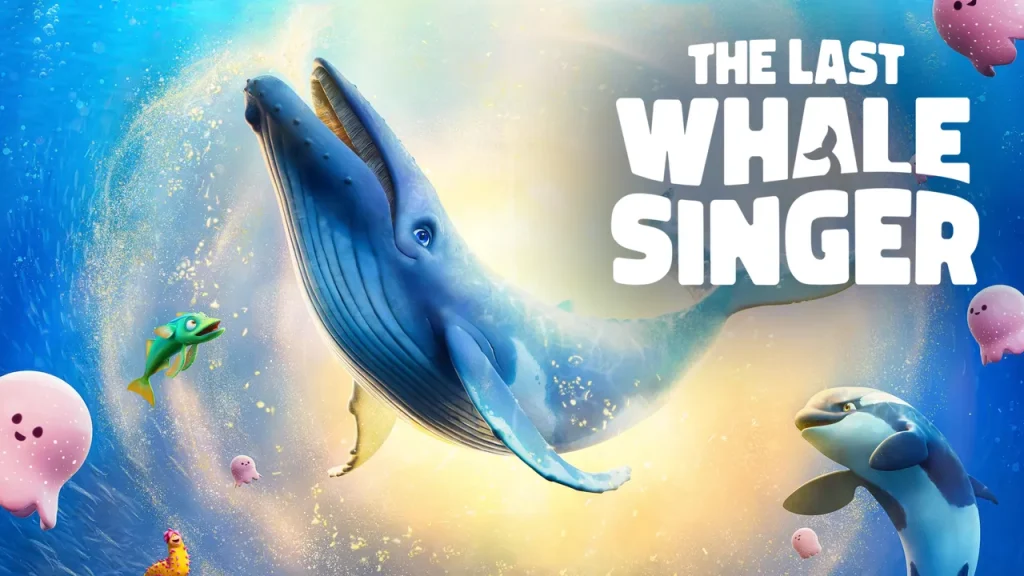
The Last Whale Singer
Something familiar is in the waves, we’ve swum through most of these waters before.


 20 Sep 2026
  Russ Matthews
 The Last Whale Singer has a healthy heritage in the oceans. The animation is colourful, the message is positive, and its creators clearly want families to leave the cinema thinking about friendship, responsibility and caring for the world around them. The problem is that almost everything feels strangely familiar.
Vincent is a teenage humpback whale living beneath the considerable shadow of his father, the legendary last Whale Singer. When a monstrous creature known as the Leviathan escapes from a melting iceberg and threatens the ocean, Vincent must discover whether he has inherited more from his father than merely the family name. Joined by Walter, his remora fish nanny, and Darya, a deaf orca, the young whale embarks on an underwater adventure that eventually requires him to discover his own song. If that sounds familiar, it should.
There is a considerable amount of Finding Nemo swimming through these waters, while Vincent’s relationship with his father and the burden of living up to his legacy carries more than a little The Lion King and Happy Feet. Then throw in a giant whale, a monstrous creature from the depths and the occasional whisper of Moby Dick, and you have an animated cocktail made from some very recognisable ingredients.
A familiar song
To its credit, The Last Whale Singer looks good. The underwater environments provide plenty of colour and movement, and the animation is more accomplished than might be expected from a production that doesn’t carry the Pixar, Disney or DreamWorks name. The most original component is contained within the title itself. Whales are not merely creatures swimming through this animated ocean; their songs have significance. Vincent has to discover his voice and learn that what he has been given may be precisely what is needed to help those around him. It’s a lovely idea.
Unfortunately, the story surrounding it rarely matches that originality. The narrative moves from reasonably plausible family adventure to increasingly ridiculous fantasy, throwing creatures, dangers and mythology into the ocean until the whole thing threatens to become waterlogged. At times, you may find yourself wondering whether the filmmakers have simply decided that if one underwater threat is entertaining, five more must be even better. Still, younger audiences are unlikely to worry too much about narrative originality.
There is also a noticeable spiritual dimension woven into Vincent’s journey, with elements of Eastern mythology and transcendental-style meditation used as part of his search for identity, inner strength and connection to the world around him. These ideas sit alongside the film’s environmental message, presenting harmony with nature, looking within oneself and accessing a deeper spiritual awareness as part of discovering his gift. For Christian families, this provides another worthwhile conversation point, particularly around the difference between looking inward for spiritual enlightenment and the biblical understanding that our identity, gifts and purpose ultimately come from our Creator.
Saving the oceans
The environmental message is impossible to miss. Humanity’s rubbish and its impact upon the oceans become part of the adventure, while the melting ice and damage to the underwater world provide a broader ecological backdrop. For families, this actually creates some worthwhile opportunities for conversation.
Regardless of where people land on every aspect of the environmental debate, teaching children that the world shouldn’t be treated as one enormous rubbish bin seems like a reasonably safe place to begin. Stewardship, responsibility and caring for creation are valuable lessons, and The Last Whale Singer packages them in a way younger viewers can understand.
There are also positive ideas surrounding teamwork and family. Vincent cannot accomplish everything alone. He needs his friends, just as they need him. The film repeatedly reinforces the idea that our abilities are best used alongside others rather than merely for ourselves. These are all worthwhile themes. The frustration is that they are contained within a film that offers so little originality in its storytelling. It sings a pleasant enough song; we’ve simply heard most of the melody before.
What should parents know?
The Last Whale Singer is primarily designed as family entertainment, with positive messages surrounding friendship, courage, teamwork, environmental stewardship and discovering your abilities.
There is some mild peril, particularly involving the Leviathan and the darker depths of the ocean, which may unsettle particularly sensitive younger viewers. The environmental elements also include humanity’s pollution and rubbish entering the oceans, although these themes are presented in a child-accessible manner rather than becoming overly confronting.
For most families, this should prove to be a relatively safe option at the cinema. Parents may not discover much they haven’t seen before, but children should find enough colour, creatures and underwater adventure to keep them swimming along with Vincent.
The bottom line
The Last Whale Singer is a perfectly respectable family adventure that suffers primarily because audiences have seen considerably better versions of almost everything it attempts. Its animation is admirable, its environmental intentions are commendable and the musical mythology surrounding the Whale Singers gives the film its one genuinely distinctive note. Yet its combination of Finding Nemo, The Lion King and almost every other animated story about a young hero trying to live up to a parent’s legacy prevents it from ever developing a voice entirely of its own.
Families looking for something positive to watch together could certainly do considerably worse. Just don’t be surprised if you spend much of the film wondering where you’ve heard this song before.
REEL DIALOGUE: What are you doing with the gifts God has given you?
Vincent spends much of The Last Whale Singer searching for something he already possesses. He lives beneath the reputation of his father and understandably wonders whether he could ever measure up. Yet his journey isn’t ultimately about becoming his father. It is about discovering his own voice and learning how to use what he has been given.
That’s a surprisingly helpful question for the rest of us.
The Bible presents our abilities as more than accidental talents. We are created differently, equipped differently and given opportunities to use those gifts for the benefit of others.
Peter writes: “As each has received a gift, use it to serve one another, as good stewards of God’s varied grace.” — 1 Peter 4:10
The important word may be use.
Having a gift is not the same as developing it. Someone may have musical ability but never practise. Another person may naturally lead but never learn how to lead wisely. Someone else may have compassion, creativity, hospitality, intelligence or the ability to communicate, yet leave those abilities largely unexplored.
Paul similarly tells Timothy to “fan into flame the gift of God” (2 Timothy 1:6).
There is intentionality in that picture. Gifts need to be recognised, developed and exercised. Perhaps that is where Vincent’s underwater adventure provides its most valuable lesson. We don’t need to spend our lives trying to become somebody else. Instead, we can ask what God has already placed within us and how those abilities might be developed for his purposes and the good of others.
What gifts has God given you, and what are you doing to develop them?

Reel Dialogue has entered the world of YouVersion: Download the app, dive into the plans, and engage with the Bible in a fresh and exciting way.
Reel Dialogue has entered the world of YouVersion: Download the app, dive into the plans, and engage.


