The Richest Woman in the World
Money cannot fix the human heart


 6 May 2026
  Russ Matthews
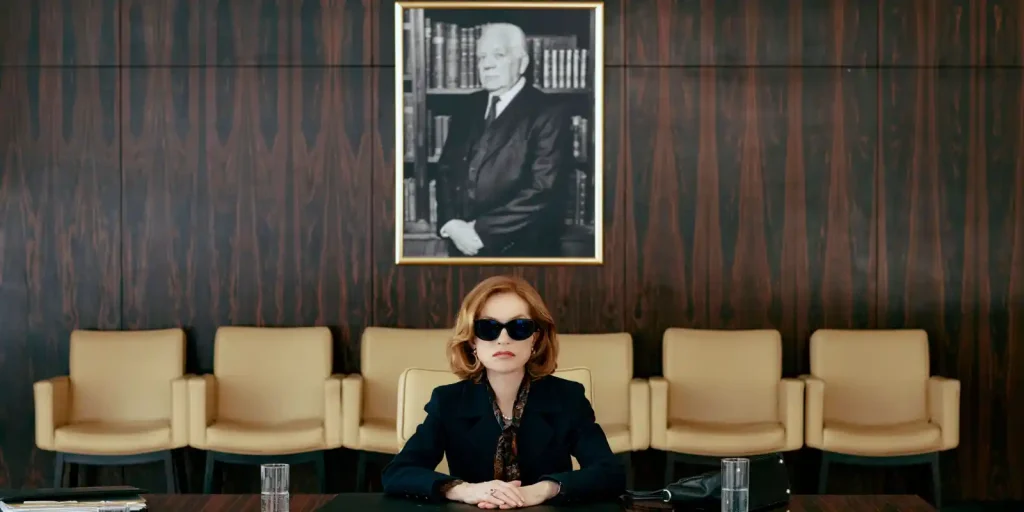
 Few modern scandals have fascinated France quite like the Bettencourt affair. While the rest of the world purchased more and more cosmetics, the real-life controversy surrounding L’Oréal heiress Liliane Bettencourt exposed the intersection of immense wealth, political corruption, family conflict, and personal manipulation. Writer/director Thierry Klifa loosely adapts these extraordinary events into his latest film, a darkly tragic, while at times humorous, drama driven by the powerful and depressing performance of Isabelle Huppert.
Renamed as Marianne Farrère (Isabelle Huppert) for this story, her central character is the head of a global cosmetics empire and considered the richest woman in the world in her time. During a photoshoot, she meets Pierre-Alain Fantin (Laurent Lafitte), a flamboyant writer and photographer whose charm quickly draws her into an increasingly complicated relationship. What begins as companionship soon develops into a troubling dependence that unsettles the hieress’ family and those closest to her. As Pierre-Alain’s influence grows, concerns over manipulation, loyalty, and financial exploitation begin to surface, leading to a series of investigations that threaten to unravel the family and expose the excesses of their privileged world.
Thierry Klifa approaches the story with a noticeably satirical lens, exposing the absurdities and moral decay that can accompany extreme wealth. The performances are undeniably strong, particularly from Huppert and Lafitte, whose chemistry carries much of the film’s tension. Lafitte fully embraces Pierre-Alain’s indulgent and exploitative lifestyle that depicts the worst of humanity, while Huppert portrays Marianne as a woman caught between loneliness, power, and vulnerability.
Yet, despite the quality of the performances, the film struggles to frame Marianne as a truly sympathetic figure. While the real-life Bettencourt’s battled Alzheimer’s disease, something that played a significant role in the original scandal. This aspect feels underdeveloped here, lessening the emotional complexity surrounding her manipulation. Instead, the film becomes more of a portrait of excess, family drama and dysfunction than a tragedy centred on exploitation.
There is little within this world that feels uplifting. From the political undertones surrounding the cosmetics empire to the hollow lifestyles of the wealthy elite, the film presents a bleak portrait of privilege disconnected from genuine fulfilment. The closest thing to moral clarity comes through Marianne’s daughter (Marina Foïs), whose growing concern for her mother grounds the story emotionally, alongside the quiet dignity of her husband (André Marcon) and the sacrificial loyalty of the family’s butler (Raphaël Personnaz).
Ultimately, The Richest Woman in the World becomes less a celebration of wealth and more a cautionary tale about its limitations. No one truly wins, and despite the luxury surrounding these characters, the film leaves audiences with the unsettling reality that riches cannot protect people from loneliness, corruption, or broken relationships.
REEL DIALOGUE: Money can’t buy happiness
One of the clearest messages woven throughout The Richest Woman in the World is the emptiness that can come from making wealth the centre of life. Despite possessing unimaginable riches, Marianne and those around her remain trapped by fear, manipulation, and dissatisfaction.
Jesus spoke often about money—not because wealth itself is evil, but because of its power to control our priorities and shape our hearts.
“No one can serve two masters… You cannot serve both God and money.” — Matthew 6:24
The issue is not whether someone has money, but whether money has them. The film demonstrates how easily wealth can become a master rather than a tool, promising freedom while ultimately creating deeper isolation.
True fulfilment cannot be purchased or protected by status, success, or possessions. The Bible points instead to a different source of peace and satisfaction—one found not in what we own, but in a relationship with God.
Perhaps the question worth considering is this: what truly rules our lives?

Reel Dialogue has entered the world of YouVersion: Download the app, dive into the plans, and engage with the Bible in a fresh and exciting way.
Reel Dialogue has entered the world of YouVersion: Download the app, dive into the plans, and engage.


