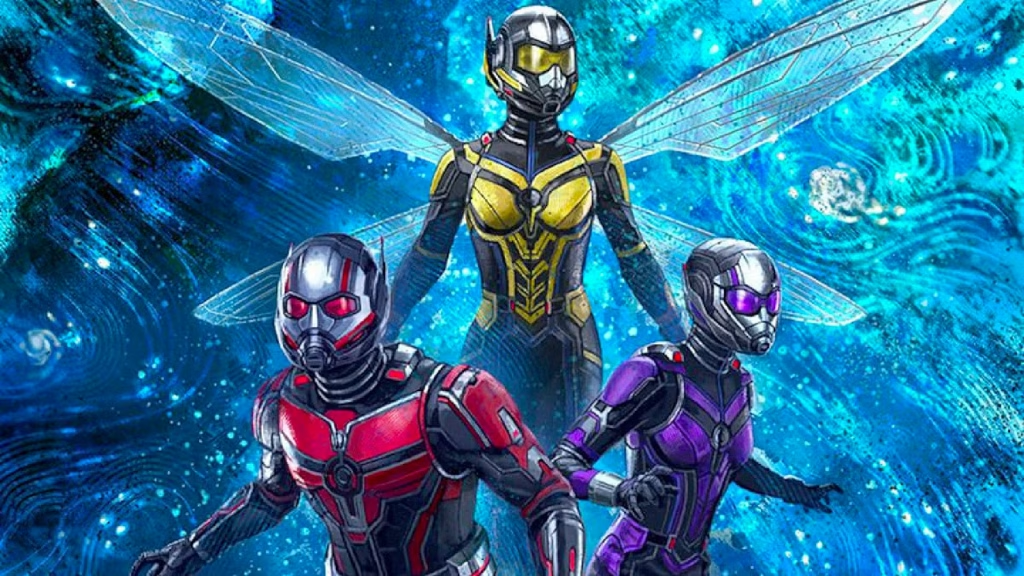
Ant-Man and the Wasp: Quantumania
Look out for the little guy


 15 Feb 2023
  Michael Walsh
 After four phases of films, the Marvel Cinematic Universe is now set to launch into Phase Five. The film kicking off the proceedings is none other than Ant-Man and the Wasp: Quantumania, the third film in the Ant-Man series, and the 31st film in the Marvel Cinematic Universe. Audiences were first introduced to Scott Lang (Paul Rudd) in Ant-Man, which served as Phase Two's epilogue back in 2015. Despite his humble on-screen origins, this latest entry is a far more expansive, epic, and indeed manic adventure into new unknown worlds.
In the newest chapter, Scott Lang and Hope van Dyne (Evangeline Lilly), together with Scott’s daughter, Cassie (Kathryn Newton), and Hope’s parents, Hank (Michael Douglas) and Janet (Michelle Pfieffer), find themselves trapped in the Quantum Realm. They embark on an adventure that pushes them beyond what they thought was possible as the foursome battle against a mysterious and dangerous new threat, Kang the Conqueror (Jonathan Majors), and fight to protect the ones they love.
Whilst the Ant-Man franchise began with a heist film aesthetic, and small-stakes action. This latest installment is more akin to the Guardians of the Galaxy or the latter Thor films. Gone is the grounded San Francisco-based setting, replaced with psychedelic quantum chaos, bright CGI colours, increasingly cheap comedy, and yet another exposition of what audiences can expect from the multiverse. It’s Ant-Man in Wonderland with all manner of crazy characters. From revolutionaries fighting against Kang, to the duplicitous Krylar (Bill Murray) to the MCU’s reimagining of comic villain MODOK (Corey Stoll) Unfortunately, these side characters are not given much to do but be comedic side fodder, in a film that already has a very comedic lead. Rudd’s comedic chops are given a great opportunity to shine. Still, it’s also exciting to see him given more dramatic moments, especially those focusing on his relationship with his teenage daughter Cassie. Kathryn Newton takes over the role here and is excellent at making Cassie sympathetic, even when she gets preachy and self-righteous.
The film’s other great strength, outside of the father-daughter relationship, is the big screen introduction to Kang the Conqueror. Having previously appeared as a version of Kang in Loki named He Who Remains, Majors is now allowed to let loose and introduce us to the next Thanos-level threat to the MCU. His gravitas, complexity, and sheer power are magnetic and prove why Kang is a villain worth building this next Marvel saga around. However, because this is his introduction, the film feels like chapter one in a larger story, meaning plot threads feel unresolved. Additionally, it’s a shame that Evangeline Lilly is given so little character development for a movie titled Ant-Man and the Wasp. The most interesting part of Hope is her ever-changing hairstyles. It feels like a missed opportunity to explore her family dynamic with her recently reunited parents, in contrast to Scott-Cassie. Yet, sadly only a little time is given to the Pym/van Dyne clan. Pfieffer does well to portray the PTSD of Janet, and Michael Douglas is delightfully dry, even if it does feel like he’s just sleepwalking through the film half the time.
Overall, Ant-Man and the Wasp: Quantumania is an intriguing start to Phase Five. Part Alice in Wonderland, part Star Wars with rebellion, new worlds, and wacky characters, it’s a shame that this film gets a little bit too big for its own good and loses focus of the little things that made us first fall in love with Scott Lang and company.
Reel Dialogue: What does looking out for the little guy mean?
One of the most humorous recurring gags in the film is the new book that Scott has written called “Looking Out for the Little Guy.” It’s part autobiography, part self-help, and all tongue-in-cheek. But it raises an important question. What does it actually mean to look out for the little guy? Is it only the job of heroes to protect the weak? Is it only our job to help the poor and oppressed if it affects us too? Or should we always champion on behalf of the causes we know are just?
Scott’s daughter Cassie constantly pushes her father to be a big world-threat fighting superhero and take on the battles of those who cannot fight for themselves. The Bible teaches us that we are to look after one another, because all lives matter to God. We are to care for the poor, the needy, the afflicted, and the oppressed. The most remarkable example of this is Jesus. He cared for those who were outcasts. He ate with sinners. He championed against mistreatment. And showing mercy to those who were in need. Still, He did not just address their physical needs. He came for their spiritual need, the forgiveness of sin. Jesus is the ultimate hero because He cares not just for the little guys, but because He died for them. Have you accepted this rescue?

Bible References
Philippians 2:4 “Let each of you look not only to his own interests, but also to the interests of others.”

Reel Dialogue has entered the world of YouVersion: Download the app, dive into the plans, and engage with the Bible in a fresh and exciting way.
Reel Dialogue has entered the world of YouVersion: Download the app, dive into the plans, and engage.