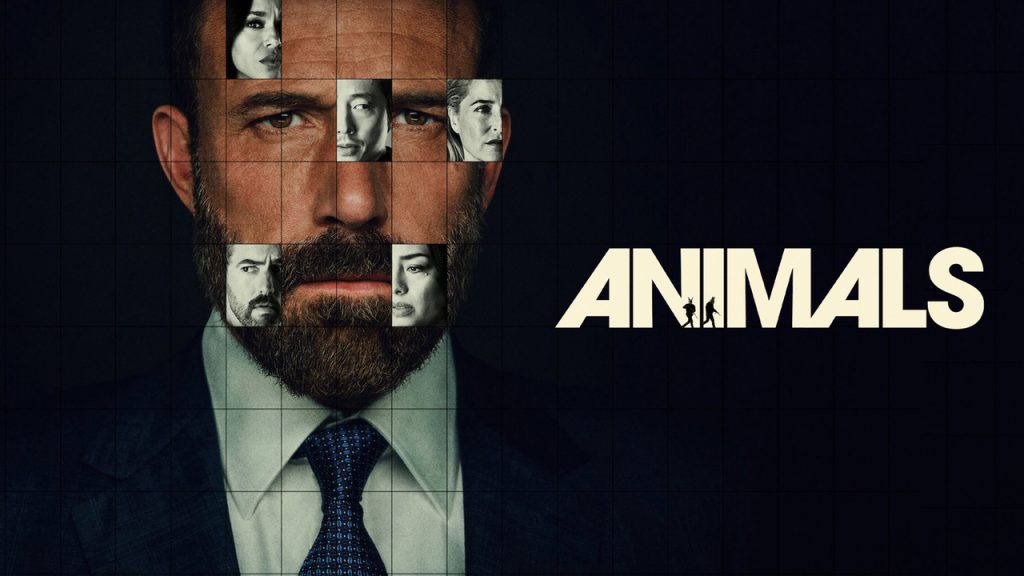
Animals
Taking the Audience Hostage for an Unsatisfying Ransom


 10 Oct 2026
  Michael Walsh
 Ben Affleck has established himself as one of Hollywood's more dependable actors-turned-directors who understands how to build tension, balance competing interests and make the stakes feel personal. From the gritty crime drama Gone Baby Gone to the gripping heist thriller The Town, the Oscar-winning filmmaker has demonstrated an ability to craft compelling characters within tightly constructed narratives. His Best Picture winner Argo further cemented his reputation, while Air was a welcome crowd-pleaser.
Concurrently, Akira Kurosawa’s High and Low (1963) remains a masterclass in moral tension. Beginning as a kidnapping thriller, it gradually becomes a devastating examination of class, privilege and the distance between the comfortable and the desperate. Its brilliance lies not merely in the mechanics of its central dilemma, but in the way that dilemma exposes the moral character of everyone involved. Spike Lee’s recent Highest 2 Lowest demonstrated that this story could be reimagined for contemporary audiences without losing its thematic richness, as Lee brought his own cultural perspective, visual energy and a commanding Denzel Washington performance to the material. But Affleck, meanwhile, offers a version that feels curiously unsure of what it wants to say.
Animals has the foundations of a compelling moral thriller, but the director’s usual strengths are conspicuously muted. For a filmmaker capable of considerably better, this is a frustrating step backwards.
A kidnapping and a moral dilemma
This version of the story follows Los Angeles independent mayoral candidate Mark Kimball (Ben Affleck), who learns that his son, Denny (Christopher Woodley), has been kidnapped. Alongside his wife, Abigail (Kerry Washington), Mark scrambles to secure the ransom while navigating the demands of his campaign manager, Sam (Steven Yeun), who involves the mysterious hostage specialist Dayle (Gillian Anderson) to help them recover their son. However, things take a turn when Denny walks in the front door, and the group soon realises the kidnappers have mistakenly taken Hector (Jacob Estrada), the son of their nanny Cecilia’s (Adriana Paz) undocumented gardener boyfriend, Ramon (Luis Gerardo Méndez). Now Mark is confronted with a moral dilemma that challenges his public convictions, personal ambitions and understanding of justice.
How far will he go to protect his reputation, and what will he sacrifice to preserve the life he has built?
A promising premise that fails to deliver
There is something particularly frustrating about watching a talented filmmaker deliver a film that is not especially bad, but never particularly good either. Animals is not an outright disaster. It is competently assembled, features a respectable cast and contains the ingredients of an engaging thriller. Yet, for all its shouting, scrambling and manufactured urgency, it struggles to generate the tension or emotional investment that its premise needs because of its predictability.
The film explores marital fractures, political compromises and uncomfortable questions of privilege without allowing these threads to develop organically, instead just dropping you into the midst of them. There is a fascinating character study to be found in the contrast between the values a person proclaims and the compromises they make when those values become personally costly, but unfortunately, Animals rarely digs beneath the surface. Affleck certainly commits to the intensity, but yelling is not the same as character development.
His and Washington’s performances repeatedly reach for emotional extremes without establishing the depth necessary to make those moments resonate. Rather than revealing a complex couple under pressure, the film too often reduces them to shallow caricatures of a politician with ambition and a wife in exasperated desperation. The supporting cast fares little better, with Gillian Anderson injecting some welcome intrigue into her scenes as the enigmatic Dayle, but her character creates more questions than the film is interested in exploring.
A weaker echo of a cinematic classic
This is particularly disappointing given the source material. Kurosawa’s High and Low understands that the mechanics of a kidnapping are only the beginning. The real drama lies in the questions and moral choices that follow, and in what those choices reveal about a society divided by wealth and opportunity. Spike Lee’s Highest 2 Lowest likewise finds ways to make that conflict feel contemporary and culturally specific. Animals borrows the framework but struggles to justify its own existence.
Its political setting offers an obvious avenue for exploring public virtue versus private self-interest, particularly when a candidate’s carefully managed image comes under threat, but the film settles for predictable developments and blunt thematic statements. The tension rarely builds beyond the immediate circumstances, and its revelations lack the impact they need to transform our understanding of the characters. None of this is helped by the film’s unfortunate timing. Arriving so close to Highest 2 Lowest, it invites inevitable comparisons with a more confident reimagining of the same story. Affleck’s film feels less like a fresh interpretation than a weaker echo, repeating familiar beats without discovering much that is new to say.
The bottom line
There is still enough here to make Animals watchable.
The premise is inherently compelling, the production is perfectly serviceable, and occasional flashes of tension remind us of what the film might have been.
But competence is not the same as distinction.
Ben Affleck is capable of better than this, and whilst Animals is not poorly made, it is simply bland.
For a story about the desperate lengths people will go to protect what they love, it proceeds predictably to its expected conclusion, leaving little to wrestle over.
REEL DIALOGUE: What Makes Us Human?
When discussing the morality of the kidnappers, Mark says, “Decency is what separates us from the animals.”
It is a compelling statement, particularly when the people making it are forced to confront the limits of their own decency. But Dayle’s response cuts to the heart of the film’s central question:
“Humans are animals who tell stories.”
We are remarkably good at telling stories about ourselves.
We construct narratives that make our decisions seem reasonable, our ambitions noble and our compromises necessary. We call ourselves generous when generosity costs us little. We proclaim justice until justice demands something personal. We speak of compassion while finding reasons to excuse our indifference to the suffering of others.
The danger is not simply that we behave selfishly. It is that we become so invested in our own stories that we no longer recognise the selfishness beneath them.
Christianity offers an uncomfortable but necessary challenge to this instinct.
The Gospel does not allow us to measure our goodness merely by comparison with someone else’s failures. Instead, it confronts us with the reality that every human being falls short of God’s standard, regardless of wealth, status, reputation or public image.
But the message is not one of hopeless condemnation.
The Gospel reminds us that our worth is not secured by the stories we tell about ourselves, but by the grace of God.
In Christ, we are invited to abandon self-justification, acknowledge our failures and learn to love others beyond the boundaries of our own comfort.
“So in everything, do to others what you would have them do to you, for this sums up the Law and the Prophets.” — Matthew 7:12

Reel Dialogue has entered the world of YouVersion: Download the app, dive into the plans, and engage with the Bible in a fresh and exciting way.
Reel Dialogue has entered the world of YouVersion: Download the app, dive into the plans, and engage.

About Michael Walsh


More Films like this
View All 500 MIles
Sometimes the longest journey isn't measured in miles, but in the distance between people who once loved one another
Digger
One of the most brilliantly constructed films I have absolutely no desire to watch again