Fatherland
A haunting journey through a divided homeland, where the past refuses to fade and the meaning of belonging is brought into question.


 14 Nov 2026
 Juliana Purnell
With the 99th Academy Awards just around the corner, many countries from around the world have submitted their nation's pick for the Best International Film category. Representing Poland this year is Fatherland.
Having won the Best Director award at Cannes, this film has already proven itself to be a wise pick for the Oscars shortlist. After all, director Paweł Pawlikowski is no stranger to accolades; his previous two films, Ida and Cold War, were both nominated in this category, with Ida taking home the award in 2014. Is his latest film up to the task of going all the way at the Academy Awards once again?
Set entirely in the post-Second World War period, Pawlikowski’s three films operate as a loose trilogy. Like his previous productions, audiences are drawn into a world that is still picking up the pieces and trying to function after the devastation of war. Inspired by true events (although still considered heavily fictionalised), the story follows the journey of Thomas Mann, a prestigious German writer who fled his homeland during the war to avoid persecution. Now that the fighting has ended, allowing society and the arts the chance to flourish again, Mann is not only invited back to the “fatherland” but has also been offered the prestigious Goethe Prize.
He is joined by his daughter Erika as they navigate their conflicted feelings whilst travelling through a nation that once hypocritically wished to end the very life it is now keen on celebrating. The situation becomes even more twisted when Mann is asked to accept a second Goethe Prize in East Germany, bringing his sense of patriotism into question.
Fatherland is elegant in its storytelling. Subtle. It never truly reveals the inner thoughts of its main characters; it doesn’t hold the audience’s hand or tell viewers what to think or believe. It allows the events surrounding an otherwise mundane awards tour to unfold without much physical drama, with almost all of the inner conflict residing in the story’s themes. With its slice-of-life narrative presentation, viewers with prior knowledge of Germany’s history immediately after its defeat in the Second World War will find themselves more at home here, possibly more so than the characters themselves.
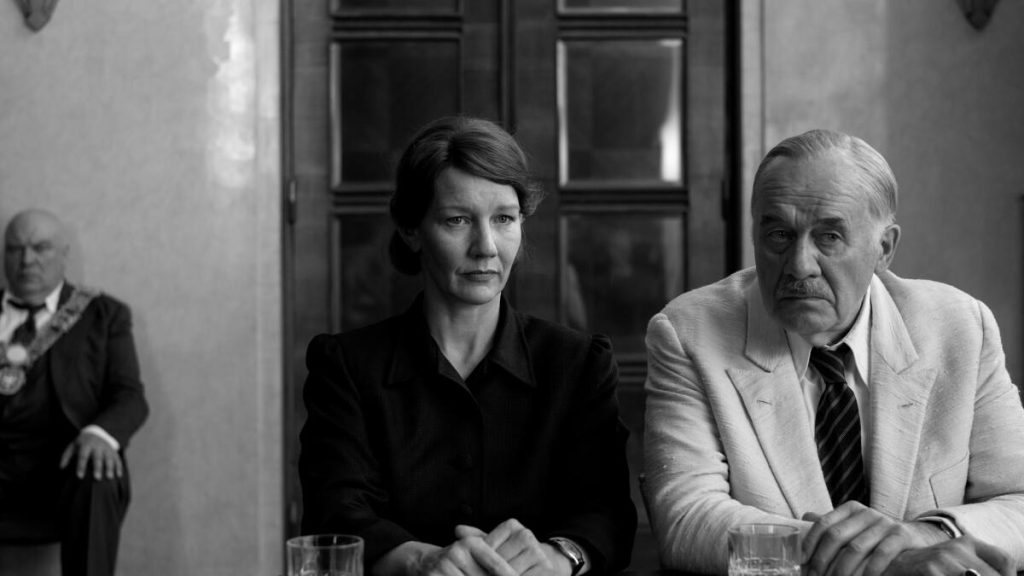
Both Hanns Zischler and Anatomy of a Fall‘s Oscar-nominated actress Sandra Hüller deliver measured but captivating performances as the story’s central figures. So much is said without saying much at all. There is an underlying quality of lament woven throughout the piece, as if it is grieving the intangible ambience of something that was lost whilst making room for an undefined vision of the future. The camera simultaneously feels distant yet intimate, quietly focusing on these characters as they try to make sense of a world that hasn’t yet accepted that their country has forever changed, no matter how much others try to revive its former glory.
The choice to film in black and white (or, metaphorically, shades of grey) is an interesting one, as it not only reflects the time period but also lacks the warmth of familiarity, lending a coldness to the environment.
It’s a plot that’s more ponderous than action-oriented. As a poignant little vignette of a film, it’s certainly not for everyone. Those with curious minds who like to get lost in deeper themes, who prefer to ask questions rather than have the answers hand-delivered, will find themselves ruminating over the sense of loss, uncertainty and the quandary of patriotism presented within the film.
Those who don’t, or who are simply looking for an entertaining time at the cinema away from life’s worries, may find Fatherland rather uneventful. As such, the film has the potential to make it all the way to the Academy Awards, though this may depend on whether another contender can uncover the same level of thematic integrity while offering greater accessibility to general audiences.
It may not be an all-round crowd-pleaser of a movie, but it does offer a thoughtful and masterfully restrained narrative of a period in history that’s rarely explored with such a limited scope and emotionally resonant depth.
REEL DIALOGUE: Adapting to a Transient World
There is a saying: history repeats itself.
Thomas Mann’s journey in Fatherland is not new. There are many moments throughout history when one could draw parallels between the themes explored in the film and the various diasporas that have occurred over time. For Christians, the film may conjure up imagery of the Babylonian exile and what the Judeans faced when they were finally allowed to return home and rebuild the Temple.
In the film, Thomas and Erika may find familiarity with the geography of their homeland and some aspects of its culture, though there is a fragility to their sense of national identity. Their world has changed, and there’s no going back (despite physically returning), all while the entire nation struggles to reconcile its present identity with its past actions. There’s grief mixed with a sense of longing and hope, along with the dreadful uncertainty of their precarious circumstances, as the country is still haunted by its lingering politics.
If anything, the movie puts a face to what others may have experienced when they returned to a home that was barely recognisable. After watching Fatherland, the events reported in Ezra 3, concerning the rebuilding of the Temple, hit a little harder, particularly with the mixed emotions detailed in verses 12 and 13 (NIV):
Ezra 3:12–13
“But many of the older priests and Levites and family heads, who had seen the former temple, wept aloud when they saw the foundation of this temple being laid, while many others shouted for joy. No one could distinguish the sound of the shouts of joy from the sound of weeping, because the people made so much noise. And the sound was heard far away.”
In both cases, the issue is clear: the returning exiles had to confront the fact that the home they had spent decades longing for was no longer the home they remembered.
It raises the important lesson that perhaps our identity shouldn’t be wrapped up in a particular nation, government or political movement, since all these things are subject to change. Humanity appears to desire the comfort that permanence brings, although we live in a world that refuses to remain still. It’s not that patriotism is wrong, but rather that it must never become the foundation of our identity or an excuse to overlook wrongdoing.
In which case: Can we love our homeland without allowing it to define who we are?
Both the movie and Ezra demonstrate that this is possible amidst the grief, but the wider message in Scripture offers a more fascinating paradox, exploring how people can belong to a place and yet recognise that their ultimate home lies elsewhere.

Reel Dialogue has entered the world of YouVersion: Download the app, dive into the plans, and engage with the Bible in a fresh and exciting way.
Reel Dialogue has entered the world of YouVersion: Download the app, dive into the plans, and engage.

About Juliana Purnell


More Films like this
View All
The Cat in the Hat (2026)
A wonderfully chaotic return to the imagination of Dr Seuss