Ink
Any Scandal Is Fair Game

 5 Nov 2026
 Michael Walsh
There are few figures in modern media whose influence has been as significant, controversial and consequential as Rupert Murdoch. The Australian-born media mogul has built an international media empire spanning newspapers, television and entertainment, fundamentally reshaping the way news is reported, consumed and commercialised.
Arguably, one of his most consequential acquisitions was a struggling British newspaper in 1969: The Sun.
Under the editorial direction of Larry Lamb, The Sun pursued an unapologetically sensationalist approach to journalism, prioritising circulation, controversy and entertainment in a competitive news market. Its eventual introduction of the infamous Page 3 girls, featuring topless models, became emblematic of the newspaper’s willingness to push boundaries, exploit scandal and challenge conventional standards of taste and decency. Whilst its commercial success was undeniable, the publication’s editorial philosophy also raised significant questions about journalistic responsibility, the objectification of women and the increasingly blurred distinction between public interest and public curiosity.
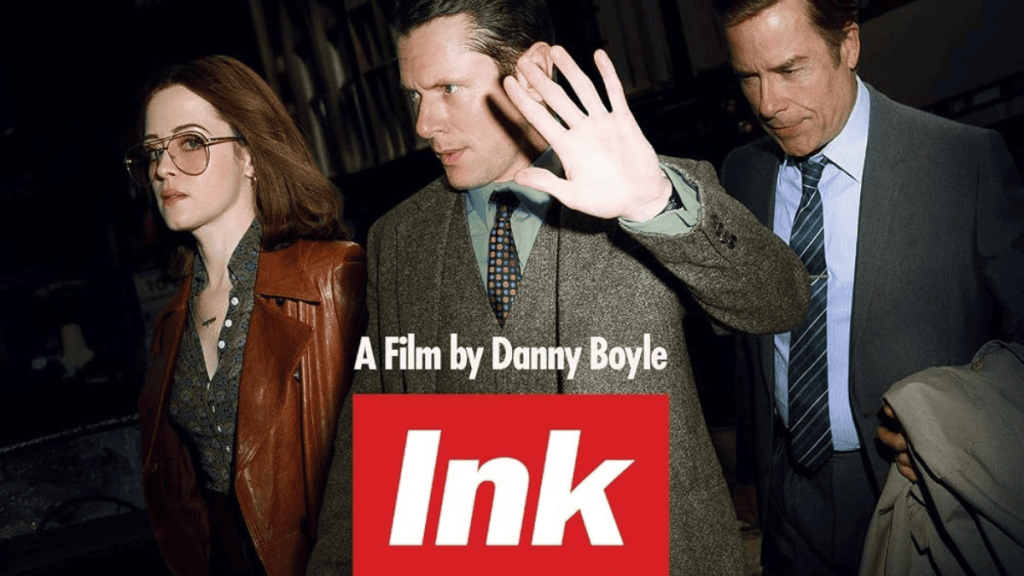
Set against the competitive newspaper landscape of late-1960s Fleet Street and adapted by James Graham from his 2017 award-winning play of the same name, Ink follows ambitious editor Larry Lamb (Jack O’Connell) as he is recruited by Rupert Murdoch (Guy Pearce) to transform The Sun from a struggling publication into a commercially successful tabloid.
Tasked with taking on the seemingly untouchable Daily Mirror, Lamb assembles an unconventional newsroom of journalists, photographers and personalities, determined to give ordinary readers something they actually want to read. This leads them to embrace an increasingly provocative editorial philosophy, pursuing sensational headlines, human-interest stories and scandalous revelations. As circulation begins to climb, the publication’s success comes at an increasingly uncomfortable moral cost.
What begins as an ambitious attempt to democratise the newspaper industry gradually becomes an exercise in exploiting human tragedy, manufacturing outrage and commercialising controversy. With the boundaries of journalistic integrity continually tested, Ink examines the people and decisions behind the birth of modern tabloid culture.
DISCLAIMER: The unfortunate use of AI in small areas of the film to animate newspaper images and provide other minor visual effects is neither necessary nor convincing, and casts an unfortunate shadow over an otherwise brilliant film.
A pulpy, pressing and propulsive newsroom thriller
From its first moments, this snappy stage-play adaptation, full of crackling dialogue, brazen performances and strong filmmaking, should hook you in. Then mix that with a journalistic thriller turned true-crime mystery, with plenty of pertinent and timely thematic propulsion underneath it, and audiences are in for a whirlwind ride.
Danny Boyle’s energy is so perfectly matched to the material, with absolutely pulsing editing and frenetic sound design matched with fluid cinematography. Whilst some may want the story to be more historically expansive, there is something to appreciate about the focused, year-long look at the rise of The Sun, followed by a simple epilogue that acknowledges the subsequent trajectory of Larry Lamb.
Jack O’Connell is deliciously devilish, adding yet another character to his oeuvre who is despicable yet deeply likeable. O’Connell threads the nuanced needle of playing a deeply selfish and consequence-avoidant man with unending charm and magnetic energy.
Guy Pearce is magnificent as Rupert Murdoch, bringing a steady humanity before gradually revealing the moral corruption of a man who would eventually embody much of what we decry in today’s modern media landscape. Claire Foy is also memorable as Jules Davies, an amalgamation of the newsroom women who worked on Fleet Street at the time, offering a compelling counterpoint to the increasingly questionable editorial decisions being made around her.
The rest of the ensemble is really well utilised, and it is fascinating to watch how readily so many become complicit in the scandalous, egregious and increasingly immoral rise of tabloid media. There is something particularly compelling about watching otherwise ordinary people rationalise their involvement in something questionable when the rewards are seemingly worth the compromise.
The film understands that moral corruption rarely happens all at once, but through a succession of increasingly convenient concessions and appeals to humanity’s most perverse desires.
Whilst Ink may not be revolutionary in its condemnation or revelations of what has led us to our current newsroom reality, it does energetically capture just how revolutionary The Sun was under the editorial zeal of Larry Lamb.
Pulpy, pressing and propulsive, Ink is an entertaining and occasionally unsettling examination of the commercialisation of journalism, with a fascinating collection of performances and filmmaking flourishes that make this one a thoroughly compelling watch, albeit one unafraid of scandal, salaciousness and controversy.
More than just the story of a newspaper, Ink explores the beginning of a media revolution whose consequences continue to reverberate throughout contemporary culture.
REEL DIALOGUE: The Importance of Truth
There is an important distinction between reporting something that interests the public and reporting something that genuinely serves the public interest. Journalism has an enormous responsibility to pursue truth, hold people accountable and give a voice to those who might otherwise go unheard. However, when the pursuit of readership, ratings and commercial success becomes more important than the pursuit of truth, the consequences can be deeply destructive.
Scandal becomes entertainment, gossip becomes journalism and the dignity of real people becomes collateral damage in the pursuit of another headline.
Christian integrity requires us to be people who value truth over sensationalism, righteousness over reputation and the wellbeing of others over our own ambition. The temptation to compromise our convictions for popularity, influence or financial reward is hardly exclusive to the newsroom. It is a temptation that confronts all of us.
And whilst we may not all be responsible for publishing tomorrow’s headlines, we are responsible for the words we speak, the stories we share and the things we choose to celebrate and engage with.
In a world increasingly captivated by scandal, controversy and outrage, perhaps we could all do with a little more truth, nobility and integrity.
“Finally, brothers and sisters, whatever is true, whatever is noble, whatever is right, whatever is pure, whatever is lovely, whatever is admirable, if anything is excellent or praiseworthy, think about such things.” — Philippians 4:8

Reel Dialogue has entered the world of YouVersion: Download the app, dive into the plans, and engage with the Bible in a fresh and exciting way.
Reel Dialogue has entered the world of YouVersion: Download the app, dive into the plans, and engage.

About Michael Walsh


More Films like this
View All 
