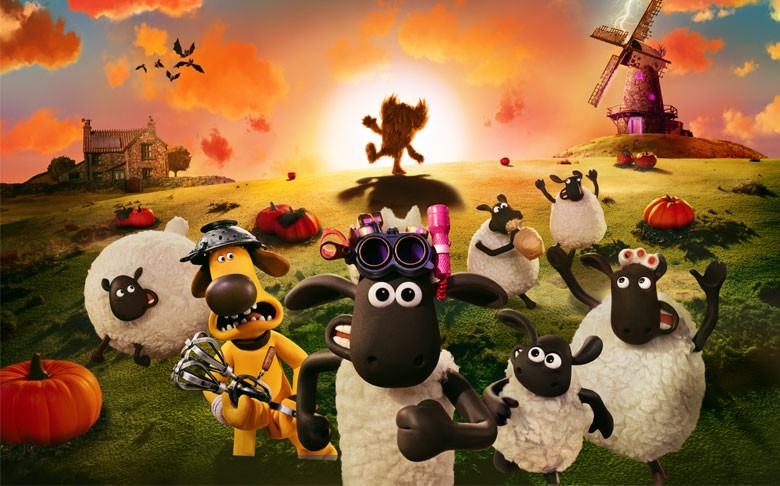
Shaun the Sheep: The Beast of Mossy Bottom
Who knew a Aardman horror (sort of) movie starring sheep could be this much fun?


 13 Sep 2026
  Russ Matthews
 There is something wonderfully reassuring about Aardman. In an era when children's films often seem determined to be louder, faster and filled with celebrity voices, the team behind Wallace & Gromit, Chicken Run and Shaun the Sheep continues to prove that a raised eyebrow, a perfectly timed reaction and a lump of carefully manipulated clay can still make an audience laugh.
Shaun the Sheep: The Beast of Mossy Bottom understands exactly who its audience is.
Like the great silent comedies of the past — with perhaps a little Mr Bean thrown in — Shaun’s world needs almost no dialogue. The comedy comes through expressions, movement, slapstick and wonderfully constructed visual jokes. This time Aardman turns its attention towards classic horror films, producing something that looks spooky without ever becoming particularly scary.
Our grandchildren were rapt from beginning to end. And their grandparents laughed quite a bit too.
Something strange at Mossy Bottom
Halloween is approaching and the residents of Mossy Bottom Farm are preparing for the festivities when the Farmer accidentally destroys the flock’s beloved pumpkin patch. Shaun decides that science might provide the solution, but his attempts to repair the damage soon create an even bigger problem. Before long, rumours are spreading about a mysterious beast roaming the woods and Shaun once again finds himself trying to fix a situation he helped create.
Directors Steve Cox and Matthew Walker clearly have an affection for the horror genre, borrowing imagery and ideas from classic monster movies while filtering everything through Aardman’s wonderfully eccentric British humour. The filmmakers have specifically cited influences ranging from Universal and Hammer horror to Scooby-Doo, Goosebumps and Ghostbusters. Adults familiar with those films will probably recognise jokes that sail straight over children’s heads, while younger audiences can simply enjoy Shaun and the flock trying to survive another increasingly ridiculous adventure. That’s part of Aardman’s enduring appeal.
Old-fashioned comedy for a new generation
For families being introduced to Shaun or even Aardman for the first time, The Beast of Mossy Bottom demonstrates why this style of animation continues to work. The stop-motion craftsmanship is remarkable, but it is never allowed to become more important than the characters. Shaun remains mischievous but loveable, Bitzer desperately attempts to maintain order and the Farmer remains blissfully unaware of much of the chaos happening around him. There is slapstick, physical comedy and an abundance of visual storytelling that feels connected to a bygone era of cinema. Yet it never feels old.
Instead, Aardman has found a way of introducing this kind of comedy to another generation. Children can laugh at what Shaun is doing while parents and grandparents appreciate why the joke works. That’s increasingly rare family entertainment.
What should parents know?
For many families, this will probably be the most important question surrounding The Beast of Mossy Bottom.
The film is rated G in Australia, and despite borrowing heavily from horror movies, this isn’t designed to frighten children. There are monsters, dark woods, spooky situations and moments of mild peril, but everything remains firmly within Shaun’s comedic world.
Halloween is a significant part of the story. Pumpkins, costumes, spooky imagery and Halloween celebrations feature prominently throughout. Christian families who choose not to participate in Halloween will want to be aware that it isn’t simply a passing reference; it provides much of the setting and visual inspiration for the adventure.
There are also a few subtle political and social jokes scattered through the story. Younger viewers are unlikely to notice them, while parents may recognise the commentary behind some of the humour. Beyond those considerations, there is remarkably little to concern parents. There is virtually no meaningful dialogue, no coarse language, no sexual material and the frightening elements are deliberately softened by comedy.
More positively, the story emphasises friendship, responsibility, helping others and attempting to put things right when our actions cause problems. For our family, the best indication came from watching the grandchildren. They laughed, remained completely engaged and were rapt with attention from beginning to end.
This is one of those increasingly uncommon films where children, parents and grandparents can genuinely enjoy the same experience for different reasons.
The bottom line
Aardman knows its audience. Shaun the Sheep: The Beast of Mossy Bottom isn’t trying to revolutionise animation or transform Shaun into something he has never been. Instead, it takes the simple ingredients that have made these characters so enduring — slapstick, visual storytelling, wonderfully expressive characters and genuine heart — and gives them a playful horror-movie makeover.
At around 80 minutes, it doesn’t overstay its welcome either. Children can enjoy the monster adventure. Adults can spot the classic movie references. And everyone gets to laugh together. Sometimes family cinema really can be that simple.
REEL DIALOGUE: Can we make up for our mistakes?
One of the recurring pleasures of Shaun the Sheep is that Shaun’s great ideas rarely work out quite the way he expects.
His adventures usually come at somebody else’s expense, particularly the Farmer’s.
The Beast of Mossy Bottom takes that familiar formula and gives it a worthwhile additional dimension. Making a mistake is one thing. What matters is what Shaun chooses to do afterwards.
The Bible never suggests that people won’t make mistakes. In fact, it is remarkably realistic about our tendency to get things wrong.
What it does emphasise is responsibility.
Paul writes:
“Let each of you look not only to his own interests, but also to the interests of others.” — Philippians 2:4 (ESV)
That’s an interesting way to think about Shaun’s journey.
When our choices hurt somebody else, saying we are sorry matters. Yet genuine repentance often asks something more of us. Where possible, we should try to repair the damage we’ve caused and help those affected by our actions.
Jesus described this kind of change when Zacchaeus recognised how his actions had harmed others. His response wasn’t merely to feel bad about what he had done; he sought to make things right (Luke 19:1–10).
Shaun may be an unlikely source of theological reflection, but his latest misadventure leaves families with a surprisingly useful question:
When we make a mess of things, what are we prepared to do to help put them right?

Reel Dialogue has entered the world of YouVersion: Download the app, dive into the plans, and engage with the Bible in a fresh and exciting way.
Reel Dialogue has entered the world of YouVersion: Download the app, dive into the plans, and engage.


