Wild Horse Nine
A Darkly Comedic Journey Through Friendship, Grief and the Consequences of Our Past


 7 Nov 2026
 Russ Matthews
There are few filmmakers who can blend dark humour, moral ambiguity and the absurdities of human behaviour quite like Martin McDonagh. From In Bruges to Three Billboards Outside Ebbing, Missouri and The Banshees of Inisherin, the writer-director has demonstrated an extraordinary ability to find comedy in tragedy and humanity in some of cinema's most morally compromised characters.
Now, with Wild Horse Nine, McDonagh ventures into the politically volatile world of 1970s Chile, bringing together John Malkovich, Sam Rockwell and Steve Buscemi for a story that unfolds against one of the most extraordinary landscapes on Earth. With the mysterious statues of Easter Island providing the backdrop, this unusual combination of espionage, political intrigue and complicated human relationships offers another opportunity to explore the darker corners of the human condition.
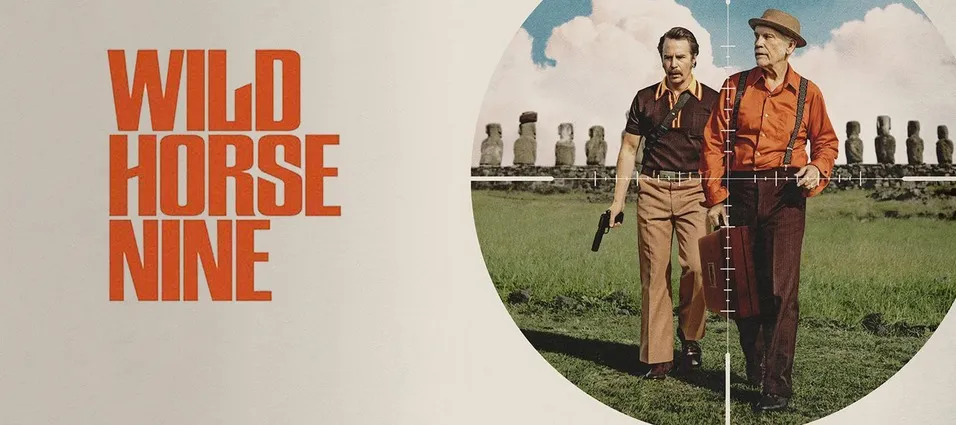
Set in 1973, shortly before the military coup that would dramatically alter Chile’s political future, Wild Horse Nine follows two CIA agents, Chris (John Malkovich) and Lee (Sam Rockwell), who are unexpectedly dispatched from Santiago to the remote Easter Island by their bureau chief, MJ (Steve Buscemi). Surrounded by the island’s iconic stone statues and seemingly removed from the growing political turmoil on the mainland, the longtime partners find themselves confronting personal histories and troubling secrets that threaten their already complicated relationship.
However, when Chris develops an unexpected connection with two rebellious students (Mariana di Girolamo and Ailín Salas), their assignment begins to take a series of unpredictable turns. What initially appears to be an unusual journey to an isolated paradise gradually becomes a story of divided loyalties, personal regrets and the uncomfortable consequences of decisions made in the shadows of political power.
Martin McDonagh’s Unconventional Brilliance
Martin McDonagh is a brilliant filmmaker, but he is undoubtedly an acquired taste. He is a writer-director who manages to get the most out of his leading actors while simultaneously ripping open the human narrative through a collection of unusual, confronting and often deeply uncomfortable relational experiences. His films rarely follow conventional storytelling patterns, and his characters seldom behave in ways audiences might expect. Yet there is something extraordinary about his ability to expose the complexities of human relationships through the most unlikely circumstances.
Wild Horse Nine is no exception. What initially appears to be an unusual espionage adventure gradually develops into an unexpected exploration of friendship, grief, redemption and the challenge of coming to terms with our past. The political setting and remote island location provide an intriguing backdrop, but the real substance of this story is found in the complicated relationship between its two central characters. John Malkovich and Sam Rockwell prove to be perfect choices for their roles as quirky and unconventional CIA operatives with sordid pasts and a rather unique partnership. Both actors possess an extraordinary ability to portray morally complicated characters while finding moments of unexpected humanity beneath their questionable behaviour. Their chemistry becomes one of the film’s greatest strengths, allowing McDonagh’s distinctive dialogue and darkly comedic observations to come alive.
As the screenplay unfolds, the nuances of their relationship and the reasons behind their assignment to Easter Island are gradually revealed. McDonagh refuses to provide audiences with easy answers, preferring instead to allow the story’s mysteries and emotional complexities to emerge through conversations, uncomfortable encounters and moments of unexpected revelation. The result is a narrative that can be confronting, occasionally bewildering and ultimately satisfying in ways that are difficult to anticipate. There is something particularly compelling about watching these two men navigate the complicated history they share. Their friendship is hardly conventional, and their professional responsibilities have clearly left marks upon their lives that cannot simply be ignored. Yet beneath the sarcasm, questionable decisions and morally compromised circumstances lies a surprisingly heartfelt examination of human connection.
This is where McDonagh’s writing demonstrates its greatest strength. He has an unusual ability to explore the darker realities of life without completely abandoning the possibility of compassion, reconciliation or redemption. His characters may be deeply flawed, but they remain recognisably human, and their struggles reveal something about the universal desire to make sense of our experiences and relationships.
Performances Worthy of Recognition
While the screenplay provides the foundation for this unusual adventure, it is the performances of John Malkovich and Sam Rockwell that elevate the material into something particularly memorable. Both actors seem perfectly suited to McDonagh’s distinctive cinematic world, where absurdity and tragedy frequently occupy the same conversation. Rockwell brings his familiar unpredictability and offbeat charm to Lee, creating a character whose behaviour can be both entertaining and unsettling. His ability to move between humour and emotional vulnerability adds considerable depth to the partnership at the centre of the film.
Yet it is John Malkovich who delivers the standout performance. Malkovich has built an extraordinary career portraying eccentric, intelligent and frequently unsettling individuals, but his work in Wild Horse Nine deserves recognition among his finest performances. There is a remarkable complexity to his portrayal of Chris, a man whose past seems to follow him into every conversation and relationship. Through subtle expressions, carefully delivered dialogue and moments of genuine emotional vulnerability, Malkovich reveals the humanity beneath a character who could easily have become little more than an eccentric caricature.
Both actors deserve serious consideration during awards season, with Malkovich particularly worthy of recognition. His performance is a reminder of the extraordinary depth an experienced actor can bring to a character when given material that allows him to explore the full range of human emotions.
A Film That Will Not Appeal to Everyone
Of course, it must be acknowledged that Martin McDonagh’s distinctive style of writing and filmmaking will only appeal to a particular audience. His stories are often deliberately uncomfortable, his humour can be extraordinarily dark, and his characters frequently inhabit a world where moral boundaries are difficult to define. Wild Horse Nine contains strong language, violence and confronting subject matter that will undoubtedly prevent some viewers from engaging with the story. These elements are not incidental to McDonagh’s approach, but neither should they be dismissed when considering whether this is an appropriate film for every audience.
There are also moments when the narrative seems determined to challenge viewers rather than provide them with a straightforward cinematic experience. The unusual pacing, complicated relationships and unexpected turns may frustrate those looking for a conventional political thriller or espionage adventure. Yet for those willing to embrace McDonagh’s particular perspective on the human condition, there is a brilliance to his storytelling that can only truly be experienced rather than explained. His films invite audiences to sit with uncomfortable questions, laugh at situations that perhaps should not be funny and recognise aspects of themselves within characters they might otherwise prefer to condemn.
This is an adventure into the world of friendship within the CIA that brings out the darkly comedic aspects of life while exposing the harsh realities of human existence. The political intrigue may provide the setting, but the emotional consequences of personal decisions become the true driving force of the narrative. And perhaps that is what makes Wild Horse Nine so intriguing. Beneath the unusual circumstances, sharp dialogue and moments of absurdity lies a story about people who cannot escape the lives they have lived or the decisions they have made.
The Bottom Line
Wild Horse Nine may not be Martin McDonagh’s finest film, but it remains a fascinating and unexpectedly satisfying addition to his extraordinary body of work. His ability to combine dark humour, complicated relationships and confronting moral questions continues to distinguish him as one of contemporary cinema’s most unconventional storytellers. John Malkovich and Sam Rockwell deliver outstanding performances, bringing depth, humour and emotional complexity to two deeply flawed individuals whose shared history gradually becomes the heart of the story. Malkovich, in particular, deserves serious awards consideration for a performance that captures both the eccentricity and the humanity of his character.
This is certainly not a film for everyone. Its language, violence and unconventional storytelling will challenge some audiences, while others may struggle to connect with McDonagh’s deliberately uncomfortable approach to human relationships. Yet for those who appreciate his distinctive cinematic voice, Wild Horse Nine offers an intriguing examination of friendship, grief, regret and the possibility of redemption.
It is a film that reminds us that no matter how far we travel, how much we attempt to reinvent ourselves or how desperately we try to bury the decisions of our past, the consequences have a remarkable way of finding us. And sometimes the most confronting journeys are not those that take us to the other side of the world, but those that force us to look honestly at the people we have become.
REEL DIALOGUE: Can We Ever Escape the Consequences of Our Past?
There is something deeply unsettling about the idea that our past can follow us wherever we go. We may change our surroundings, develop new relationships, pursue different careers or attempt to reinvent ourselves, but the decisions we have made and the experiences we have endured remain part of our story. For the characters in Wild Horse Nine, this reality becomes increasingly apparent as their unusual assignment unfolds. Despite finding themselves on one of the most remote islands in the world, they discover that physical distance does little to separate them from the consequences of their previous actions.
The isolation of Easter Island provides a fascinating backdrop for this exploration. Surrounded by the mysterious stone figures of a civilisation whose history continues to intrigue the modern world, these men find themselves confronted by personal histories that cannot simply be left behind. And this raises a question that extends well beyond the circumstances of a fictional espionage adventure.
Can we ever truly escape the consequences of our past?
Most of us have moments in our lives that we would prefer to forget. Decisions we regret, relationships we have damaged, opportunities we have missed or actions that have caused pain to ourselves and others. Sometimes these experiences are relatively minor, while at other times they can leave consequences that continue to shape our lives for years. Our natural inclination is often to believe that enough time, distance or personal achievement might eventually allow us to leave these experiences behind. Yet the reality is rarely that simple.
The Bible offers a remarkably honest assessment of the human condition. In Romans 3:23, the Apostle Paul writes:
“For all have sinned and fall short of the glory of God.” (NIV)
This is not simply a statement about particularly immoral individuals or those whose actions have resulted in extraordinary consequences. It is a reminder that every one of us has fallen short of God’s perfect standard and that none of us can claim to have lived without failure. The consequences of our actions can extend far beyond the moments in which they occur. A careless word can damage a friendship, a selfish decision can affect a family, and a moment of dishonesty can undermine years of trust. Even when we recognise our mistakes and genuinely regret them, we cannot always undo the harm that has been done.
And perhaps the most confronting reality is that even death does not provide the ultimate escape from our past. From a Christian perspective, death is not simply the point at which our moral responsibilities disappear or the consequences of our lives cease to matter. Hebrews 9:27 reminds us that human beings face death and then judgement. This is a sobering reminder that our lives possess eternal significance and that our actions cannot simply be erased by the passage of time.
If the Christian message ended there, it would offer little comfort to those struggling with guilt, regret or the consequences of past decisions. Thankfully, the Gospel offers something radically different. At the centre of Christianity is the extraordinary claim that while we cannot change our past, Jesus Christ offers forgiveness, reconciliation and the possibility of a genuinely new beginning.
In 2 Corinthians 5:17, Paul writes:
“Therefore, if anyone is in Christ, the new creation has come: The old has gone, the new is here!” (NIV)
These words offer a remarkable contrast to the idea that we must spend our lives attempting to outrun our mistakes. The Gospel does not suggest that our past never happened or that the consequences of our actions will automatically disappear. Rather, it declares that our identity and eternal future need not remain defined by those failures. Through the death and resurrection of Jesus Christ, the Christian faith offers redemption that we could never achieve through our own efforts.
Ephesians 2:8–9 reminds us that salvation comes through God’s grace, received by faith, rather than through our attempts to earn forgiveness by becoming better people or compensating for the mistakes we have made. This distinction is particularly important. We may be able to apologise for past actions, make restitution where possible or work towards rebuilding damaged relationships. These are meaningful and necessary steps towards reconciliation. Yet there are limits to what human effort can accomplish.
We cannot rewrite history, restore every broken relationship or undo every consequence of our decisions. And we certainly cannot earn our way into a right relationship with God through our own achievements. But the Gospel declares that what we cannot accomplish for ourselves, Christ has made possible through His sacrifice.
Romans 8:1 offers this extraordinary assurance:
“Therefore, there is now no condemnation for those who are in Christ Jesus.” (NIV)
For Christians, this is the foundation of genuine freedom from the guilt and ultimate condemnation associated with our past. It does not mean that earthly consequences vanish or that we are no longer responsible for the harm we may have caused. Instead, it means that forgiveness and reconciliation with God are possible, even when our history contains things we deeply regret.
There is also something profoundly hopeful about the possibility of reconciliation with others. The Gospel calls Christians not merely to receive forgiveness, but to extend grace, seek peace and pursue restored relationships wherever possible. This does not guarantee that every damaged friendship or broken relationship will be repaired. Trust can take time to rebuild, and some consequences may remain throughout our lives. Yet the Christian understanding of redemption reminds us that our past does not have to determine the entirety of our future.
In Wild Horse Nine, the characters are confronted by the complicated histories that have shaped their relationships and decisions. Their experiences reveal the extraordinary difficulty of escaping the emotional and moral consequences of the lives they have lived. Yet the Gospel invites us to consider a different possibility. What if freedom is not found in running away from our past, but in honestly acknowledging it and discovering that forgiveness is possible? What if reconciliation begins not with pretending our failures never happened, but with recognising our need for grace? And what if the greatest hope available to us is not the opportunity to rewrite our story, but the promise that through Jesus Christ, our story can have a genuinely new beginning?
Martin McDonagh’s darkly comedic exploration of the human condition reminds us that the past has a remarkable way of catching up with us. Yet Christianity offers the extraordinary assurance that while we may never be able to erase what has happened, we do not have to remain imprisoned by it. The Gospel does not change the facts of our past, but it can transform our relationship with those facts, reconcile us to God and offer freedom from the condemnation that our failures deserve. And that is a hope that extends beyond our present circumstances, beyond our regrets and even beyond death itself.
The conversation starter: If we cannot change the decisions of our past, where can we find genuine forgiveness and freedom, and what might it mean to discover that redemption is possible even when the consequences remain?

Reel Dialogue has entered the world of YouVersion: Download the app, dive into the plans, and engage with the Bible in a fresh and exciting way.
Reel Dialogue has entered the world of YouVersion: Download the app, dive into the plans, and engage.

About Russ Matthews


More Films like this
View All The Cat in Hat (2026)
A wonderfully chaotic return to the imagination of Dr Seuss