Pressure
Who knew weather could be this thrilling!


 2 Jul 2026
  Michael Walsh
 Weathermen may be boring, but the weather never is, and that was certainly the case in the lead up to the climactic D-Day Allied invasion of Normandy to turn the tide in the Second World War, 82 years ago on Tuesday June 6.
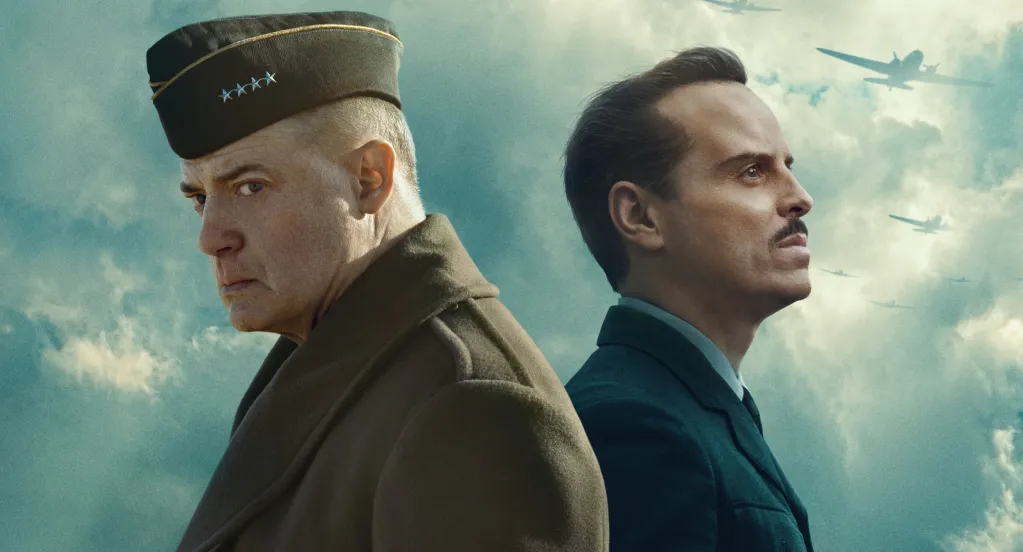
The forces were assembled, the plans were drawn, but before General Dwight D. Eisenhower (Brendan Fraser) could give the go ahead to proceed, he needed a weather forecast. And at the commendation of British Prime Minister Winston Churchill, meteorologist Group Captain James Stagg (Andrew Scott) was summoned to offer his professional expertise. It doesn’t sound all that thrilling, but director Anthony Maras (Hotel Mumbai) manages to craft a propulsive pressure cooker thriller based on David Haig’s play of the same name, Pressure.
Here Stagg is played by Andrew Scott. He’s a classically straight-laced stiff-upper-lipped Scotsman summoned to the Allied command headquarters at Southwick House at the direction of Eisenhower, played by Brendan Fraser. From his arrival, it’s clear that Stagg cares little about being liked, but a lot about being right. He immediately clashes with Col. Krick (Chris Messina) – the US Forces lead meteorologist whose preference for analogue weather maps and experience in stable climate prediction in North Africa instantly put him offside with the data driven and unpredictable European climate exposed Stagg. Unable to agree on a forecast for D-Day, the clock is ticking down to determine whether or not the Allied forces will be successfully able to embark on their climactic invasion or whether the plans will be disastrously scuppered by the weather. Stagg is assisted by Kerry Condon’s measured Lt. Kay Sommersby, Eisenhower’s assistant, who is a stabilising voice to the General in contrast to the blustery Field Marshal Montgomery played by Damien Lewis, who is hellbent on the D-Day launch regardless of its potential for failure.
The resulting film is an impressively mounted war room thriller that takes a staged screenplay and cinematises it epically. Characters move with purpose down hallways and cross-examine one another in increasingly tense confrontations. Maras’ camera knows when to follow, when to watch and when to move and Volker Bertelmann’s score propels the film along as the sharp editing and confident direction bring ample tension to this real world military drama. Whilst the film’s bigger picture is focused on the war games, the heart is found in the homelife of Stagg, whose pregnant wife is hospitalised only for the ward to be bombed. Unable to determine his wife’s fate, Stagg’s mind increasingly frays as he feels the pressure of the lives of the men who may be sent out into not just enemy fire, but monstrous waves, torrential rains and rough winds which would make their advance even more impossible.
The final climactic moments are thus an immense emotional catharsis as D-Day does go ahead during a narrow window in the wild weather identified only from direct data from a remote north Irish weather station. The sense of celebration that the film ends with releases the tension that it so tightly winds, and Stagg is finally dismissed to be reunited with his wife and new child. It’s a powerful emotional payoff that balances Stagg’s professional success with his personal triumph. For fans of war films, political thrillers or any meteorological nerds, Pressure delivers a taught and tense military drama that provides a fresh new angle to one of the most cinematically familiar days in the entirety of World War Two.
Reel Dialogue: Certainty in the Face of Adversity
In Pressure, General Dwight D. Eisenhower demands certainty before committing the Allied forces to D-Day, but the film reminds us that no one can control the weather or predict the future with complete confidence. Many of us know that life is often marked by ambiguity, especially in moments of adversity. Good leadership, therefore, is not about possessing absolute certainty, but about exercising wisdom, humility and integrity amid uncertainty, listening carefully to trusted voices before making difficult decisions.
Perhaps the greatest uncertainty people face is not the weather or even war, but death itself. Is there any certainty beyond the grave? While the future often feels unpredictable, the Christian faith offers confidence where it matters most. Writing to the Corinthians, the apostle Paul declares that through Jesus’ death and resurrection, death itself has been defeated and those who belief in Christ can therefore face an uncertain world with hope, trusting God’s ultimate victory even when many of life’s immediate outcomes remain unknown. Do you share this certain hope?
“O death, where is your victory? O death, where is your sting? For sin is the sting that results in death, and the law gives sin its power. But thanks be to God, who gives us the victory through our Lord Jesus Christ.” 1 Corinthians 15:55-57

Reel Dialogue has entered the world of YouVersion: Download the app, dive into the plans, and engage with the Bible in a fresh and exciting way.
Reel Dialogue has entered the world of YouVersion: Download the app, dive into the plans, and engage.

About Michael Walsh


More Films like this
View All