Animal Farm
All animals are equal. Some adaptations are more equal than others.


 21 Jul 2026
  Russ Matthews
 There are few novels as unsettling as George Orwell’s Animal Farm. More than eighty years after its publication, this scathing political satire continues to expose the seductive nature of power and humanity’s remarkable ability to justify its own corruption. This latest animated adaptation may resemble family entertainment, but beneath its polished presentation lies one of literature’s darkest warnings about leadership, propaganda and the human condition.
Following the overthrow of their cruel farmer, the animals of Manor Farm dream of creating a society founded on equality and justice. Led by the increasingly ambitious pigs, they establish a new order in which every animal is supposedly equal. Yet as authority becomes concentrated in the hands of a few, the ideals of the revolution give way to manipulation, fear and oppression.
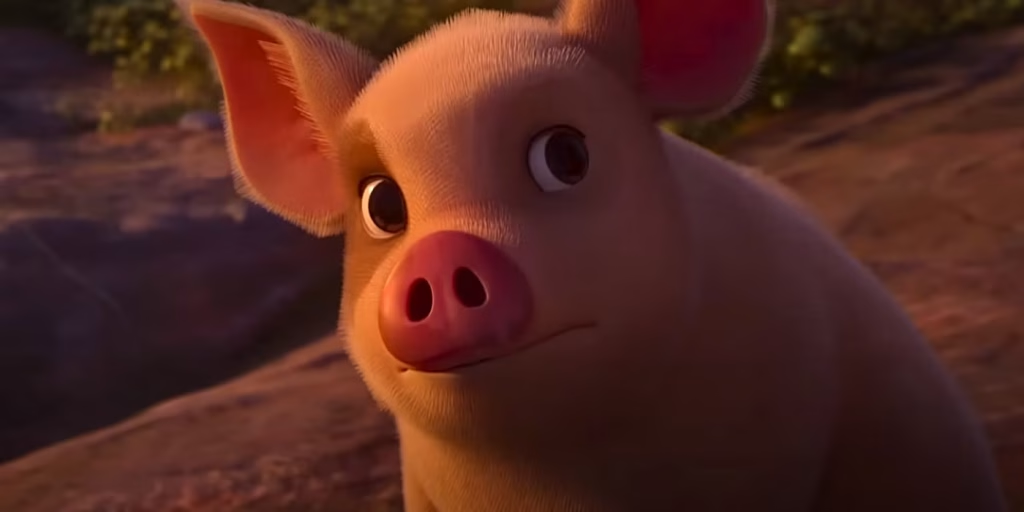
Andy Serkis’ adaptation introduces a new generation to Orwell’s story through contemporary animation and a recognisable voice cast. The animation is technically proficient, while the vocal performances from Seth Rogen, Steve Buscemi, Glenn Close, Kieran Culkin, Woody Harrelson and others are perfectly serviceable. Yet neither the visuals nor the celebrity voices manage to elevate the material into a particularly engaging cinematic experience for families to enjoy.
This is partly because Animal Farm occupies an awkward space between political allegory and family animation. Orwell’s original story was never written for children, despite its talking animals and relatively simple narrative. Its purpose was to satirise the Russian Revolution and the rise of Stalinism while warning that revolutionary ideals can become indistinguishable from the oppressive structures they replace.
The filmmakers attempt to make this bleak material accessible to younger viewers by introducing new characters and a coming-of-age element. However, the resulting film struggles to reconcile those lighter additions with Orwell’s deeply pessimistic view of power. The political ideas remain too complex and confronting for many children, while the attempt to soften the material weakens some of the original story’s force.
It is also surprising to see the film distributed by Angel Studios. Although Angel has expanded beyond explicitly faith-based productions, Animal Farm has a far sharper political edge than audiences may associate with the company. Angel acquired the distribution rights after the film had already been produced, but its involvement still raises questions about why this particular adaptation was chosen for its slate.
There are certainly contemporary parallels to be drawn. Orwell’s warnings about propaganda, manipulated language, rewritten history and leaders who place themselves above the laws they create remain relevant across political systems worldwide. Yet the film rarely develops these themes with enough subtlety or dramatic strength to make the adaptation feel necessary. It gestures towards present-day political concerns without offering a particularly fresh or penetrating interpretation of Orwell’s work.
Parents should also resist assuming that the Angel Studios name makes this suitable family viewing. The company may have identified the literary value and moral discussion within the story, but this is neither one of its stronger releases nor an obvious fit for its audience. The animation may attract children, but the content and political messaging are far more appropriate for older teenagers and adults.
The original novel remains powerful because of its simplicity, economy and devastating conclusion. This adaptation understands the broad message but struggles to reproduce its impact. The animation is adequate, the cast is capable and the lessons remain valuable, but the overall experience is surprisingly flat.
Animal Farm may prompt worthwhile discussions about power and the human heart, but it is neither a great adaptation nor a convincing family film. Even with its celebrated source material and impressive vocal cast, this revolution never fully comes to life.
What should parents know about Animal Farm?
Despite being animated and distributed by Angel Studios, Animal Farm is not designed for young children. It contains themes of oppression, political manipulation, intimidation, betrayal and violence, alongside a bleak portrayal of leadership and human behaviour.
Older teenagers may benefit from watching it alongside a study of Orwell’s novel or twentieth-century history. However, younger viewers are unlikely to understand the political allegory and may find portions of the story confusing or disturbing.
REEL DIALOGUE: Can we trust ourselves to write the rules?
The animals begin their revolution with commandments intended to protect equality and prevent oppression. Yet the rules are gradually altered whenever those in authority find them inconvenient.
What begins as: “All animals are equal”
eventually becomes a justification for inequality and privilege.
Orwell’s warning is not merely that certain political systems fail. It is that human beings repeatedly reshape morality to serve themselves. When we become the highest authority, the rules inevitably move according to our desires.
The Bible shares this honest assessment of the human heart.
“Everyone did what was right in his own eyes.” Judges 21:25
Scripture gives humanity commandments, but it also shows that laws alone cannot transform us. Even when God’s standards are clear, people fail to live by them. Our deepest problem is not simply a lack of rules but a heart inclined towards pride, selfishness and control.
This is where the Christian message moves beyond Orwell’s diagnosis.
God does not merely provide better commandments. He offers grace through Jesus Christ. Jesus fulfils the law we continually fail to keep and demonstrates a model of authority based not on domination but sacrifice.
“For even the Son of Man came not to be served but to serve, and to give his life as a ransom for many.” Mark 10:45
Animal Farm shows what happens when flawed creatures establish themselves as the ultimate authority. The gospel points towards a King whose authority is inseparable from truth, justice, humility and grace.
Where to look for more details: Judges 21:25; Jeremiah 17:9; Mark 10:42–45; Romans 3:23–24; Galatians 5:13–14

Reel Dialogue has entered the world of YouVersion: Download the app, dive into the plans, and engage with the Bible in a fresh and exciting way.
Reel Dialogue has entered the world of YouVersion: Download the app, dive into the plans, and engage.

About Russ Matthews


More Films like this
View All Digger
One of the most brilliantly constructed films I have absolutely no desire to watch again