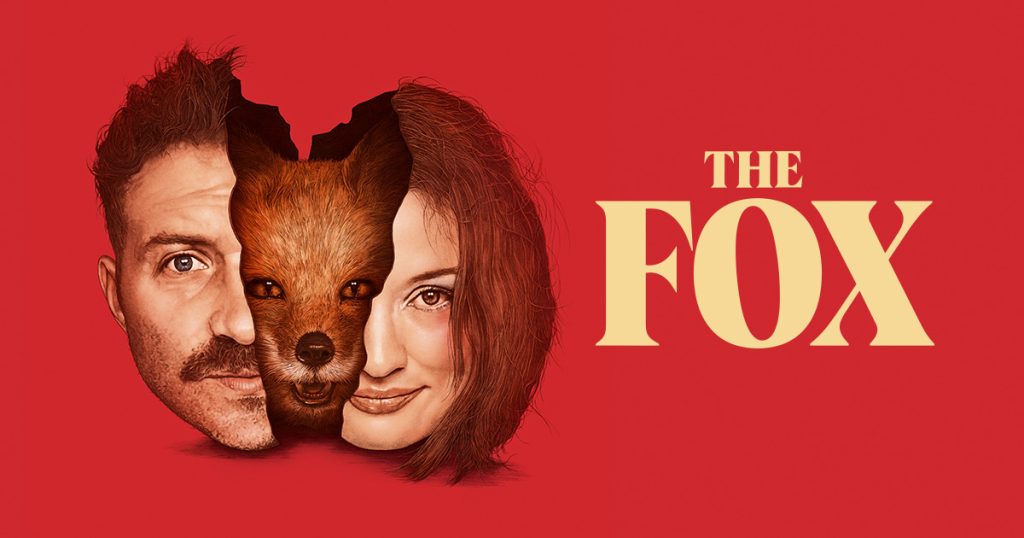
The Fox
What could possibly go wrong when you take relationship advice from a talking fox?


 14 Nov 2026
 Russ Matthews
Australian cinema has never been afraid to get a little weird, and The Fox appears more than willing to embrace that tradition. Part dark comedy, part twisted folktale and part relationship drama, Dario Russo’s feature debut brings together Jai Courtney, Emily Browning and Damon Herriman, alongside Olivia Colman as a talking fox and Sam Neill as a magpie. Yes, you read that correctly.
There is something immediately appealing about a film willing to take Australian country life, relationship problems, talking animals and a touch of supernatural absurdity and throw them all together. Yet underneath the ridiculous premise sits a potentially interesting question about relationships: What happens when loving someone becomes confused with wanting to change them?
Nick (Jai Courtney) is a well-meaning but rather simple country bloke whose life begins to unravel when he discovers that his fiancée Kori (Emily Browning) has been cheating on him with her boss, Derek (Damon Herriman). Then things get considerably stranger. While out hunting, Nick captures a mysterious talking Fox (voiced by Olivia Colman), who offers him an unusual deal. If Nick lets her live, she can help him solve his relationship problems. All he needs to do is take Kori to a magical place in the wilderness capable of transforming her into his idea of the perfect partner. Desperate to repair his relationship, Nick follows the Fox’s advice.
Initially, the plan appears to work. Kori emerges seemingly transformed into everything Nick thought he wanted. Yet her increasingly strange behaviour begins to suggest that getting exactly what you ask for may not be quite the blessing Nick imagined.
Writer-director Dario Russo turns this increasingly bizarre situation into a distinctly Australian dark folktale about relationships, desire and our attempts to control the people we claim to love. With a magical hole, a talking fox and Sam Neill waiting somewhere in the wings as a magpie, one thing is certain. Nobody should expect a conventional relationship drama.
When weird becomes difficult to stomach
Unfortunately, The Fox doesn’t merely become strange. It becomes increasingly difficult to stomach.
The first surprise is how such an accomplished cast became attached to material that eventually ventures into some genuinely confronting sexual territory. Courtney, Browning and Herriman are talented performers, while having Olivia Colman and Sam Neill providing voices should only increase the potential for something wonderfully absurd.
Initially, there are hints of an Australian answer to a provocative relationship drama, only with more laughs and a distinctly rural sensibility. There is even the possibility of an amusing modern fable about relationships, dissatisfaction and the danger of attempting to manufacture the perfect partner. Then the story keeps going.
What begins as ridiculous gradually becomes an overly sexualised fable that ventures into disturbing human-animal sexual material and increasingly transgressive territory. Provocation can certainly have a purpose, particularly when satire is attempting to expose something uncomfortable about human behaviour. The difficulty here is determining what The Fox ultimately wants us to take away from any of it.There are laughs scattered throughout, but too many fall flat as the story moves further towards the rather bleak abyss at its centre.
A fable without much of a moral
Foxes have rarely done particularly well in traditional fables. From Aesop onwards, they have represented cunning, deception and the dangers of allowing clever voices to manipulate our desires. The Fox certainly does little to rehabilitate their reputation. Perhaps there is even a particularly Australian joke hidden in there somewhere about foxes being introduced predators and the damage they have caused to our native wildlife. Yet a fable normally leads somewhere.
This one struggles to find its moral centre. There are ideas about desire, infidelity, control, sexual appetite and dissatisfaction, but they never quite coalesce into something meaningful. Instead, the increasingly bizarre sexual material begins to overwhelm whatever observations the filmmakers may have wanted to make about relationships. The clearest message left standing is also the oldest:
Be careful what you wish for.
Nick believes that if he could only change the woman he loves into exactly what he desires, everything would finally be right. Of course, it isn’t. Perhaps that is the tragedy at the heart of this bizarre tale. The imagined version of another person can never compete with the complicated reality of actually loving them.
What should parents know?
This is definitely not one for children or younger teenagers, regardless of the talking animals or fable-like premise.
Parents should be aware that The Fox contains strong adult themes, sexual content and increasingly confronting material involving human sexuality and animals. The film deliberately pushes into territory associated with bestiality, alongside infidelity, sexual desire and dysfunctional relationships. There is also coarse humour and mature thematic material throughout.
The fantastical talking animals should therefore not be mistaken for an indication that this is family entertainment. This is an adult dark comedy deliberately designed to provoke and discomfort its audience.
The bottom line
There is an intriguing film buried somewhere inside The Fox. A talented cast, Australian setting, talking animals and a twisted fable about trying to transform someone into our perfect partner could have produced something genuinely clever.
Instead, the film becomes increasingly consumed by its own desire to shock. The performances remain committed and there are occasional laughs, but there is remarkably little here to celebrate in either the characters or their relationships. By the time the story reaches its more extreme territory, whatever charm existed in the original premise has largely disappeared.
Aesop’s fox usually arrives with a warning. Perhaps this one does too. Unfortunately, audiences have to venture somewhere particularly unpleasant to find it.
REEL DIALOGUE: Be careful what you wish for
One worthwhile idea does survive The Fox: getting what we desire doesn’t necessarily satisfy us.
Nick believes his problem can be solved if Kori simply becomes the person he wants her to be. It is an ancient human temptation.
We convince ourselves that happiness is waiting just beyond the next relationship, achievement, possession or experience. If we could only have that, surely we would finally be satisfied. Yet desire has an extraordinary ability to move the finish line.
The writer of Ecclesiastes understood this remarkably well:
“Whatever my eyes desired I did not keep from them. I kept my heart from no pleasure.” — Ecclesiastes 2:10 (ESV)
Yet after acquiring everything he wanted, his conclusion was sobering:
“Behold, all was vanity and a striving after wind.” — Ecclesiastes 2:11 (ESV)
James approaches the issue from another direction, asking where our conflicts and dissatisfaction come from:
“Is it not this, that your passions are at war within you?” — James 4:1 (ESV)
The problem isn’t simply that we haven’t received what we want. Sometimes the problem is what we want and what we expect it to do for us.
That may be the most worthwhile conversation to emerge from this deeply strange Australian fable.
What if getting everything you wished for still wasn’t enough?

Reel Dialogue has entered the world of YouVersion: Download the app, dive into the plans, and engage with the Bible in a fresh and exciting way.
Reel Dialogue has entered the world of YouVersion: Download the app, dive into the plans, and engage.

About Russ Matthews


More Films like this
View All How to Rob a Bank
A digital-age Robin Hood caper that steals from the system, broadcasts the loot, and loses its moral compass along the way.
The Cat in the Hat (2026)
A wonderfully chaotic return to the imagination of Dr Seuss