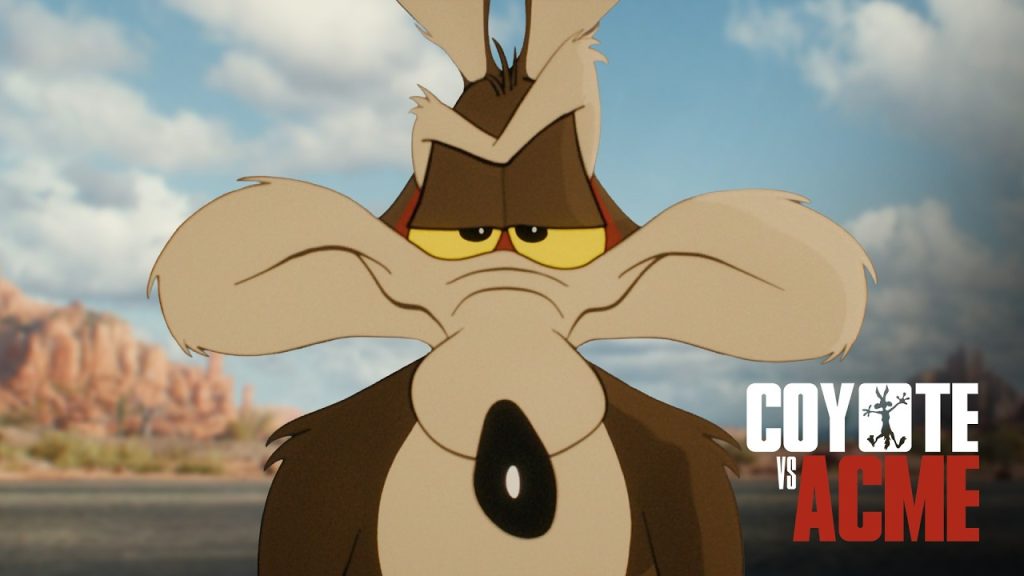
Coyote vs. Acme
Failure is temporary. ACME products are forever.


 16 Sep 2026
  Russ Matthews
 After years of falling anvils, exploding rockets and catastrophically unreliable products, Wile E. Coyote has finally done something sensible. He’s hired a lawyer.
For generations, audiences have watched Wile E. Coyote order increasingly ridiculous contraptions from the ACME Corporation in his never-ending pursuit of the Road Runner. Rockets explode, catapults malfunction, cliffs collapse and somehow the Road Runner continues merrily down the highway.
Yet nobody seems to have asked the obvious question: Does Wile E. Coyote have grounds for a product liability lawsuit? Coyote vs. Acme finally gives him his day in court. And I'm not sure when we've had this much fun at the cinema.
After years of ACME products spectacularly failing to help him capture the Road Runner, Wile E. Coyote decides he has endured enough. Enter Kevin Avery (Will Forte), a down-on-his-luck personal injury lawyer who agrees to represent perhaps the most accident-prone client in legal history. Together, Kevin and Wile E. launch a lawsuit against the enormous ACME Corporation. Standing in their way is Buddy Crane (John Cena), Kevin’s former boss and ACME’s intimidating lawyer, who has considerably more resources at his disposal than Wile E. and his struggling legal representative. What follows brings the logic of Looney Tunes cartoons into the courtroom as decades of explosions, falls and malfunctioning inventions suddenly become evidence. It is an inspired premise.
That’s all, folks? Thankfully not
Coyote vs. Acme delivers laughs, emotion and an enormous helping of nostalgia for young and old. Although, let’s admit it, probably more for the old.
Many of the best jokes are wired directly into generations who grew up watching Warner Bros. cartoons. The filmmakers understand the rich history of Bugs Bunny, Daffy Duck, Porky Pig, Road Runner and Wile E. Coyote, allowing familiar gags to return while finding wonderfully modern explanations for decades of extreme cartoon violence. How exactly has Wile E. survived being crushed by boulders, blown up by dynamite and dropped from cliffs? It’s probably best not to ask.
The impressive thing is that the film never appears embarrassed by these characters. There is no desperate attempt to reinvent them or make them edgy enough for contemporary audiences. Instead, it celebrates them. And that’s refreshing.
Who Framed Roger Rabbit for another generation?
Comparisons with Who Framed Roger Rabbit are inevitable. Both films bring animated characters into a live-action world and ask human actors to interact convincingly with cartoon counterparts. Yet Coyote vs. Acme manages something slightly different.
It retains the anarchic energy of classic Looney Tunes while remaining remarkably accessible to families. There isn’t the same movement into frightening or sexualised territory to make the cartoons seem more adult. The filmmakers trust that slapstick, clever writing and characters audiences already love are enough.
Will Forte understands exactly what kind of film he’s in, playing things seriously enough for the ridiculousness around him to become even funnier. John Cena proves again that his enormous physical presence can be used brilliantly for comedy. But this remains Wile E.’s film. Remarkably, a character who has spent decades trying to eat a bird becomes genuinely endearing.
What should parents know?
This is where Coyote vs. Acme deserves particular praise. There is plenty of cartoon violence. Characters are flattened, exploded, launched through the air and subjected to the kind of physical punishment that would require several ambulances in the real world, but this is unmistakably Looney Tunes slapstick.
The violence operates according to cartoon logic rather than realism, and the film even has fun acknowledging the absurdity of how much punishment these characters have survived over the decades. There may be moments of peril for younger children, but the tone remains comedic rather than frightening. More importantly, the film doesn’t feel the need to sexualise its animated characters or load the screenplay with inappropriate adult humour merely to keep parents entertained.
Families should also realise that some of the humour will land differently depending on age. Children can enjoy the visual comedy, while parents and grandparents may find themselves laughing at references connected to decades of Warner Bros. history. That makes this something increasingly rare: a family film generations can actually enjoy together.
The bottom line
Coyote vs. Acme was surprisingly entertaining, wonderfully enjoyable and, perhaps most unexpectedly, genuinely endearing. The nostalgia certainly helps, but nostalgia alone cannot sustain a film. What makes this work is the affection the filmmakers demonstrate for these characters and the world they inhabit. Bugs Bunny and his clan don’t need to be rescued from the past. They simply need filmmakers who understand why audiences loved them in the first place. Coyote vs. Acme does exactly that.
It gives new life to Warner Bros.’ extraordinary animation heritage while reminding us that there is still something wonderfully therapeutic about watching a coyote strap himself to an ACME rocket when we already know exactly how things are going to end. One of the most entertaining films of the year proves something surprisingly simple. It’s okay to laugh again.
REEL DIALOGUE: Can a cartoon coyote teach us about perseverance?
Of all the characters who might teach us something about perseverance, Wile E. Coyote probably wouldn’t be our first choice.
Yet think about it. For decades, he has failed. Spectacularly. Rockets explode. Traps backfire. Bridges collapse. Gravity repeatedly demonstrates that it is not his friend. And still he gets up and tries again.
Of course, the Bible isn’t encouraging us to continue pursuing foolish goals simply because we’ve already invested years in them. Sometimes wisdom means recognising when we’re heading in the wrong direction. Yet perseverance itself is consistently presented as an important part of Christian life.
James writes: “For you know that the testing of your faith produces steadfastness.” — James 1:3 (ESV)
Paul similarly encourages believers: “Let us not grow weary of doing good, for in due season we will reap, if we do not give up.” — Galatians 6:9 (ESV)
Biblical perseverance isn’t stubbornness for its own sake. It is continuing to pursue what is good and faithful when circumstances make giving up considerably easier. Wile E. Coyote may never catch the Road Runner. In fact, after all these years, somebody might gently suggest he consider another hobby.
But there is something strangely admirable about a character who gets flattened by a boulder, crawls out from underneath it and starts drawing another plan. Maybe that’s why we’ve been laughing with him for generations.
Failure doesn’t have to be the end of the story. Sometimes you simply have to get back up.
Beep, beep.

Reel Dialogue has entered the world of YouVersion: Download the app, dive into the plans, and engage with the Bible in a fresh and exciting way.
Reel Dialogue has entered the world of YouVersion: Download the app, dive into the plans, and engage.

About Russ Matthews


More Films like this
View All The Love Hypothesis
Love might be difficult to prove scientifically, but that has never stopped Hollywood from experimenting with the formula.