Whalefall
A Lot to Stomach


 19 Oct 2026
  Michael Walsh
 Whether it be falling victim to witch possession or outrunning monstrous mutants, Austin Abrams' characters just can't seem to catch a break. The actor excels at playing scraggly Gen Z everyman types thrust into the worst days of their lives, and after playing addict James in Weapons and courier Bryan in Resident Evil, he's now turned his talents to playing diver Jay in an adaptation of Daniel Kraus' 2023 survival thriller, Whalefall.
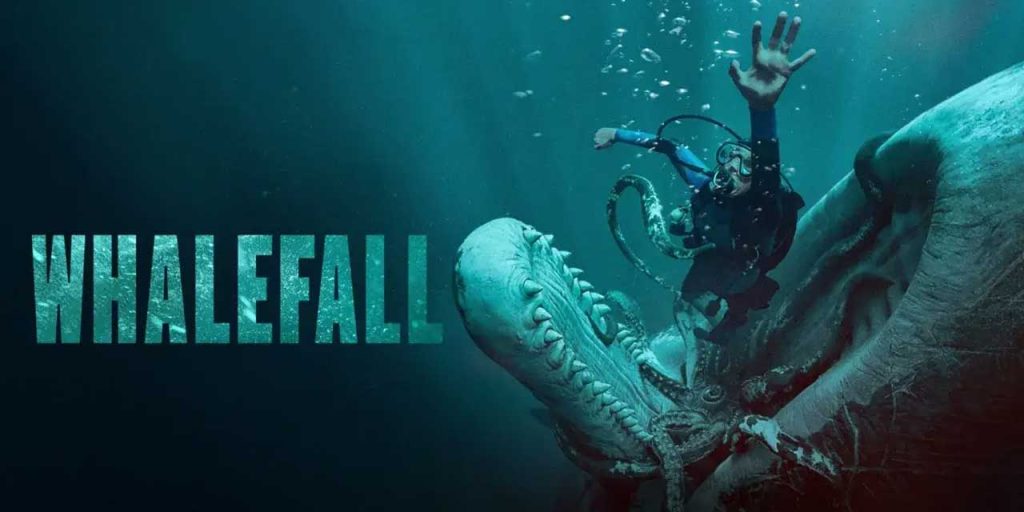
The film focuses on Jay Gardiner (Austin Abrams), who, following the suicide of his father, Mitt (Josh Brolin), goes diving off the coast of California in search of his remains. However, he soon finds himself in a desperate fight for survival when he’s swallowed whole by a sperm whale and trapped inside its stomach. From there, he must figure out a way to escape as his oxygen supply starts to deplete, and he is pushed to remember lessons his father taught him.
A stomach-churning survival thriller
As a survival thriller, Whalefall is an impressively visceral experience. Jay must contend with a swallowed squid, contracting stomach muscles, corrosive stomach acid and all manner of other biological hazards. The sound design, visual effects, practical effects and production design are superb, immersing the audience in an environment that is as claustrophobic as it is horrifying. From snapped bones to necrotic hands to burst eardrums, this is not a film for the faint of heart. It is an intense, often stomach-churning experience, and Abrams does an excellent job of grounding Jay’s increasingly desperate struggle for survival.
Grief beneath the surface
However, Whalefall is not content to be just a straightforward survival thriller. Beneath the stomach survival lies an extended allegory for grief, as Jay finds himself swallowed not only by a whale but also by the unresolved grief of his relationship with his father. Through memories and hallucinations brought on by nitrogen narcosis, Mitt becomes a recurring presence in Jay’s struggle to survive. Their relationship was fractured by a father who struggled to connect with his son, whose harshness and controlling nature left wounds that could not simply be healed by his death.
Brolin is deliberately unlikeable, and that is precisely the point. Jay is grieving a father he never truly understood, whose love was difficult to recognise beneath the damage he inflicted. The film’s most compelling emotional territory lies in this uncomfortable reality: grief is rarely straightforward, particularly when the person you have lost is also the person who hurt you. Sometimes, the hardest thing to mourn is the relationship you never got to have.
When the metaphor becomes too much
Unfortunately, Whalefall struggles to reconcile its competing ambitions. The technical filmmaking is remarkable, but the screenplay is messy, with its survival thriller and emotional allegory often working against one another. The whale-as-father metaphor is so heavy-handed (or should that be fat-finned?) that it occasionally threatens to undermine the very real emotional complexities the film is trying to explore. There is something rather dumbfounding about watching an already extraordinary survival scenario become increasingly burdened with symbolic significance.
Not everything needs to be elevated into a grand metaphor, especially when the premise already demands such an enormous suspension of disbelief. The film would have benefited from grounding its survival elements in greater realism rather than pushing them towards increasingly implausible extremes. The result is a film that is frequently compelling, occasionally moving and technically impressive, but never quite as profound as it seems to think it is.
There is an interesting story here about grief, trauma and the complicated legacy of a difficult parent. I just wish Whalefall trusted that story enough to let it breathe, rather than swallowing it whole.
REEL DIALOGUE: Jonah and the Mercy of God
The biblical account of Jonah is a story of God’s mercy, not only towards a disobedient prophet but also towards the people he would rather see destroyed than forgiven. When Jonah is swallowed by a great fish, he finds himself at the mercy of God, who gives him another opportunity to fulfil his task of proclaiming salvation. Yet even after Nineveh repents, Jonah struggles to accept that God’s compassion extends to his enemies.
There is an interesting parallel with Whalefall, as Jay finds himself swallowed by a whale while wrestling with the complicated grief of losing his father. But where Jonah’s story confronts our reluctance to extend mercy to others, Jay’s journey is about coming to terms with a father whose love was tangled up with control, harsh words and unresolved conflict.
Both stories explore what happens when we find ourselves in circumstances beyond our control and are forced to confront truths we would rather avoid. However, the Gospel hope of mercy extends beyond simply learning to live with our pasts. Christians worship a God who does not abandon us in our darkest moments but meets us with grace we could never earn.
In Jesus, we see that mercy most clearly. At the cross, God deals with the reality of sin and offers reconciliation to those who have turned away from Him. Unlike Jonah, who ran, Jesus was willingly swallowed up by the depths of Sheol to bring salvation to others.
Whalefall may be a story about surviving the belly of a whale, but the book of Jonah and the Gospel both remind us that even in the depths, we are never beyond the reach of God’s mercy.
“Salvation comes from the LORD.” — Jonah 2:9

Reel Dialogue has entered the world of YouVersion: Download the app, dive into the plans, and engage with the Bible in a fresh and exciting way.
Reel Dialogue has entered the world of YouVersion: Download the app, dive into the plans, and engage.

About Michael Walsh


More Films like this
View All