Verity
When the stories we tell become more persuasive than the truths we live


 14 Oct 2026
  Cliff Phlipiah
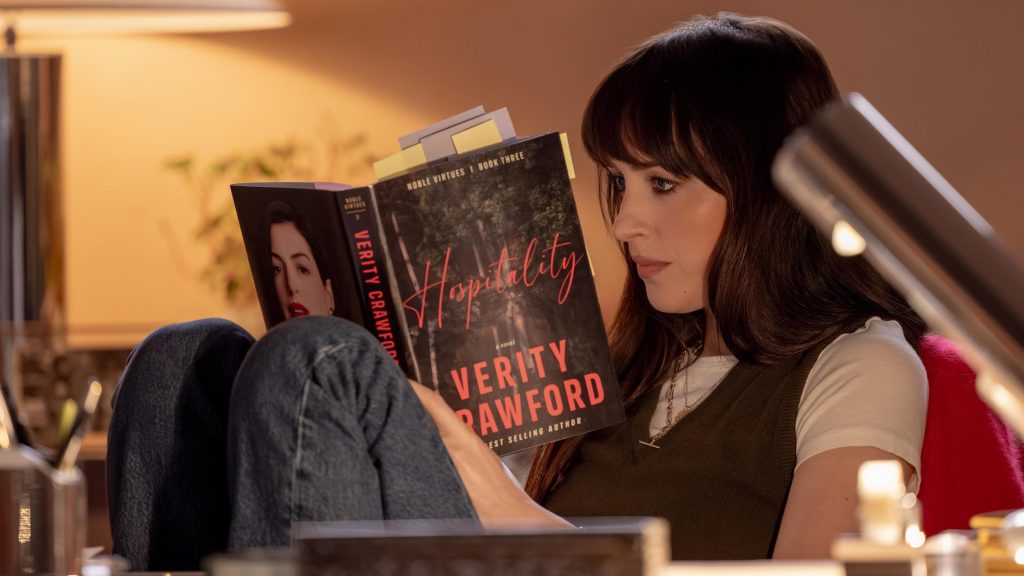
 Witnessing a horrific car crash is merely the prelude to a life-changing encounter for struggling crime novelist Lowen Ashleigh (Dakota Johnson). When a handsome stranger comes to her aid before an important publishing meeting, she is stunned to discover him at the same meeting. He is Jeremy Crawford (Josh Hartnett), husband of mega-bestselling crime author Verity Crawford (Anne Hathaway).
With Verity left apparently catatonic following a near-fatal accident, Lowen is offered the opportunity of a lifetime: to step into the bestselling author’s brilliant yet twisted literary world and complete her latest unfinished manuscript. Moving into the Crawford family home for the duration of the project, Lowen discovers Verity’s unpublished autobiography, So Be It. What initially appears to be an extraordinary professional opportunity soon becomes something considerably more disturbing. As the manuscript reveals unsettling details about the Crawford family’s tragic past, Lowen begins to question everything she has been told.
But is she merely an unsuspecting pawn in a sadistic game? And if so, who is pulling the strings?
When fiction becomes more convincing than reality
At its most intriguing, Verity explores the uneasy relationship between artistry and deception, questioning what happens when the stories we tell become more persuasive than the truths we live.
Directed by Michael Showalter and adapted from Colleen Hoover’s bestselling novel, the film uses the conventions of the domestic psychological thriller to examine obsession, grief and the perilous intimacy of reading another person’s private thoughts. Lowen’s appointment as ghostwriter to the incapacitated Verity draws her into a claustrophobic world steeped in tragedy.
The discovery of Verity’s disturbing memoir transforms the assignment into a psychological conflict, as Lowen struggles to reconcile the increasingly horrific revelations within its pages with the family she encounters in the Crawford household. What begins as a literary exercise gradually becomes an obsession with uncovering the truth. Yet the more Lowen discovers, the less certain she becomes about the people around her.
The film’s greatest strength lies in this uncertainty. A manuscript can be an honest confession, an imaginative exercise or a carefully constructed deception. The challenge is determining which interpretation should be believed, particularly when the author is apparently unable to explain herself. For a novelist accustomed to creating fictional worlds, Lowen finds herself trapped within a narrative she cannot control.
A household of secrets
The Crawford home becomes an increasingly unsettling environment as Lowen attempts to complete Verity’s manuscript. The family’s history is overshadowed by devastating loss, and the emotional consequences of that tragedy linger throughout the household. Jeremy appears to be a grieving husband and father struggling to maintain some semblance of normality. Yet his apparent vulnerability raises as many questions as it answers.
Lowen’s growing attraction to him further complicates her understanding of the family she has entered. As professional boundaries begin to dissolve, her emotional involvement threatens to compromise her judgement. The distinction between sympathy, desire and suspicion becomes increasingly difficult to maintain. Meanwhile, Verity remains a disturbing presence within the home.
Although apparently helpless, she seems to exert an extraordinary influence over everyone around her. Her written words continue to shape the family’s relationships, even when she cannot participate in them. This creates an atmosphere in which every gesture, silence and unexplained occurrence becomes potentially significant. The audience, like Lowen, must continually question whether appearances can be trusted.
Three performances and one disturbing mystery
Anne Hathaway provides the film’s most arresting presence, investing Verity with a tension between apparent helplessness and concealed cruelty. Much of the character’s unsettling power comes from the contrast between her physical vulnerability and the disturbing personality revealed through her writing. Hathaway effectively sustains that ambiguity, allowing Verity to remain both an object of sympathy and a possible source of terror.
Dakota Johnson adopts a more understated approach as Lowen, lending her gradual unraveling a compelling uncertainty. Rather than portraying a conventional thriller protagonist confidently piecing together a mystery, Johnson presents a woman whose professional curiosity becomes entangled with emotional vulnerability and personal desire. Her increasing uncertainty mirrors that of the audience.
Josh Hartnett’s measured performance suggests a grief-stricken man whose emotional opacity may conceal more than sorrow. Jeremy’s apparent devotion to his family is complicated by the secrets surrounding his marriage and the unsettling circumstances that have brought Lowen into his home. Together, the three performances create a psychological triangle in which trust becomes increasingly difficult to establish. Each character possesses a version of events. Each has reasons to conceal aspects of the truth. And each may be capable of manipulating the others.
The unsettling power of an ambiguous ending
One of the more fascinating aspects of Verity is its refusal to provide audiences with the comfortable certainty that often accompanies a conventional thriller. The film builds towards revelations that challenge our understanding of the Crawford family’s history, yet the ultimate question of what truly happened remains open to interpretation. This is both the attraction and the frustration of the story.
Who doesn’t love an ambiguous ending to a thriller?
For some viewers, the absence of a definitive explanation may feel unsatisfying. After investing so much attention in the mystery, there is a natural desire to know who has been telling the truth and who has been manipulating the circumstances. Yet the ambiguity is central to the film’s examination of storytelling.
Verity is a successful novelist, a woman whose livelihood depends upon constructing convincing narratives and manipulating the emotions of her readers. The possibility that her greatest work of fiction may exist beyond the pages of her published novels becomes a particularly disturbing proposition. But the film also challenges the assumption that the most shocking account must necessarily be the most truthful.Ultimately, the audience is left to consider several competing interpretations, each with troubling implications for the characters involved.
Perhaps that uncertainty is the point.
The bottom line
Verity is a disturbing psychological thriller that examines the fragile boundaries between truth, fiction, obsession and manipulation.
Michael Showalter draws upon the unsettling premise of Colleen Hoover’s novel to create a story in which the act of reading becomes an increasingly dangerous exercise.
Hathaway delivers the film’s most compelling performance, while Johnson and Hartnett contribute to the uncertainty surrounding a household fractured by grief and suspicion.
The film’s greatest achievement is not simply the revelations it offers, but the questions those revelations leave behind.
In a world where every character may be an unreliable narrator, discovering the truth becomes considerably more complicated than identifying the most convincing story.
And when the final page is turned, the audience must decide for itself which version of events deserves to be believed.
REEL DIALOGUE: Can we always trust the stories people tell us?
(Submitted by Russ Matthews – Reel Dialogue)
One of the most unsettling questions raised by Verity is whether we can ever be entirely certain that someone is telling us the truth. Throughout the film, characters construct narratives about their lives, relationships and experiences. Some accounts appear convincing, while others are deeply disturbing. Yet the difficulty lies in determining whether a compelling story is necessarily an accurate one.
Human beings have an extraordinary ability to shape the way others perceive us. We can emphasise certain details, conceal uncomfortable realities and present events in ways that support our preferred interpretation. Sometimes this deception is deliberate. At other times, we may become so invested in our own version of events that we struggle to recognise the truth ourselves. The Bible acknowledges this uncomfortable reality about the human heart.
Jeremiah writes:
“The heart is deceitful above all things, and desperately sick; who can understand it?” — Jeremiah 17:9 (ESV)
This is a confronting assessment of human nature. We are not always reliable interpreters of our own motives, let alone the motives of others.
In Verity, the characters’ accounts of their experiences become increasingly difficult to reconcile. The audience must decide whom to believe, even when the available evidence appears contradictory. Yet Christianity does not leave us with the conclusion that truth is ultimately unknowable.
Jesus declares:
“I am the way, and the truth, and the life.” — John 14:6 (ESV)
For Christians, truth is not merely the most persuasive interpretation of events or the story that best suits our circumstances. Truth is ultimately grounded in the character of God, who knows what is hidden and cannot be deceived.
The Apostle Paul encourages believers to reject falsehood and pursue honesty in their relationships:
“Therefore, having put away falsehood, let each one of you speak the truth with his neighbour, for we are members one of another.” — Ephesians 4:25 (ESV)
This challenges us to consider not only whether we can trust the stories other people tell, but whether we are willing to be truthful about ourselves. Are we prepared to acknowledge uncomfortable realities, even when doing so threatens the image we wish to present? And are we willing to examine our assumptions before accepting the most convincing explanation?
Verity reminds us that a well-told story can be extraordinarily powerful.
But the most persuasive story is not always the truth.
Perhaps the more important question is whether we genuinely want to discover the truth, particularly when it challenges everything we have chosen to believe.

Reel Dialogue has entered the world of YouVersion: Download the app, dive into the plans, and engage with the Bible in a fresh and exciting way.
Reel Dialogue has entered the world of YouVersion: Download the app, dive into the plans, and engage.

About Cliff Phlipiah


More Films like this
View All 500 MIles
Sometimes the longest journey isn't measured in miles, but in the distance between people who once loved one another