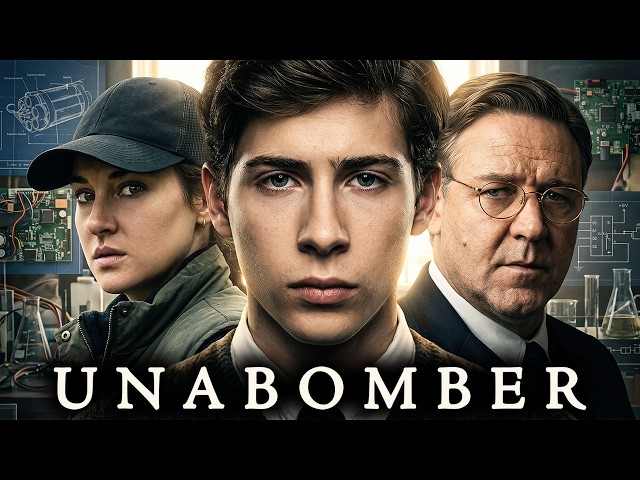
Unabomber
Before asking how they caught the Unabomber, this film wants to know how Ted Kaczynski became him.


 27 Sep 2026
  Russ Matthews
 Most films about notorious criminals focus on the chase. Who did it? Where are they hiding? How will investigators finally put the pieces together?
Unabomber takes a different path.
Director Janus Metz (Andor) divides the story between the nationwide hunt for Ted Kaczynski and the experiences that helped shape the brilliant young mathematician who would eventually retreat from society and begin a bombing campaign that killed three people and injured 23 others. Yet despite Shailene Woodley and Alexander Ludwig being involved in the investigative side of the story, this is far less interested in being a conventional police thriller than in exploring the making of the man behind the crimes.
That makes Unabomber a fascinating, disturbing excursion into the human mind.
The making rather than the manhunt
Jacob Tremblay plays the young Ted Kaczynski, a gifted 16-year-old who enters Harvard and eventually becomes involved in psychological experiments overseen by Professor Henry Murray (Russell Crowe). This is where the film finds its most unsettling material.
Rather than concentrating primarily on the bombs themselves, Unabomber spends considerable time examining Kaczynski’s formative years, increasing isolation and involvement in Murray’s controversial psychological studies. Those experiments were real. Kaczynski participated in Murray’s research for several years, where subjects had their deeply held beliefs aggressively challenged while their physiological responses were monitored. The research would not meet modern ethical standards. However, there is no established causal connection between those experiments and Kaczynski’s later crimes, something worth remembering when considering the film’s interpretation of events.
Still, the questions raised are uncomfortable. How much do we really understand about the human mind? What responsibility accompanies the ability to probe another person’s deepest beliefs, fears and vulnerabilities? And what can happen when academic ambition becomes more important than the individual sitting on the other side of the experiment? The film doesn’t need to provide definitive answers for those questions to remain disturbing.
Tremblay and Crowe provide the spark
Despite the impressive cast, Unabomber belongs primarily to Jacob Tremblay. The young actor carries much of the dramatic weight as he portrays Kaczynski’s gradual descent from extraordinarily intelligent student into an increasingly isolated and troubled man. Tremblay avoids turning him into a cinematic monster from the beginning. Instead, we watch changes occurring incrementally, which makes knowing where this story ultimately leads even more unsettling.
Russell Crowe provides the disturbing rock around which much of this transformation occurs. His Henry Murray has the confidence and intellectual authority of someone convinced that pushing psychological boundaries is justified by what might be discovered on the other side. Crowe continues to prove how effective he can be when allowed to inhabit characters who make an audience uncomfortable.
Together, Tremblay and Crowe provide the film with its strongest scenes.
Netflix describes the story as crosscutting between “the making of the Unabomber and the capture of the Unabomber,” but the first of those proves considerably more compelling. Shailene Woodley plays FBI agent Joanne Miller, while Alexander Ludwig also features prominently on the investigative side. Interestingly, Miller is a fictional character created for the film rather than one of the actual agents who led the historical investigation. Their pursuit provides the necessary framework, but these sequences feel considerably more familiar. After years of police procedurals and serial-killer dramas, there is little here that audiences haven’t encountered before.
The real tension lies at Harvard.
How much can we understand the human mind?
Kaczynski eventually eluded authorities for 17 years while conducting a bombing campaign across the United States. His manifesto ultimately contributed to his capture after his brother recognised similarities between its language and Ted’s previous writings. Yet Unabomber seems less fascinated with how investigators eventually found him than with the uncomfortable possibility that there were warning signs long before anyone knew where the story would lead.
This is where the film works best.
It would be irresponsible to suggest that Henry Murray’s experiments simply created the Unabomber. Human beings are considerably more complicated than that, and Kaczynski remained responsible for the horrific choices he subsequently made. Still, the film offers a sobering warning about how little we understand the human mind and the consequences that can follow when people believe they can manipulate it without considering the person attached to it.Tremblay makes that journey compelling, while Crowe provides the disturbing presence necessary to make these questions linger after the credits.
The investigative material may be comparatively standard, but the psychological story underneath it proves considerably harder to shake.
The bottom line
Unabomber could easily have been another true-crime thriller about investigators hunting an elusive killer. Instead, its more interesting question is how an intellectually gifted teenager became one of America’s most notorious domestic terrorists.
Jacob Tremblay delivers the film’s standout performance, while Russell Crowe is suitably unsettling as Henry Murray. Woodley and Ludwig provide the investigative counterbalance, even if their side of the story never generates the same fascination or tension. The film cannot definitively explain Ted Kaczynski—and perhaps that is precisely the point. The human mind is extraordinarily complicated and sometimes frighteningly difficult to understand.
REEL DIALOGUE: Can God know the human heart? Better yet, can he fix it when it’s broken?
Psychology attempts to understand the human mind.
Henry Murray wanted to probe it. The FBI wanted to understand it. Audiences watching Unabomber inevitably find themselves trying to understand it too. What happened inside Ted Kaczynski that allowed an extraordinarily gifted young man to justify taking innocent lives?
The Bible asks similarly uncomfortable questions about what happens inside us, although it uses another word: the heart.
Jeremiah writes: “The heart is deceitful above all things, and desperately sick; who can understand it?” — Jeremiah 17:9
That question could sit comfortably over much of Unabomber.
Who can understand it?
Yet the following verse provides an answer: “I the LORD search the heart and test the mind.” — Jeremiah 17:10
Christianity does not teach that people become evil simply because someone damaged them. Neither does it deny the profound impact that trauma, abuse and the actions of others can have upon us. Instead, Scripture presents a more challenging picture. Our hearts can be wounded by others, but they are also capable of producing their own destructive desires and choices. Which leads to an even bigger question.
If the human heart is broken, can it actually be repaired?
The biblical answer is not merely better education, stronger willpower or deeper psychological understanding. God promises something more radical:
“And I will give you a new heart, and a new spirit I will put within you.” — Ezekiel 36:26
That doesn’t remove personal responsibility, nor does it suggest that psychological care has no value. It simply recognises that humanity’s deepest problem cannot ultimately be solved by understanding the mind alone.
Unabomber shows us people desperately trying to understand what was happening inside Ted Kaczynski. Christianity asks us to consider whether the One who created the human heart might not only understand what is happening within us, but also be capable of changing it.
If God truly knows the darkest corners of the human heart, are we willing to trust him with our own?

Reel Dialogue has entered the world of YouVersion: Download the app, dive into the plans, and engage with the Bible in a fresh and exciting way.
Reel Dialogue has entered the world of YouVersion: Download the app, dive into the plans, and engage.


