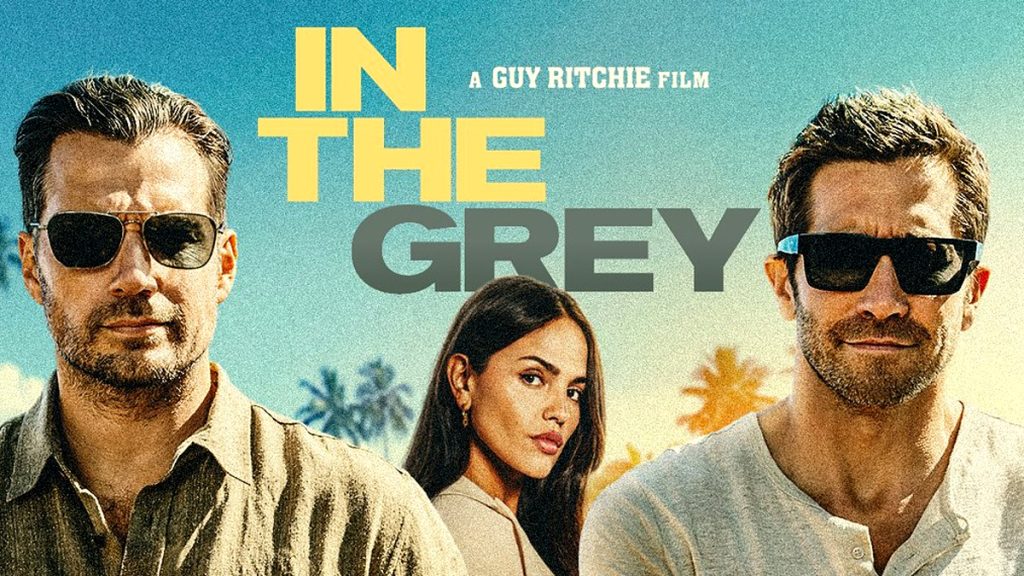
In the Grey
Guy Ritchie’s return to form


 18 May 2026
  Michael Walsh
 Few filmmakers possess a cinematic signature as instantly recognisable as Guy Ritchie. From the kinetic swagger of Lock, Stock and Two Smoking Barrels and Snatch through to recent crowd-pleasers like The Gentlemen and the more critically-acclaimed The Covenant, Ritchie has built a career out of stylish criminals, international espionage, morally compromised operators and dialogue that crackles with effortless cool.
While some of his recent outings have leaned too heavily on style over substance, In the Grey feels like a recalibration and a reminder of how entertaining Ritchie can be when his visual confidence is paired with disciplined momentum and a charismatic ensemble willing to fully commit to the ride.
The film also marks another notable step for Black Bear Pictures as the company continues establishing itself as a distributor associated with ambitious mid-budget adult thrillers. In an era where many slick action dramas are quietly funnelled straight to streaming, it is refreshing to see a film like In the Grey receive a theatrical push, even if the marketing campaign felt surprisingly subdued. Black Bear’s eye for quality projects remains impressive but the challenge now is ensuring audiences actually know these films exist before they disappear into the algorithmic abyss.
The ruthless Salazar (Carlos Bardem) rules an expansive empire of illegal and legal international assets, partly funded by a $1 billion loan from asset management firm Spencer Goldstein. Desperate to recoup their owed debts, fund manager Bobby (Rosamund Pike) reluctantly hires the poised and calculating Rachel (Eiza González) a legal fixer who is able to recover seemingly unrecoverable debts. Her team works both the legal asset seizure angle whilst also operating in the moral greys to apply direct pressure via a skilled crew of elite specialists led by Sid (Henry Cavill) and Bronco (Jake Gyllenhaal) who navigate a dangerous underworld where legality and morality rarely align. As alliances fracture and the pressure mounts, the team must outmanoeuvre Salazar before mounting debts – financial, moral and personal – finally come due.
In the Grey succeeds because it understands precisely what kind of film it wants to be. This is not an introspective espionage drama interested in peeling back emotional trauma layer by layer. It is a slick, sharply tailored globetrotting thriller fuelled by charisma, momentum and escalating pressure. Thankfully, Ritchie directs it with enough confidence and restraint to keep the engine humming for almost its entire runtime.
The cast is undeniably the film’s greatest strength. González brings poise, elegance and controlled intensity to Rachel, grounding the film amidst its constant movement and chaos. Cavill and Gyllenhaal meanwhile appear to be having enormous fun, bouncing off each other with playful bravado that gives the film much of its personality. Their chemistry sells the camaraderie of an elite covert unit that has survived countless dangerous missions together. Supporting players Baker (Kojo Attah), Gucci (Jason Wong), Moreno (Christian Ochoa Lavernia) and Dunne (Emmett J. Scanlon) all contribute to the highly trained international operation, slinging the jargon to help make the tactics and globe-spanning espionage feel convincing.
Visually, the production impresses throughout. Contemporary costuming, luxurious locations and explosive action sequences create a polished aesthetic that perfectly complements Ritchie’s trademark style. The action itself is cleanly staged and refreshingly coherent, prioritising tension and momentum over chaotic editing. The finale especially delivers a cathartic payoff as the pressure cooker narrative finally detonates.
That said, the film’s weaknesses are difficult to ignore. Characterisation remains frustratingly thin. Beyond surface-level charm and competence, no members of the team are given meaningful emotional depth or backstory. While audiences do not necessarily enter a Guy Ritchie ensemble expecting profound character studies, stronger emotional foundations would have elevated several sacrificial or dramatic moments that ultimately pass too quickly to fully resonate. The first act also leans heavily on exposition. Characters frequently explain the plot rather than allowing the audience to discover information naturally, creating a slightly overstuffed opening stretch before the film eventually settles into a far more engaging rhythm driven by action and suspense.
Still, despite these shortcomings, In the Grey remains enormously entertaining. It is sleek, propulsive and consistently engaging, delivering a stylish return to form from a filmmaker who still knows how to make criminality look irresistibly cool while keeping audiences thoroughly invested in the chase.
Reel Dialogue: Who pays our eternal debts?
One of the central ideas running through In the Grey is the belief that nobody escapes their debts forever. Every choice carries consequences, every act of greed creates a cost and every compromise eventually demands repayment. The film’s operatives may live in the moral “grey,” but even there, the story insists that corruption and selfish ambition inevitably collapse under the weight of accumulated wrongdoing. Scripture echoes this truth repeatedly. Greed promises power, security and control, yet it ultimately enslaves people to endless hunger for more. Throughout the film, characters attempt to manipulate others for profit or survival, only to discover that debts, moral or otherwise, always come calling.
The Christian story offers both warning and hope. Humanity carries a debt created by sin that cannot simply be ignored or outmanoeuvred. Yet where the world demands payment, Jesus steps forward to pay it on our behalf through His death and resurrection. The Gospel declares that forgiveness is not earned through cleverness or power, but received through grace.
Matthew 6:12 “And forgive us our debts, as we also have forgiven our debtors.”

Reel Dialogue has entered the world of YouVersion: Download the app, dive into the plans, and engage with the Bible in a fresh and exciting way.
Reel Dialogue has entered the world of YouVersion: Download the app, dive into the plans, and engage.

About Michael Walsh


More Films like this
View All 