Lifeboat
Love, Sacrifice and Freedom


 10 Sep 2026
  Russ Matthews
 Over fifty years after the fall of South Vietnam, many of the stories surrounding the conflict have faded from public memory. History books often reduce the Vietnam War to political debates and military strategies, but LifeBoat, directed by Australian filmmaker Geoff Young, reminds audiences that behind every historical event are real people whose lives were forever changed.

This documentary follows the journey of Bang Pham and his family, tracing their experiences during the Vietnam War, the persecution they endured under the Communist regime that followed, their perilous escape by boat, and their eventual resettlement in Australia. What emerges is not merely a refugee story, but a deeply personal account of love, sacrifice, faith, and freedom.
As someone who arrived in Australia as a Vietnamese refugee in 1981, Bang’s desire to preserve his family’s story gives the documentary its emotional centre. He was only a child when his parents made the life-altering decision to leave everything behind in search of freedom. Through interviews and family recollections, audiences are invited into moments of courage, fear, uncertainty, and hope that shaped not only one family but a generation of Vietnamese refugees.
One of the documentary’s greatest strengths is its careful handling of the historical timeline. For many viewers, the events surrounding the final years of the Vietnam War and its aftermath may be unfamiliar. LifeBoat effectively contextualises these events while never losing sight of the personal experiences at its heart. The memories shared by Bang’s parents provide an authenticity that transforms historical facts into a compelling human drama.
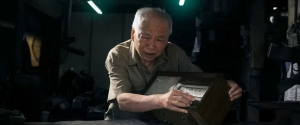
Particularly moving are the accounts of the family’s escape by boat. These scenes highlight the unimaginable risks undertaken by thousands of Vietnamese refugees who chose the uncertainty of the sea over the certainty of oppression. The documentary captures the desperation and determination that drove so many families to seek freedom beyond the borders of their homeland.
Complementing these stories is a rich collection of archival footage that vividly illustrates the conflict and its consequences. The historical images strengthen the narrative and serve as powerful reminders of the cost of war and the fragility of freedom. Some wartime scenes are graphic and may be disturbing for sensitive viewers, but they are presented with purpose and restraint.
Throughout the film, themes of family and faith emerge as guiding forces. The Pham family’s story demonstrates how love and sacrifice can sustain people through extraordinary hardship. Equally significant is the spiritual thread woven throughout the documentary. The film suggests that behind the events of history, God was at work—guiding a family from persecution toward freedom and, ultimately, drawing individuals toward a deeper spiritual freedom found in Christ.
Where LifeBoat does struggle to remain afloat is in its attempt to connect Communist oppression in Vietnam with contemporary concerns surrounding artificial intelligence, social media, and modern Australian society. While these comparisons are understandable as conversation starters, they feel underdeveloped and disconnected from the documentary’s otherwise focused narrative. The historical account is compelling enough on its own and requires little contemporary parallel to communicate its significance. These moments risk distracting from the emotional power established elsewhere in the film.
Even so, LifeBoat remains a captivating documentary. It preserves stories that might otherwise be lost and invites audiences to consider the true value of freedom. More than a history lesson, it is a testimony to perseverance, faith, and the enduring resilience of the human spirit.
Reel Dialogue: Our Response to the Immigrant
One of the most compelling layers of LifeBoat is its portrayal of the immigrant journey. While political discussions often dominate conversations about migration, this documentary reminds viewers that immigration is ultimately about people—families seeking safety, opportunity, and hope for the future.
Interestingly, the story of people leaving one land in search of another sits at the very heart of the biblical narrative. Throughout Scripture, God consistently shows compassion for the poor, the afflicted, and the displaced. From Abraham leaving his homeland, to Israel’s exile, to Mary and Joseph fleeing with the infant Jesus, the experience of being a stranger in a foreign land is woven throughout God’s story.
There have been countless books, debates, and films exploring immigration and refugee experiences. Yet Jesus approached people differently than society often does. He explained that he came “not for the healthy, but for the sick” (Matthew 9:12). Similarly, the apostle Paul reminds believers that God’s family is often made up of those whom society overlooks: “not many wise, not many powerful, not many of noble birth” (1 Corinthians 1:26-31).
Like their God who loves them, followers of Christ are called to see people before politics. They are challenged to recognise the dignity of those who arrive with little, carrying stories of loss, courage, and hope. LifeBoat provides an opportunity to reflect on how we respond to those seeking a new beginning and whether our communities reflect God’s heart for the outsider, the vulnerable, and the stranger.

Reel Dialogue has entered the world of YouVersion: Download the app, dive into the plans, and engage with the Bible in a fresh and exciting way.
Reel Dialogue has entered the world of YouVersion: Download the app, dive into the plans, and engage.

About Russ Matthews


More Films like this
View All 500 MIles
Sometimes the longest journey isn't measured in miles, but in the distance between people who once loved one another