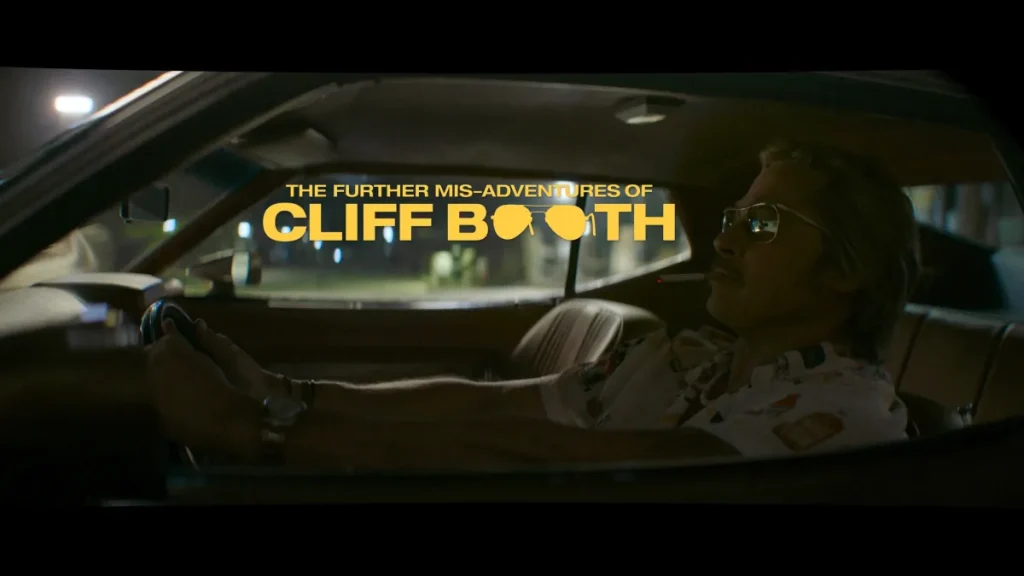
The Further Mis-Adventures of Cliff Booth
Once upon another time in Hollywood...


 26 Nov 2026
 Russ Matthews
There are certain cinematic combinations that are difficult for film enthusiasts to resist. Take one of my favourite directors, David Fincher, provide him with a screenplay from Quentin Tarantino and bring back one of the most memorable characters from the latter's cinematic universe. Brad Pitt's Academy Award-winning performance as Cliff Booth in Once Upon a Time... in Hollywood was one of the highlights of the 2019 production, and the prospect of revisiting the enigmatic stuntman under Fincher's direction was an enticing proposition.
Having collaborated with Pitt on Se7en, Fight Club and The Curious Case of Benjamin Button, Fincher has managed to draw some of the actor’s most memorable performances out of him. Yet, bringing together the meticulous nature of Fincher’s filmmaking and the wonderfully unpredictable imagination of Tarantino could have taken this production in any number of directions. Both filmmakers have proven adept at exploring the darker aspects of humanity, but their approaches to storytelling are distinctly different. Would their cinematic sensibilities complement one another or would one creative personality ultimately overshadow the other?
Eight years have passed since the events of the original film, and Hollywood has undergone considerable changes by the summer of 1977. Former stuntman Cliff Booth (Brad Pitt) has established himself as a fixer for those operating within the entertainment industry. His reputation for resolving complicated situations attracts the attention of talent agent Karen Crosby (Elizabeth Debicki), drawing him further into the murkier aspects of the business. In a town built on illusion, Cliff’s particular set of skills continue to prove valuable to those with something to hide. Yet, this latest chapter also affords audiences an opportunity to discover more about the man behind the sunglasses, from his military history to his years as a stuntman in Tinseltown.
What becomes apparent throughout this adventure is that this is very much a Quentin Tarantino film that has been given the David Fincher touch. The director manages to retain the cheekiness, intensity and brutality of the original production without the underlying tension afforded by the historical significance of the Manson murders. Instead, the screenplay relies considerably more on Pitt’s ability to carry the film and the audience’s fascination with a character whose past is arguably as intriguing as his present.
Where Tarantino’s filmmaking style can be wonderfully abrupt, Fincher brings a smoothness to the proceedings that gives this production a slicker feel. The latter’s attention to detail and visual precision complement the former’s distinctive dialogue, dark humour and propensity for sudden bursts of violence. The result is an interesting marriage of two cinematic styles that manages to retain the personality of both filmmakers without becoming a mere imitation of either.
As charismatic as Pitt continues to be in this role, Elizabeth Debicki manages to take ownership of virtually every scene she inhabits. The Australian actress brings a level of sophistication and depth to the production that it desperately needs. Her performance provides a fascinating counterbalance to Booth, who proves to be a considerably seedier character than audiences may remember, willing to do whatever is necessary to survive in the less glamorous corners of Hollywood.
Yet, surprisingly, much of the film’s heart comes from Peter Weller as Gus Booth. His contribution allows audiences to see beyond Cliff’s seemingly impenetrable exterior. For all the character’s effortlessly cool demeanour and legendary exploits, Weller helps to humanise a man who could otherwise remain little more than a cinematic caricature. These moments provide some welcome emotional depth amongst the violence, humour and Hollywood nostalgia.
Where the production may lack in originality, Tarantino’s screenplay manages to find another gear for a character who has seemingly lived more lives than he deserves. Pitt comfortably slips back into the role that earned him an Oscar, although the greater exposure to Booth’s questionable morality may leave audiences reconsidering their affection for the character. There is something fascinating about a man who spends his life resolving other people’s problems while remaining seemingly incapable of addressing his own.
Like most productions associated with Tarantino and Fincher, the extreme elements of mature content will make this film inaccessible to many viewers. The language, violence and darker aspects of Hollywood life are not for everyone, and the involvement of these filmmakers should provide ample warning of what audiences can expect.
Nevertheless, for fans of these legendary directors and Pitt himself, The Further Mis-Adventures of Cliff Booth offers an entertaining return to a wonderfully stylised era of Hollywood. It may lack the originality and historical tension of its predecessor, but there is considerable enjoyment to be found in watching Fincher take Tarantino’s creation out for another spin around Tinseltown.
REEL DIALOGUE: Who Fixes the Fixer?
One of the more intriguing aspects of Cliff Booth is his moral ambiguity. Despite his considerable charm, loyalty and ability to navigate dangerous situations, he is a character whose methods frequently challenge conventional notions of right and wrong.
Cinema has long had a fascination with the antihero. These are individuals who operate outside the boundaries of accepted morality, yet somehow manage to earn the affection and admiration of audiences. We find ourselves cheering for characters whose actions we would rarely endorse in our everyday lives.
Why are we so drawn to these individuals? Is it their independence, their willingness to confront corruption or the satisfaction of seeing someone dispense justice without the restrictions of established authority?
Interestingly, the more we discover about Cliff Booth, the more apparent it becomes that his ability to fix other people’s problems does not necessarily mean he has the capacity to resolve his own. Beneath the confidence, resourcefulness and seemingly effortless charm is a deeply flawed human being.
The Bible offers an interesting perspective on our desire to determine right and wrong for ourselves.
There is a way that appears to be right, but in the end it leads to death. — Proverbs 14:12
The challenge is recognising that our ability to resolve a problem does not necessarily justify the means by which we achieve the desired outcome. Even when our intentions appear admirable, our understanding of justice can be compromised by our own moral limitations.
This is where the Christian understanding of grace becomes particularly relevant. Scripture reminds us that we have all sinned and fall short of the glory of God (Romans 3:23). Regardless of our abilities, resourcefulness or reputation, none of us possesses the capacity to resolve our greatest problem independently of God’s grace. Through Jesus Christ, we are offered something far more significant than a temporary solution to our circumstances: forgiveness, reconciliation and redemption.
Cliff Booth may be the man Hollywood calls when it needs someone to fix its problems, but who fixes the fixer?
Perhaps that is a question worth asking of ourselves, too.
Questions worth discussing:
- Does a desirable outcome justify questionable methods? (Romans 3:8)
- Who ultimately determines what is right and wrong? (Proverbs 21:2)
- Why are we incapable of resolving our greatest problem without God’s grace? (Ephesians 2:8–9)

Reel Dialogue has entered the world of YouVersion: Download the app, dive into the plans, and engage with the Bible in a fresh and exciting way.
Reel Dialogue has entered the world of YouVersion: Download the app, dive into the plans, and engage.


