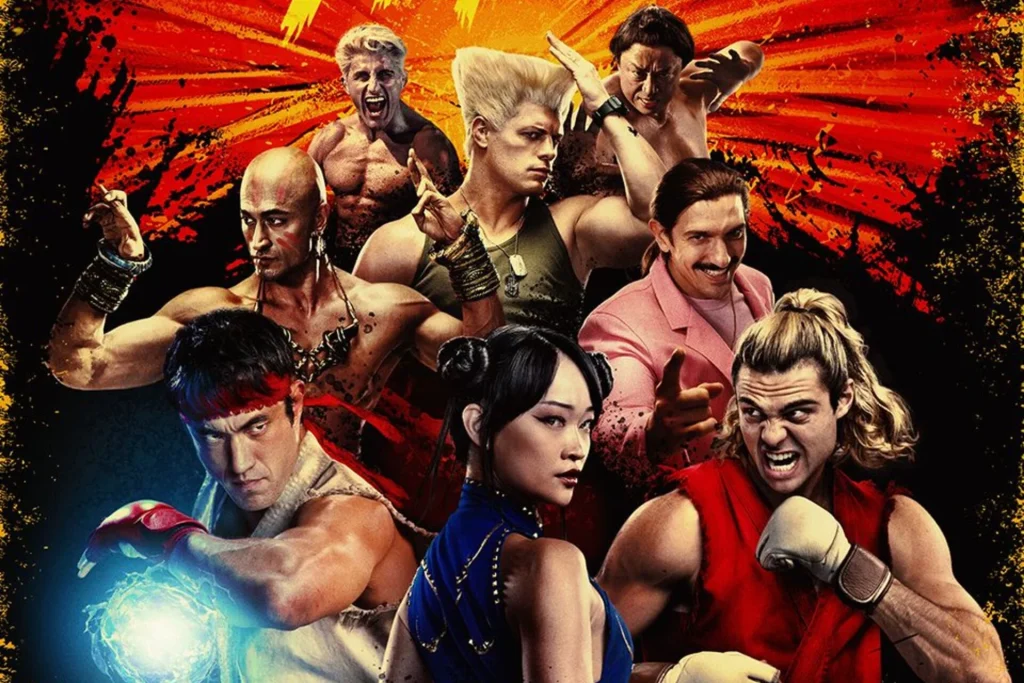
Street Fighter
The nostalgia packs a punch, but the story suffers a knockout


 15 Oct 2026
  Juliana Purnell
 The flagship series from Capcom Games, Street Fighter is one of the most famous video game franchises in the world. While the original game featured only two playable characters (Ryu and Ken), it was the second entry, Street Fighter II, which consisted of a line-up of eight combatants from varying martial arts disciplines, that ended up becoming the template for the one-on-one fighting genre as we know it today.
Debuting in 1987, but taking the world by storm with its sequel in 1991, the arcade game, alongside its rival franchise, Mortal Kombat, is credited as being one of the inspirations for the creation of mixed martial arts (MMA) combat sports, with the first Ultimate Fighting Championship (UFC) kicking off in 1993. Almost four decades later, the franchise consists of an extensive roster of characters spanning numerous games. For the 2026 film, the majority of the screen time is dedicated to the founding duo, Ryu and Ken. As boys, they came from wildly different backgrounds but were raised under the same martial arts teacher, Master Gouken, with the two eventually forming a deep, brother-like friendship.
In the movie, when Ryu wins the very first World Warrior Tournament, he unlocks a dark power within himself and subsequently disappears from public life, much to the confusion and grief of Ken. Six years later, with the location of the world’s best fighter still a mystery, various figures with different motivations decide to lure Ryu out of hiding by creating a second tournament. Their main reason is to harness and exploit his evil fighting power, which Ryu is desperately trying to keep at bay.
A nostalgic return to the arcade
The film has a lot of fun paying homage to its roots. With the majority of the action taking place in 1993, the movie parodies the VHS aesthetic and fervently embraces every cringe-worthy fashion piece and karaoke choice from the era. It’s bold with its production design, with the style being one of the most consistent elements of the film. When it’s not 1993, the film switches to dynamically animated flashback sequences, giving a solid nod to fans of the anime and cartoon series.
The cast is diverse in more ways than one. Just like its selection of characters, martial artists from various disciplines have been gathered, with some from the MMA and UFC world seemingly chosen more for their fighting capabilities than their acting skills. Noah Centineo (Ken Masters), Callina Liang (Chun-Li) and David Dastmalchian (M. Bison) carry most of the film, though it’s clear that every performer is having a blast in their role. The fight choreography is sleek and refined, with the camera, for the most part, keeping up with the geography of each scene. Fans will find it a pleasure to see most of the characters executing their signature moves at some point.
When the story loses the fight
Yet this is where the praise must end. The film starts strong when the focus is solely on the drama between Ryu and Ken, but once the subplot concerning Chun-Li’s alliance begins, along with the introduction of a second villainous motivation and sloppily handled backstories of other entrants in the tournament, the story loses its momentum. Like a spinning top, once it begins to wobble, it’s unable to right itself until it chaotically spins out of control. So too does the ‘plot’ of 2026’s Street Fighter.
It’s difficult to pinpoint where the problems begin and end. Was it always a matter of the script not being polished enough to handle the intricate layering of multiple character arcs, or was the movie butchered in the editing room? The film has enough story to fill a miniseries, yet here it feels stripped back to its bare bones to fit into a neat two-hour runtime.
It’s staggering how it loses focus on its dual protagonists but also never dedicates enough time to establishing any of the other characters, while simultaneously fumbling its coverage of the main event: the tournament. Everything happens at a rapid pace on screen, though nothing seems to happen at all. The pace lurches forward, leaving viewers behind and bewildered by certain developments.
It’s clear there are moments intended to hit with a certain amount of pathos, yet those emotions are unable to occur since the situation was only established in the space of two sentences of dialogue within the last thirty seconds of screen time. It gets to the stage where even the most light-hearted jokes fail to land, as there’s no breathing space, with every clip feeling like it has been edited and cut back within a microsecond of its life. In short, the story becomes incoherent to the point where it impacts the film’s enjoyability, even though it is so desperately wanting to be liked.
It ends up being a poor example of the tournament-style subgenre, and even worse, the film pales in comparison to its franchise and cinematic competitor. Mortal Kombat II, which was released earlier this year, is undeniably the winner in this match-up.
Fatality!
What should parents know?
Despite its narrative surrounding a collection of eclectic fighters, Street Fighter is surprisingly not gory, with most of the action feeling cartoonish in spirit. The most brutal duels are relegated to the film’s animated portions. There are some confronting and scary moves for younger viewers, such as one character having the ability to reach in and squeeze their opponent’s heart until they dissolve (all done with heavy, stylistic CGI rather than anything ‘realistic’).
If anything, the movie has more issues with its handling of its female characters, with multiple offhand sexual comments and costumes that sexualise the female form.
REEL DIALOGUE: Is there a benefit in keeping evil at bay?
If there is one semi-coherent storyline in Street Fighter, then it’s Ryu’s constant struggle with his inner demon. Similar to the dark side of the Force in Star Wars, if Ryu gives in to temptation and utilises this mighty yet evil power, he risks becoming lost to its rage and murderous intent.
Recognising the danger, Ryu spends most of the film avoiding all temptation, though situations surrounding envy and pride prove to be stumbling blocks. One of the film’s villains, Akuma, operates as the Satan equivalent of the narrative, goading and tempting Ryu into failing, hoping he succumbs to his primitive urges and departs from the teachings of his master and father figure. In some ways, what Akuma offers Ryu is reminiscent of how Satan tempted Jesus, although Ryu is certainly no Christ figure.
In both Matthew 4:1–11 and Luke 4:1–13, Jesus is tempted three times to misuse His divine powers and disobey the Father in ways that would be simple yet would orchestrate a different pathway, resulting in the victory of Satan.
Being Christ, He successfully rebukes the notion each time, even though it ultimately means His commitment to being crucified. For most of the film, Ryu is also dedicated to trying to find another way to face his problems, choosing the harder path, although the movie jokes that he’s rather pitiful at his alternative lifestyle.
The story’s messaging is sacrificed under the narrative rule of Chekhov’s Gun, where Ryu must fail in order to fulfil certain audience expectations. Thankfully, Ryu, just like followers of Christ, has an external force willing to restore him after his fall. Though not intended, the film unintentionally grapples with an even deeper question:
Is avoiding temptation the same thing as overcoming it?
The Bible is clear that sin is sin and must be avoided at all costs, though it does offer different ways in which that can occur, whether through fleeing or resisting temptation, finding others to hold one accountable, or reaching a point where the temptation no longer exists.
Like in the film, there might be situations where sin seems like the only valid response, but it’s clear it’s never without consequence, either in this world or the next. Finding that pathway is what defines the Christian walk. Christians aren’t promised freedom from temptation, but they are given ways to resist it, people to support them and grace when they fail.

Reel Dialogue has entered the world of YouVersion: Download the app, dive into the plans, and engage with the Bible in a fresh and exciting way.
Reel Dialogue has entered the world of YouVersion: Download the app, dive into the plans, and engage.