The Social Reckoning
Fighting the forces behind Facebook


 8 Oct 2026
  Michael Walsh
 In 2004, Mark Zuckerberg created Facebook. Ever since, it has been the cause of controversy and conflict whilst also seeking to foster social connection and community. In 2010, the creation of Facebook was chronicled by screenwriter Aaron Sorkin and director David Fincher in the film The Social Network. Now, 16 years later, Sorkin has returned to both pen and direct a spiritual successor with a new cast and a story focused less on the impact Facebook had on those who built it, and more on the impact those who built it have had on the 3.07 billion monthly active users and those who know them.
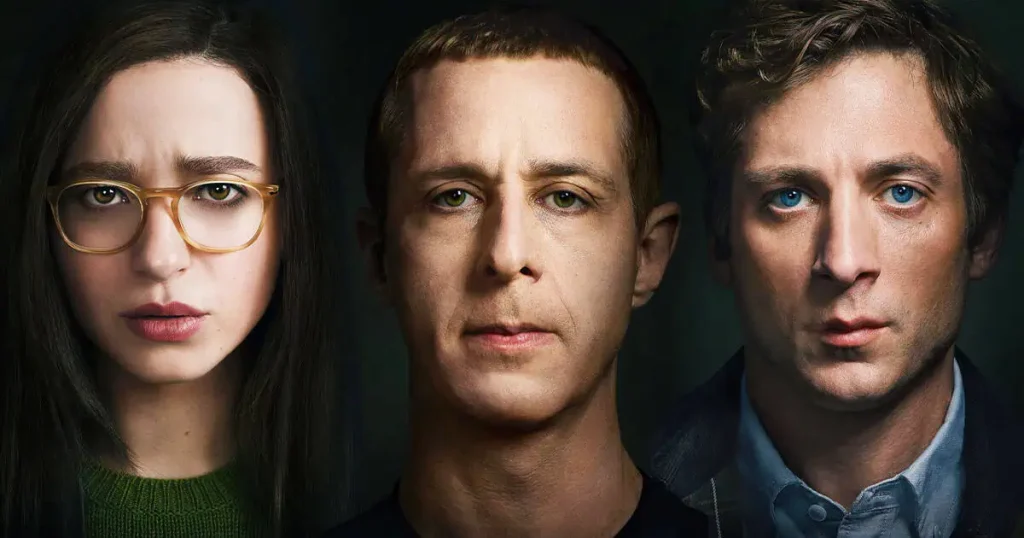
The Social Reckoning tells the true story of Facebook whistleblower Frances Haugen (Mikey Madison) as she is recruited by Wall Street Journal investigative reporter Jeff Horwitz (Jeremy Allen White). What starts as a small story quickly snowballs as they gather increasing evidence that deliberate decisions have been made to the detriment of the platform’s users. Concurrently, CEO Mark Zuckerberg (Jeremy Strong) faces growing scrutiny over Facebook’s impact on society, and the truth of his failings comes to light against the backdrop of a global pandemic and an election insurrection.
More reckoning than Social Network
Ever since Fincher’s The Social Network, many have clamoured for a follow-up film that further sheds light upon the geek behind the Meta glasses. But The Social Reckoning is not quite that film.
Its connective tissue is restricted to its screenwriter, Aaron Sorkin, and its Facebook focal point. Whilst the former was a sharp biographical drama that kept Zuckerberg front and centre, Sorkin’s follow-up shares far more in common with investigative journalism features like All the President’s Men, The Post, Thank You for Smoking, She Said and The Insider.
Instead, The Social Reckoning places whistleblower Frances Haugen and reporter Jeff Horwitz at its core, played wonderfully by Mikey Madison and Jeremy Allen White. The result is a film driven by investigation and accumulating evidence, and less by a desire to deeply interrogate the psyche of the architect behind the platform.
As a result, the film feels a tad unfocused, albeit still propulsive.
Sorkin’s dialogue continues to remind us why his work is often imitated but never replicated. As we bounce from scenes of Frances and Jeff debating the ethics of their investigation to scenes of Zuckerberg rehearsing for a congressional deposition, we are treated to frequently commanding monologues and sharply woven diatribes.
None are more captivating than Bill Burr’s Charlie Garrigan going toe-to-toe with a scarily accurate Jeremy Strong as Mark Zuckerberg. Strong delivers a haunting performance that perfectly captures the mannerisms, robotic calculation and distant affect of the tech mogul.
However, whilst Garrigan barbs Zuckerberg, the film never feels like it quite goes far enough in actually convicting Mark of any personal culpability for the public square he orchestrated. It’s a film where those of us watching are the ones actually living with the consequences of the actions of those we see being investigated, yet never truly held accountable.
The cost of the algorithm
Ultimately, The Social Reckoning is best understood not as a sequel to The Social Network, but as a spiritual successor. It’s an investigative drama that reminds us of the reasons we are living in such polarised times due to algorithmic architects who have not been held as accountable as they need to be.
For many, it won’t unveil anything we don’t already know, but its timeliness and dedication to truth-telling in an age of misinformation are to be commended. For others, it will be a hopeful reminder that there are still whistleblowers and journalists seeking to set the record straight.
REEL DIALOGUE: Truth in an age of deception
One of the most striking themes in The Social Reckoning is the question of truth.
The film examines what happens when information is manipulated, when engagement is prioritised over accuracy and when powerful institutions become more concerned with growth than integrity.
For Christians, the film’s concerns resonate on a deeper level because the Bible presents truth as more than a collection of facts.
Truth is ultimately found in a person.
Jesus declares: “I am the way, and the truth, and the life.” — John 14:6
In a world where competing narratives constantly vie for our attention, Christians believe that truth is not something we create or curate, but something revealed by God.
The film also highlights the destructive power of lies. The Bible describes Satan as “a liar and the father of lies” (John 8:44), the one who seeks to distort reality and lead people away from what is good and true.
While The Social Reckoning focuses on corporate decisions and technological systems, it points towards a broader human problem: our tendency to exchange truth for whatever benefits us most.
But the Gospel offers hope.
It proclaims that truth ultimately prevails because Christ has already overcome the powers of sin, deception and darkness. In an age of misinformation, Christians are called not only to seek truth but to embody it by speaking honestly, acting with integrity and bearing witness to the One who is Truth itself.
The Social Reckoning reminds us that truth matters.
The Gospel reminds us why.
“If you love me, keep my commands. And I will ask the Father, and He will give you another advocate to help you and be with you forever—the Spirit of truth. The world cannot accept Him, because it neither sees Him nor knows Him. But you know Him, for He lives with you and will be in you.” — John 14:15–17

Reel Dialogue has entered the world of YouVersion: Download the app, dive into the plans, and engage with the Bible in a fresh and exciting way.
Reel Dialogue has entered the world of YouVersion: Download the app, dive into the plans, and engage.

About Michael Walsh


More Films like this
View All Digger
One of the most brilliantly constructed films I have absolutely no desire to watch again
