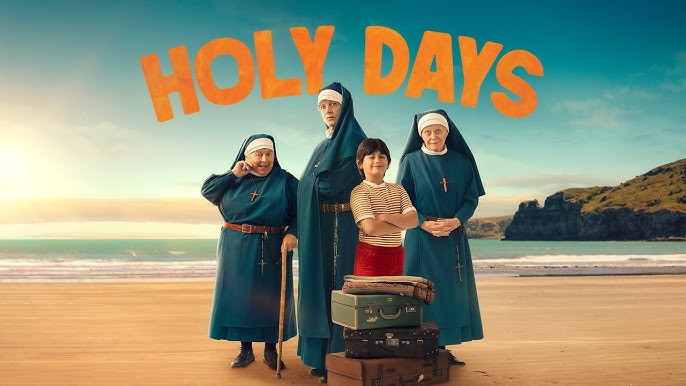
Holy Days
Sometimes the longest journeys lead us home


 5 Aug 2026
  Russ Matthews
 Road trip films often rely on the destination to justify the journey. Holy Days understands that the real adventure happens in the people we meet along the way. Filled with humour, heartbreak and genuine warmth, this New Zealand gem proves that faith, friendship and forgiveness are rarely found on the map, but often emerge through the unexpected detours of life.
When three unconventional nuns set out across New Zealand to recover the deeds to their struggling convent, they expect little more than a challenging drive. Accompanied by a young boy carrying his own burdens of grief, an unexpected snowstorm forces the unlikely travellers to confront questions of mortality, loss and what it truly means to trust God and one another. What begins as a simple mission gradually unfolds into a touching story about community, healing and hope.
There is an unmistakable charm to Holy Days that recalls the heartfelt innocence of Hunt for the Wilderpeople. Rather than relying on grand spectacle, director Camille Griffin allows the breathtaking New Zealand landscape and the chemistry of her cast to do the heavy lifting. The result is a film that never rushes its emotional moments, even if the screenplay occasionally meanders as it wanders through some of the country’s most picturesque scenery.
Jacki Weaver, Miriam Margolyes and Judy Davis are a delight together. Each brings decades of experience to these wonderfully imperfect women whose faith is expressed through humour, resilience and quiet acts of service. Rather than presenting idealised saints, Holy Days reminds audiences that those devoted to God remain wonderfully human, complete with quirks, disagreements and moments of doubt.
Yet the emotional heart of the story belongs to Elijah Tamati. His understated performance captures the confusion and sadness of a young man wrestling with grief, while his growing relationship with the sisters becomes the thread that quietly binds the entire film together. Through his journey, the screenplay gently explores what it means to find family, even in the most unexpected places.
While the humour lands consistently, Holy Days never loses sight of the deeper questions it wants audiences to consider. In a culture that often overlooks communities of faith, the film quietly celebrates the enduring value of lives lived in service of others. It doesn’t preach, nor does it offer easy answers, but it does invite viewers to reflect on forgiveness, devotion and the relationships that sustain us when life becomes difficult.
Warm, funny and quietly moving, Holy Days is a gentle reminder that hope often arrives in the company of ordinary people willing to walk beside us through life’s darkest valleys.
What should parents know?
Holy Days is suitable for most families, though it deals with themes of death, grief and loss that may prompt questions from younger viewers. These moments are handled with compassion and sensitivity, making the film an excellent opportunity for families to discuss faith, hope and the value of community together.
REEL DIALOGUE: Why don’t we need to fear death?
One of the film’s most memorable lines comes from Sister Agnes, who quietly observes that death is part of the journey and is not meant to be feared.
It is a simple statement, yet one that many people spend a lifetime wrestling with.
Death is one of life’s few certainties, yet our culture often avoids talking about it. We distract ourselves, postpone thinking about it or hope that somehow the conversation can wait until another day. Holy Days gently reminds us that grief is real, loss is painful and saying goodbye is never easy. Yet it also suggests that death is not the end of the story.
The Bible offers a remarkable hope.
Because of Jesus’ death and resurrection, Christians believe that death has been defeated. It remains painful, but it no longer has the final word. Those who place their trust in Christ can face death not with denial, but with confidence in the promise of eternal life.
Jesus said: “I am the resurrection and the life. Whoever believes in me, though he die, yet shall he live.” John 11:25
That promise does not remove grief. Even Jesus wept at the death of his friend Lazarus. But it does transform grief with hope, reminding us that for those who belong to Christ, death is not a destination to fear but a doorway into God’s eternal presence.
Perhaps that is why Sister Agnes could speak so calmly. Faith does not ignore death. It simply knows that death is not the end.
Where to look for more details: John 11:25–26; 1 Thessalonians 4:13–18; Psalm 23; Romans 8:38–39.

Reel Dialogue has entered the world of YouVersion: Download the app, dive into the plans, and engage with the Bible in a fresh and exciting way.
Reel Dialogue has entered the world of YouVersion: Download the app, dive into the plans, and engage.

About Russ Matthews


More Films like this
View All 500 MIles
Sometimes the longest journey isn't measured in miles, but in the distance between people who once loved one another
The Love Hypothesis
Love might be difficult to prove scientifically, but that has never stopped Hollywood from experimenting with the formula.