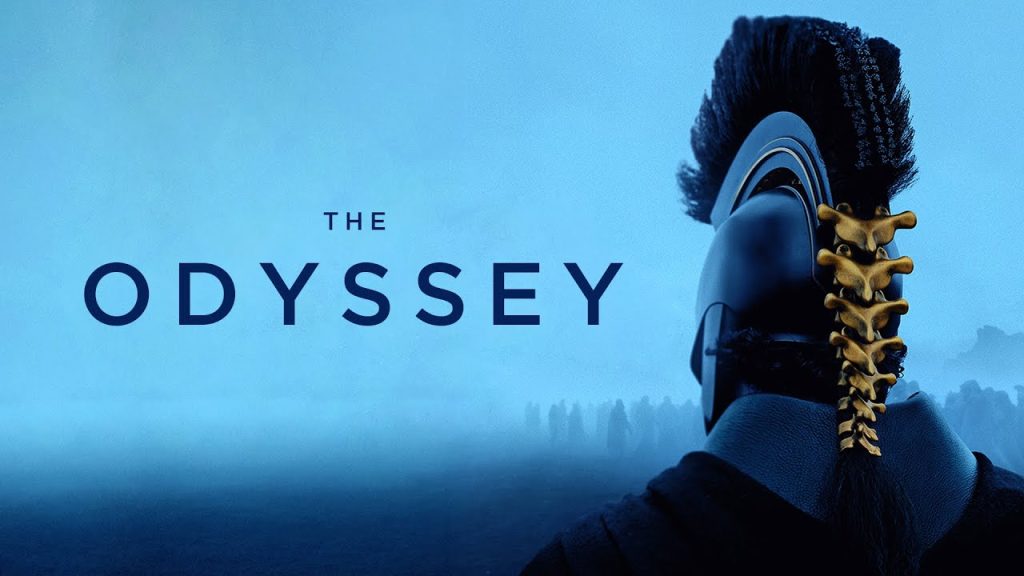
The Odyssey
Monsters, myths and more movie stars than Mount Olympus - An epic review for an epic tale


 16 Jul 2026
  Russ Matthews
 Some stories refuse to fade with time. Homer's The Odyssey has captivated readers for nearly 3,000 years, becoming one of the foundational works of Western literature. For generations of students, it has been a rite of passage through English classrooms. For Christopher Nolan, it has become the canvas for his most ambitious cinematic undertaking this year.
Following ten years of war, Odysseus (Matt Damon), the legendary King of Ithaca, sets sail for home. What should be a straightforward voyage becomes a decades-long journey through a world of mythical creatures, vengeful gods, lotus flowers and impossible trials. As he battles a cyclopes, Sirens, giants and the temptations of immortality itself, his greatest desire remains unchanged—to return to his beloved wife, Penelope (Anne Hathaway), and reclaim the life that has waited for him. As his son Telemachus (Tom Holland) yearns to know the father he never knew and his people desire for him to return, Odysseus strives to find his way back to Ithaca.
Epic almost feels too small a word to describe Nolan’s adaptation. The Academy Award-winning writer and director embraces the grandeur of Homer’s poem while recognising that every generation must discover these stories afresh. Given the oral tradition from which the epic emerged, Nolan allows himself artistic licence, weaving contemporary dialogue and a multicultural/non-binary cast into the narrative. Literary and cinematic purists may question some of these choices, but they have the potential to make this ancient tale more accessible to modern audiences.
That said, the structure of Homer’s epic does not always translate easily to the screen. The disjointed nature of the narrative, with its succession of seemingly disconnected adventures, may prove challenging for modern audiences accustomed to more linear storytelling. Nolan also assumes a level of familiarity with Greek mythology, introducing significant characters such as Calypso (Charlize Theron) with little explanation, leaving those unfamiliar with the source material to work out their importance as the story unfolds.
As expected, Nolan assembles an extraordinary cast featuring many familiar faces from throughout his career. Matt Damon delivers a weary yet determined Odysseus whose longing for home anchors the film emotionally, while Anne Hathaway brings quiet strength and dignity to Penelope. Perhaps the biggest surprise is John Leguizamo as the loyal Eumaeus, whose warmth provides some of the film’s most memorable moments amid the spectacle. Robert Pattinson also relishes his role as one of Penelope’s more menacing suitors, bringing genuine enthusiasm to the part, even if the remaining suitors often feel more like exaggerated caricatures than believable threats.
Yet the performances often take second place to Nolan’s breathtaking visual storytelling. Stunning practical effects, expansive seascapes and imaginative creature design combine to create a cinematic experience worthy of Homer’s legendary voyage. Viewers are also asked to embrace the mythical nature of the tale, where impossible escapes, divine intervention and the remarkable endurance of Odysseus and his increasingly malnourished crew require a willingness to suspend disbelief. Running for 173 minutes, the film occasionally meanders, but its visual ambition consistently rewards those willing to embark on the journey.
Whether The Odyssey reaches the cultural heights of Oppenheimer remains to be seen. What cannot be questioned is Nolan’s ambition. If this film encourages a new generation to discover one of literature’s greatest works, it will have achieved something remarkable. Like the great biblical epics of Hollywood’s golden age, The Odyssey stands as a bold reminder that timeless stories still have the power to capture the imagination.
REEL DIALOGUE: Would you remain faithful for twenty years?
At the heart of The Odyssey lies more than monsters and mythical adventures. It is a story about faithfulness. While Odysseus struggles to return home, Penelope waits, refusing to abandon hope despite years of uncertainty. Their loyalty to one another becomes one of the epic’s defining themes.
In a world that often celebrates instant gratification and disposable relationships, faithfulness can seem old-fashioned. Yet the Bible consistently presents loyalty as one of God’s defining characteristics. Throughout history, despite humanity’s repeated failures, God remained faithful to his promises and to his people.
The Apostle Paul writes: “If we are faithless, he remains faithful—for he cannot deny himself.” 2 Timothy 2:13
God’s faithfulness is not dependent on changing circumstances or human performance. It flows from his unchanging character. While few of us will wait twenty years for a loved one to return home, we are all called to consider what faithfulness looks like in our own relationships—with our families, our friends and ultimately with God.
Perhaps Homer’s greatest question is not whether Odysseus can survive the journey, but whether love and loyalty can endure the passage of time. The Bible answers with a resounding yes, pointing us to a God whose faithfulness never fails.
Where to look for more details: 2 Timothy 2:13; Lamentations 3:22–23; Hosea 2:19–20; Hebrews 10:23

Reel Dialogue has entered the world of YouVersion: Download the app, dive into the plans, and engage with the Bible in a fresh and exciting way.
Reel Dialogue has entered the world of YouVersion: Download the app, dive into the plans, and engage.


