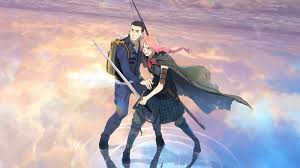
Scarlet
Shakespeare in Anime


 9 Feb 2026
  Michael Walsh
 While its pacing occasionally overstays its welcome and its themes sometimes compete for attention, Scarlet ultimately delivers a transfixing anime epic anchored by breathtaking animation, emotionally rich characters, and a finale that lingers long after the credits fade.
For the uninitiated, isekai (Japanese for “different world”) is a popular anime and manga subgenre in which a character is transported to, reborn in, or trapped within a parallel universe. Often escapist in nature, isekai stories with protagonists frequently gaining, or already possessing, powerful abilities. Across films like the Oscar nominated Mirai (2018), and Beauty and the Beast adaptation, Belle (2021), Mamoru Hosoda has consistently used other worlds to explore deeply human questions: grief, responsibility, love, and belonging. Scarlet continues this trajectory, using isekai not just to escape but to confront deep themes as well.
Reworking Hamlet through a gender-swapped lens, the film follows Scarlet, the Princess of Elsinore, who awakens after death in the Otherworld – an ethereal realm where the living and the dead from across all of time coexist. But this is no peaceful afterlife. Beings can still die here, fading into total “nothingness.” Tragically, Scarlet learns that her uncle Claudius has arrived before her and worse still, he has again murdered her father, King Amlet, for a second and final time, before seizing control of the mountain fortress that leads to the Infinite Land. From its foundation, Claudius rules as a false deity, served by roving bands led by Cornelius, Voltemand, Laertes, and Polonius.
Consumed by grief and fury, Scarlet sets out on a vengeance-fuelled quest to destroy her uncle. Hosoda complicates this trajectory through Hijiri, a paramedic from the 21st century who has also found himself drawn into the Otherworld. Where Scarlet sees righteous violence, Hijiri sees only endless cycles of death. Their unlikely companionship, between a medieval princess shaped by honour and a modern medic trained to preserve life forms the emotional core of the film. As they journey together, Scarlet is forced to confront not only Claudius, but the cost of her own rage.
Visually, Scarlet is among Hosoda’s most daring works. The real world is rendered in richly textured, traditional 2D animation, grounding the story in human fragility. The Otherworld unfolds as a vast CGI expanse that is seemingly in scale. This contrast reinforces the film’s spiritual tension between the finite and the infinite.
That said, Scarlet is not without flaws. The film runs long, and its final act could comfortably have been trimmed by ten to fifteen minutes without losing emotional impact. Additionally at times, its exploration of revenge, forgiveness, justice, and mercy feels slightly muddled, as though Hosoda is wrestling with too many ideas at once. Yet even in its messiness, the film lands its emotional beats with sincerity and power. In a cinematic landscape crowded with spectacle-driven anime, Scarlet stands apart as a meditation on repentance, mercy, and hope. It reminds us that true salvation rarely looks like triumph. More often, it looks like laying down the sword, and trusting that love, somehow, will be enough.
Reel Dialogue: Scarlet, Salvation, and the Shape of Forgiveness
In a world of life after death, Princess Scarlet functions as a messianic figure. Not because she is flawless, but because her journey mirrors a costly movement from vengeance toward self-giving love. She enters the Otherworld bearing death and injustice, determined to overthrow a false god who rules through domination. Claudius becomes less a mere villain than a parody of divinity as one who secures power through repeated acts of death rather than life. And his empty repentance demonstrates that the heart is what truly must change, not just mere confession in words.
The film’s climax makes this explicit. Scarlet’s victory is not simply Claudius’s defeat, but her refusal to become like him. She absorbs suffering rather than multiplying it, choosing life in a realm built on endless death. Like Christlike figures across myth and cinema, she descends fully into the brokenness of a world and then returns to new life in order to redeem it from within.

Reel Dialogue has entered the world of YouVersion: Download the app, dive into the plans, and engage with the Bible in a fresh and exciting way.
Reel Dialogue has entered the world of YouVersion: Download the app, dive into the plans, and engage.

About Michael Walsh


More Films like this
View All