Mayday
Cold War enemies. Unlikely friends. One promise worth keeping.


 5 Sep 2026
  Russ Matthews
 Sometimes the best way to avoid an international incident is to find yourself a Russian friend.
There was a time when the Russians were the dependable villains of Hollywood. The Cold War provided fertile ground for everything from Rocky IV to Red Dawn, while Top Gun sent ridiculously good-looking pilots into the sky against conveniently unidentified enemy aircraft.
Mayday gleefully climbs back into that 1980s cockpit.
Directors John Francis Daley and Jonathan Goldstein (Dungeons & Dragons: Honour Among Thieves, Game Night) have crafted an affectionate homage to Cold War action films that knows precisely how ridiculous these stories could be. Then they add Ryan Reynolds and Kenneth Branagh and allow the two actors to have a surprisingly enjoyable time together.
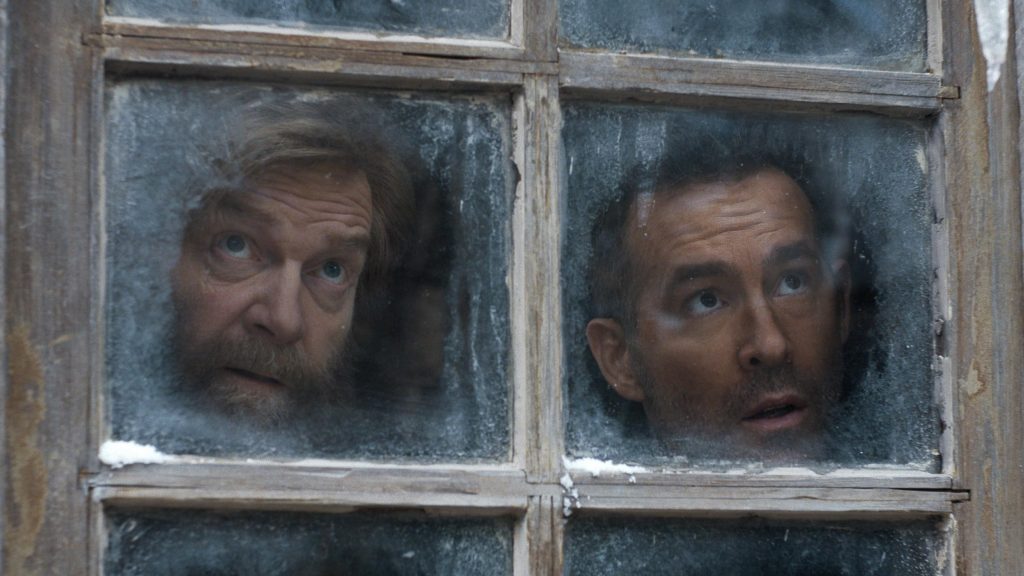
Set in 1987, Lieutenant Troy ‘Assassin’ Kelly (Ryan Reynolds) is a hotshot US Navy pilot sent on a top-secret mission into Soviet territory. Unsurprisingly, things do not go according to plan. Kelly finds himself stranded behind enemy lines, where he is discovered by Nikolai Ustinov (Kenneth Branagh), a former KGB agent with an unlikely fascination with American culture. The American pilot needs to get home. The Russian may be his only hope.
What could possibly go wrong?
Quite a lot, apparently. Yet trying to apply too much logic to Mayday would be missing the point. This is pseudo-spy action-comedy territory where international espionage, fighter pilots, family complications and unlikely friendships can all comfortably occupy the same storyline.
Reynolds does what Reynolds does. By this stage of his career, audiences know exactly what they are getting. His Troy Kelly is confident, sarcastic and equipped with a seemingly endless supply of one-liners. Reynolds has refined this persona through Deadpool, Free Guy, Red Notice and numerous other films, and Mayday gives him another opportunity to play comic relief within the buddy genre.
The surprise is Kenneth Branagh. Branagh looks like he is having an absolute ball. The actor and filmmaker who has given audiences Shakespeare, Hercule Poirot, Belfast and some of cinema’s more serious dramatic performances seems delighted to leave all of that behind for a couple of hours. His Nikolai is eccentric, unpredictable and wonderfully committed to the absurdity surrounding him. More importantly, Branagh doesn’t merely become the straight man to Reynolds’ comedian. He creates his own comedic rhythm and, surprisingly, becomes the more interesting of the pair. This is where Mayday finds its strength.
The espionage and action provide the machinery, but the friendship between these two men provides the fuel. One is American. The other Russian. They have been raised to view one another through the political suspicion of their respective nations, yet circumstances force them to discover the person underneath the nationality.
That makes the film’s arrival in 2026 particularly interesting. A comedy about an American and a Russian discovering friendship across political and ideological divides carries an unavoidable contemporary resonance. The filmmakers don’t turn Mayday into a political lecture, thankfully, but it is difficult to watch these two characters navigate Cold War suspicion without considering the present geopolitical relationship between their nations.
Perhaps that is why the film’s lighter touch works. Sometimes comedy can say something that a political drama cannot. Still, this isn’t Bridge of Spies. It is a Ryan Reynolds action comedy. There are explosions, impossible escapes, questionable espionage decisions and enough Cold War clichés to make you wonder whether someone had Top Gun playing continuously in the writers’ room. That is part of the fun. Daley and Goldstein understand the genre well enough to both celebrate and poke fun at it. The action keeps moving, the personal interplay between Reynolds and Branagh remains entertaining and the ridiculous situations are embraced rather than apologised for.
Where the film becomes less convincing is when it moves away from its central friendship.
The family elements are meant to provide additional emotional weight, but they don’t always feel necessary. Troy’s relationship with his sick father attempts to deepen Reynolds’ character beyond the wisecracking pilot, while Nikolai’s relationship with his daughter adds another dimension to his motivations. The inclusion of her sexual identity becomes another element within that storyline, but it feels more added than essential to the central narrative. None of these additions derail the film, but they do slow down what works best: two unlikely friends attempting to survive circumstances that neither fully understands.
The simpler Mayday keeps things, the better it becomes. Reynolds and Branagh are clearly enjoying this unusual pairing, but Branagh ultimately provides the film’s greatest surprise. He brings warmth and unexpected vulnerability to Nikolai without sacrificing the comedy. Underneath all the fighter planes, Russians, Americans and Cold War nostalgia, this ultimately becomes a story about friendship, family and loyalty. It may be ridiculous. It may be predictable. Yet sometimes you don’t need to reinvent the action-comedy. You just need two actors with enough chemistry to make the journey enjoyable. Mayday manages to do that.
What should parents know?
Mayday is an action-comedy aimed primarily at teenagers and adults. Australian viewers should note the film carries an M classification for mature themes, violence and coarse language.
The Cold War setting provides plenty of danger, including military action, fighting, weapons, threats and characters placed in peril. However, the comedic tone prevents much of the violence from becoming overly confronting.
Families should also be aware that the story includes illness within a parent-child relationship and discussion surrounding sexual identity as part of another family storyline. These elements provide opportunities for discussion but may warrant consideration depending on the age and maturity of younger viewers.
REEL DIALOGUE: Will you keep your word when the going gets tough?
It is easy to make a promise when keeping it costs us nothing. The real test comes when keeping our word becomes inconvenient, uncomfortable or even dangerous. That question sits underneath much of Mayday.
Troy and Nikolai begin on opposite sides of one of the world’s great political divides. Neither has any obvious reason to trust the other. Yet as their circumstances become increasingly dangerous, loyalty begins to mean more than nationality. Their relationship gradually depends upon something remarkably simple:
Can I trust you to do what you said you would do?
We live in a culture where promises can sometimes feel remarkably disposable. Commitments change when circumstances change. Friendships can disappear when they become inconvenient. Loyalty can last only as long as it benefits both parties. Yet Scripture presents faithfulness as something far more substantial.
Jesus says: “Let what you say be simply ‘Yes’ or ‘No’.” — Matthew 5:37
There is a refreshing simplicity to that command. If you say yes, mean yes. If you give your word, keep it.
Psalm 15 describes the person who can dwell in God’s presence as someone who “swears to his own hurt and does not change” (Psalm 15:4).
That is considerably more challenging. It means integrity isn’t measured when keeping our promises is easy. It is revealed when keeping them costs us something. This becomes particularly important in friendship.
Proverbs tells us: “A friend loves at all times, and a brother is born for adversity.” — Proverbs 17:17
Not merely during the good times. At all times.
The unlikely friendship at the heart of Mayday works because both men eventually discover that loyalty requires action. Friendship isn’t merely enjoying someone’s company. Sometimes it means standing beside them when doing so becomes difficult.
Christians ultimately see the greatest example of this faithfulness in God Himself. Human beings break promises. God doesn’t.
The Bible repeatedly describes Him as faithful, even when His people are not. Paul puts it simply in 2 Timothy 2:13:
“If we are faithless, he remains faithful—for he cannot deny himself.”
That may be the more meaningful conversation hidden beneath Mayday’s explosions and Cold War comedy.
What is your word worth when keeping it costs you something?
Anyone can be loyal when life is easy. Faithfulness is discovered when the going gets tough.

Reel Dialogue has entered the world of YouVersion: Download the app, dive into the plans, and engage with the Bible in a fresh and exciting way.
Reel Dialogue has entered the world of YouVersion: Download the app, dive into the plans, and engage.

About Russ Matthews


More Films like this
View All 500 MIles
Sometimes the longest journey isn't measured in miles, but in the distance between people who once loved one another